

The standard script is outdated; there is no longer a one-size-fits-all standard model.
Author: Solus Group
Source: MarsBit
Editor's Note: Recently, analyst Ash stated in a popular post that among over 100 new tokens for the 2025 TGE, 84.7% of the tokens had an FDV lower than the FDV at the time of the TGE. The median FDV of these tokens has fallen by 71% compared to their issuance (with the median market cap down by 67%). Only 15% of the tokens have increased in FDV compared to the FDV at the time of the TGE. Overall, among the newly issued tokens in 2025, most tokens belong to the category of 'the price at TGE is the peak.'
By examining this data, I found a more interesting article (from Solus Group) that also started from the project token TGE, analyzing the correlation between the trends of 113 tokens after TGE in 2025 and their financing situation, community activity, and exchange listings. After the research, it was found that high financing, active communities, and exchange listings, which were once considered the criteria for judging project quality, have little impact on the trends of project tokens. In the past, we often screened good projects based on these conditions, but by 2025, this project evaluation model has clearly 'failed'. Among them, a set of data is particularly thought-provoking:
- Projects with trading prices below the IDO price have an average income of 1.36 million dollars.
- Projects with trading prices above the IDO issuance price have an average income of 790,000 dollars.
But these projects have all received venture capital support, indicating that the market values speculation over actual performance, values stories over data, and values promises over the product itself. Web3 can no longer pretend 'everything is fine' or call bot traffic 'growth'. Of course, the conclusions drawn in this article are purely statistical and do not represent a standard applicable to all projects. Good projects and large financing can still represent the development direction of the crypto industry. Odaily Planet Daily summarizes it as follows:
Financing of 2 million dollars, top venture capital participation, 500,000 community fans, listed on major exchanges, unprecedented success on the first day of launch, a jubilant atmosphere on Discord, and a festive vibe on social media.

In a previous article, we revealed the truth behind the 0.96 times ROI: by 2025, on average, each token actually died on the first day after issuance, proving that the system has become invalid. Now, we have analyzed 113 token issuance cases since 2025, using solid data to demonstrate this point—yet most founders dare not face this data.
The research findings are shocking: large financing is useless, a large community is irrelevant, and every variable you optimize is statistically worthless.
But beneath the surface, there are more twisted things that still trouble many founders:
Currently, the revenue situation of projects is a bearish signal; the trading price of profitable project tokens is lower than that of non-profitable project tokens. This dynamic is a matter of life and death. If we continue to punish the profitable and reward the speculators, the entire industry will not survive.
Odaily Planet Daily Note: Previously, Solus Group disclosed relevant data, showing that the average investment return rate of new project tokens from TGE starting on the first day of issuance in 2025 is 0.96, indicating that their product release has been in a state of loss since day one.
Entrepreneur's data trap: financing paradox, high financing does not equal token advantage.
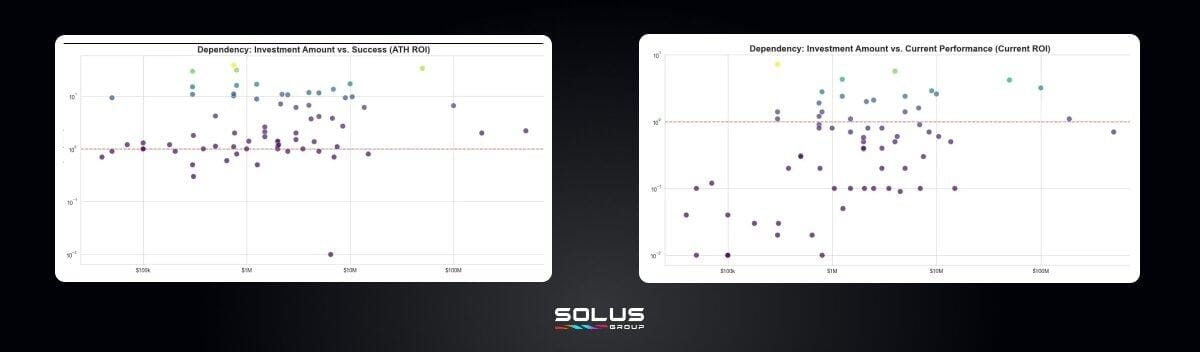
The correlation between financing and token performance: 0.04, statistically considered zero.
Projects with financing of 10 million dollars perform exactly the same as projects with financing of 1 million dollars in terms of token performance. The above chart proves this point—regardless of the amount of financing, the distribution of tokens within the ROI range is random. The best-performing projects are: Myshell, B² Network, Bubblemaps, Mind Network, Particle Network, Creator.Bid (valued at 10 to 30 times during ATH) raised between 300,000 and 3 million dollars. Meanwhile, projects like Boundless and Analog, which raised over 10 million dollars, have valuation multiples of only about 1 time.
Currently, token performance is worse; regardless of the scale of financing, most token investment returns are below 1 time. For example, tokens with financing scales of 5 million to 100 million dollars have ROIs of 0.1 to 0.7 times (e.g., Fleek, Pipe Network, Sahara AI), which are the same as those projects without much financing.
The fact is: large financing accelerates project token death.

Projects with the least funding (300,000 to 5 million dollars) have a higher ROI for each dollar raised; they execute faster, have lower switching costs, and will not be overwhelmed by the quarterly venture capital token unlock schedules, where a large number of unlocked tokens can destroy project revenues.
If you are pursuing 10 million dollars to 'compete,' then you are preparing for failure.
Fan myth: A large project community is just a 'paper tiger'.
Social media with 500,000 fans and 50,000 fans have exactly the same statistical results.
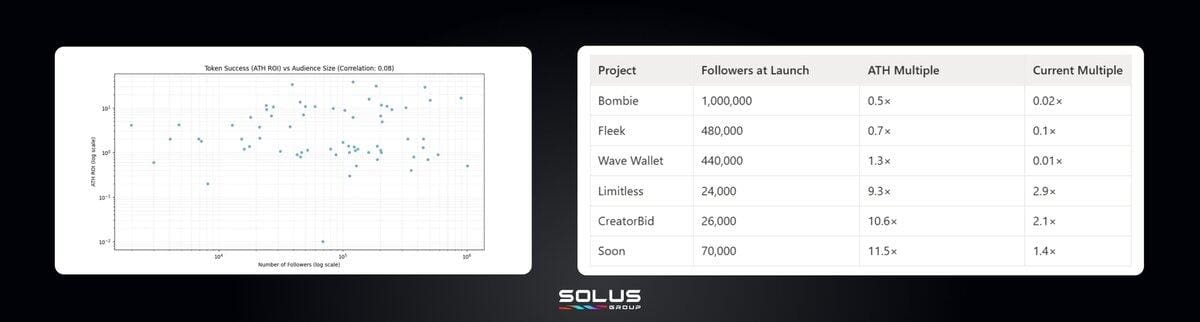
Correlation coefficient: 0.08 (token ATH) and -0.06 (token current situation)
Data shows that audience fan size has no predictive value for token performance. Projects with large fan bases perform inconsistently—some soar, some plummet, and projects with smaller audiences are the same, with no trends, no patterns, and no correlations.
Your Discord group is not a community, but a speculative audience waiting to leave.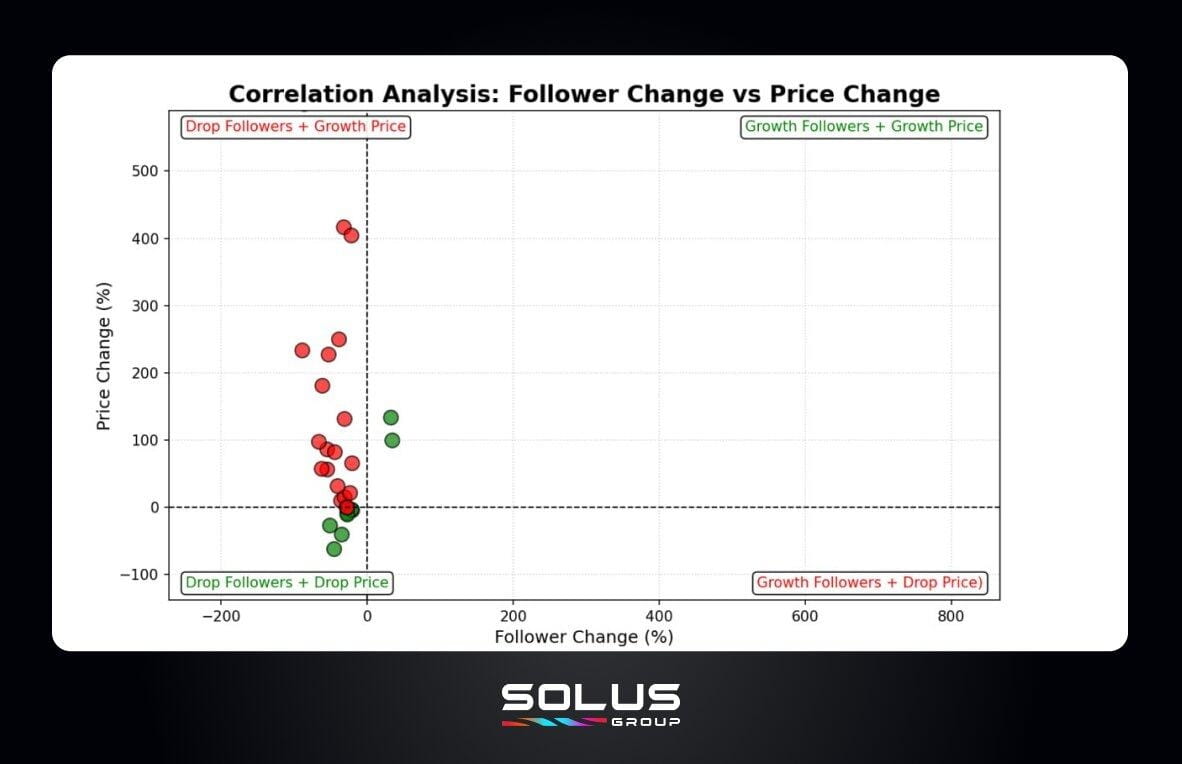
The reality is: price determines community development, not the community driving price.
When prices crash, followers will disappear. The chart proves this point—the lower left quadrant (fewer followers + price drop) is very dense. When prices soar, followers may sometimes grow, but it's not stable.
This means:
Your 'active community' never truly cares about the product—they care about the token price trend. Once the token performs disappointingly, they will disappear; community growth is a lagging indicator, not a leading indicator.
This is not just theory, but the publicly stated opinion of @belizardd (researcher and trader/KOL):
Most people come here purely for speculation, not for the product itself. We find that very few protocols perform well after TGE, and mainly those with low initial token FDV, low fundraising amounts, and generous airdrops. Honestly, I wouldn't blindly follow the trend to invest in anything right now. The risk/reward ratio is not worth it; I'm just waiting for the market to improve.
Speculators know the game has failed. They are taking a wait-and-see attitude. Meanwhile, founders keep pouring 60% of their budget into Discord bots, Twitter giveaways, and KOL promotions—burning money on statistically irrelevant metrics.
The real question is: 'If the token crashes by 50% tomorrow, how many people will stay?'
Answer: Almost none.
Token price trap, beware of overpricing/underpricing.
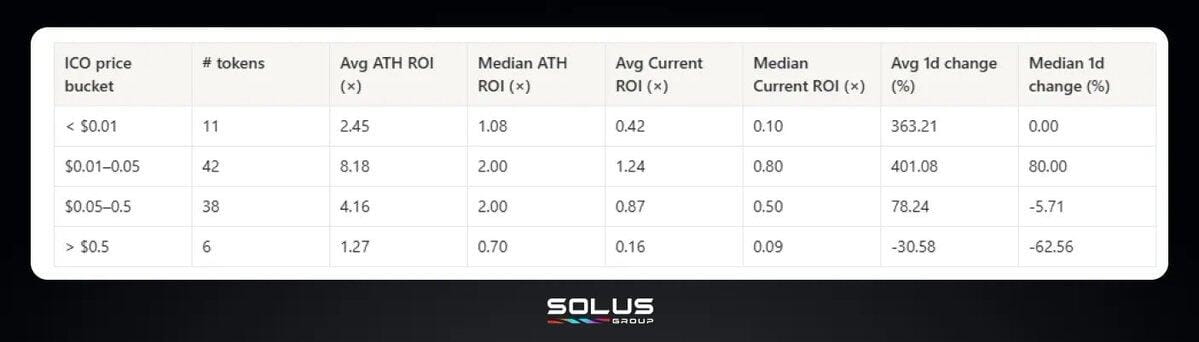
Median investment return rate calculated based on token listing price:
Below 0.01 dollars: 0.1 times (loss of 90%).
0.01 dollars to 0.05 dollars: 0.8 times (survival zone).
0.05 dollars to 0.50 dollars: 0.5 times (loss of 50%)
Above 0.50 dollars: 0.09 times (loss of 91%)
To explain once again:
A launch price below 0.01 dollars does not make your token 'easier to acquire'; it only makes you a low-priced coin that attracts profit-seeking capital, which rises quickly and falls quickly.
Pricing above 0.5 dollars does not make your token a 'premium token'; it only makes it seem overpriced, and high token prices will suffocate the retail market, and the whales won't buy in.
The token price range of 0.01 dollars to 0.05 dollars is the only pricing range with survival capability; this price is high enough to indicate the project's legitimacy while low enough to leave room for growth. Within this price range, only 42 out of 97 projects have a median token performance that is positive.
If your token economic model places your valuation at 0.003 dollars or 1.20 dollars, then stop rebuilding the model; data indicates the project has failed.
Industry status: Stop 2021-style building.
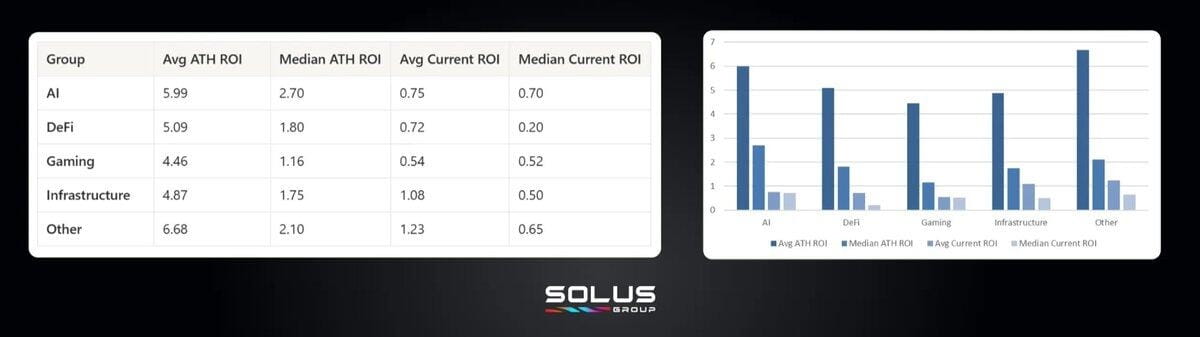
Loser: Gaming.
Average ATH ROI: 4.46 times (lowest)
Current median investment return rate: 0.52 times.
GameFi tokens are like lottery tickets; play once, and you'll be forgotten forever.
Trap: DeFi.
Average ATH ROI: 5.09 times (looks good)
Current median investment return rate: 0.2 times (disastrous).
DeFi's early price surge followed by a sharp decline is greater than any other field, and the gap between speculation and reality is extremely brutal.
Winner: AI
Average ATH ROI: 5.99 times (maximum increase)
Current median investment return rate: 0.70 times (best retention rate).
AI token prices have soared and remain stable. This trend is persistent, and funds are pouring in.
If you are developing GameFi, your execution needs to be 10 times higher than average to achieve average results. If you are in the DeFi space, be prepared for rapid rises and sharp declines. If you are in the AI sector, the market will give you opportunities, but only if you can deliver results. The requirements in the infrastructure sector are even more stringent: compared to standard decentralized applications (like AI agents), you will consume more time and resources, yet your current median ROI is slightly lower than the generally pessimistic GameFi sector.
Data does not care about the projects you are interested in.
IDO/IEO data overview: a good platform cannot save a project.
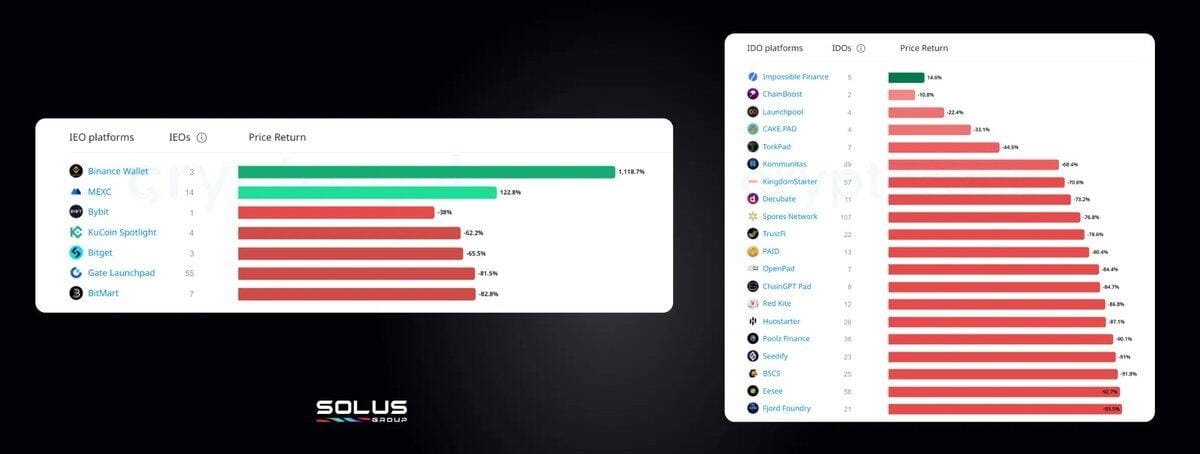
You spend months building connections just to secure a seat on Binance Launchpad or a spot in the allocation for a tier-one IDO, thinking that being selected through the platform means you are protected. The data shows otherwise.
IDO platforms: almost all projects are in a state of loss.
Only one project has a return rate of +14.6% across 5 IDO platforms, and that's it. All other projects have return rates between -70% and -93%.
The so-called 'advanced Launchpad' does not protect buyers; it only provides them with a way to lose money.
IEO platform: The ultimate embodiment of survival bias.
Binance wallet shows a return rate of 11 times. It seems unbelievable, but it only happened 3 times, and the sample size is too small. MEXC shows a return rate of +122.8% over 14 issuances—larger sample size, but still an outlier. All other projects? Poor performance. Bybit IEO tokens have a loss rate of 38%, and other projects have even more serious losses.
This proves that:
Choosing a platform is like a lottery with a better brand effect. The victory of a few outlier data distorts the average, while a large number of token issuances decline; the 'curation service' fee you pay—whether through relationships, listing fees, or token allocations—cannot reliably protect token ROI.
Platforms cannot save garbage tokens, nor can they help good tokens.
Reflecting on 2025, looking towards 2026.
The project development based on 2025 has failed on every level.
Zero layer: Foundation.
Question: 'Speculative-based token economics.' Recklessly dumping tokens into a liquidity-scarce market without an organic revenue model to absorb the shock.
First layer: Financing.
The problem lies in: 'Edit in PDF first, then handle it.'
Second layer: Market promotion.
Question: KOL model, paid bots' users disappear without a trace once payments stop.
Third layer: Liquidity.
Question: Assuming liquidity increases with speculation, but the reality is that institutional investors will wait for evidence.
Fourth layer: User retention.
Question: Zero retention infrastructure. The 'project community' consists of 10,000 Telegram users, who will abandon you within 90 days.
In 2026, old games should no longer be played. There is a deeper issue behind all this; infrastructure is indeed important, but timing determines everything. As Ivan Paskar (Head of Growth at Altius Labs) said:
Tokens cannot fix broken things—they amplify reality. Right timing = increased momentum. Wrong timing = years of effort instantly evaporated. Most teams do not fail in token design; they fail because they misjudge their stage and macro environment. Timing is not a detail; it determines everything.
In 2026, what should projects do?
Survival is not about following an old script, but about building a new one.
1. Carefully designed
Target amount of 300,000 to 5 million dollars, the projects with the highest ROI for each dollar invested are right here. More funding = more problems.
2. Survival costs.
Issuance price between 0.01 to 0.05 dollars. Other prices are hard to survive. If your token economics do not fit this range, then there is a problem.
3. Product first, token second.
If you cannot explain in one sentence why your token exists, then it does not exist. Revenue must come before speculation.
4. Ignore vanity metrics.
The number of followers is a distraction; wallet activity, retention rate, and revenue per user are the key indicators.
5. Industry realism.
Before writing code, understand the failure rate in your industry. GameFi requires double the execution efficiency to break even. AI has the wind at its back—as long as you can deliver results.
6. Integration, or perish.
The era of mergers and acquisitions is coming. If you cannot expand independently, then look for an acquirer. Acquisition is not failure, but a wise move.
These six principles are important. But the fact is: the standard script is outdated, and there is no longer a one-size-fits-all standard model.

