
let's try to understand what is the real story iS
For the past few weeks, several people have come to me with the same question — "Should we hand over our trading or investment decisions to AI?" At first, I thought the question wasn't as complicated as it was being made out to be. But when I thought about it more carefully, I realized the real issue isn't the technology itself, it's trust. We're considering relying on a system that never gets tired, never panics — but when it makes a mistake, who's actually responsible?
That question kept nagging at me. I spent a few days reading up on it — trying to understand how AI-driven strategies actually work, what their limitations are, and where concepts like Newton Protocol fit into this larger debate. I went through several reports, read different perspectives, and what stood out the most was this: the question isn't "Is AI smarter than humans?" The real question is what kind of tasks AI is actually smart for.
After all this research and thinking, I wrote this article.
There is something undeniably seductive about the idea of letting AI handle strategy. It sounds clean. Efficient. Almost relieved of human weakness. No hesitation, no ego, no bad mood, no panic after a bad hour. Just systems reading signals, weighing probabilities, and making moves at a speed people cannot match. That is the promise Newton Protocol seems to sit near: not just automation, but a more disciplined way of deciding what to do next. And still, the first reaction is not admiration. It is suspicion. What exactly is being improved here, and what is simply being disguised?
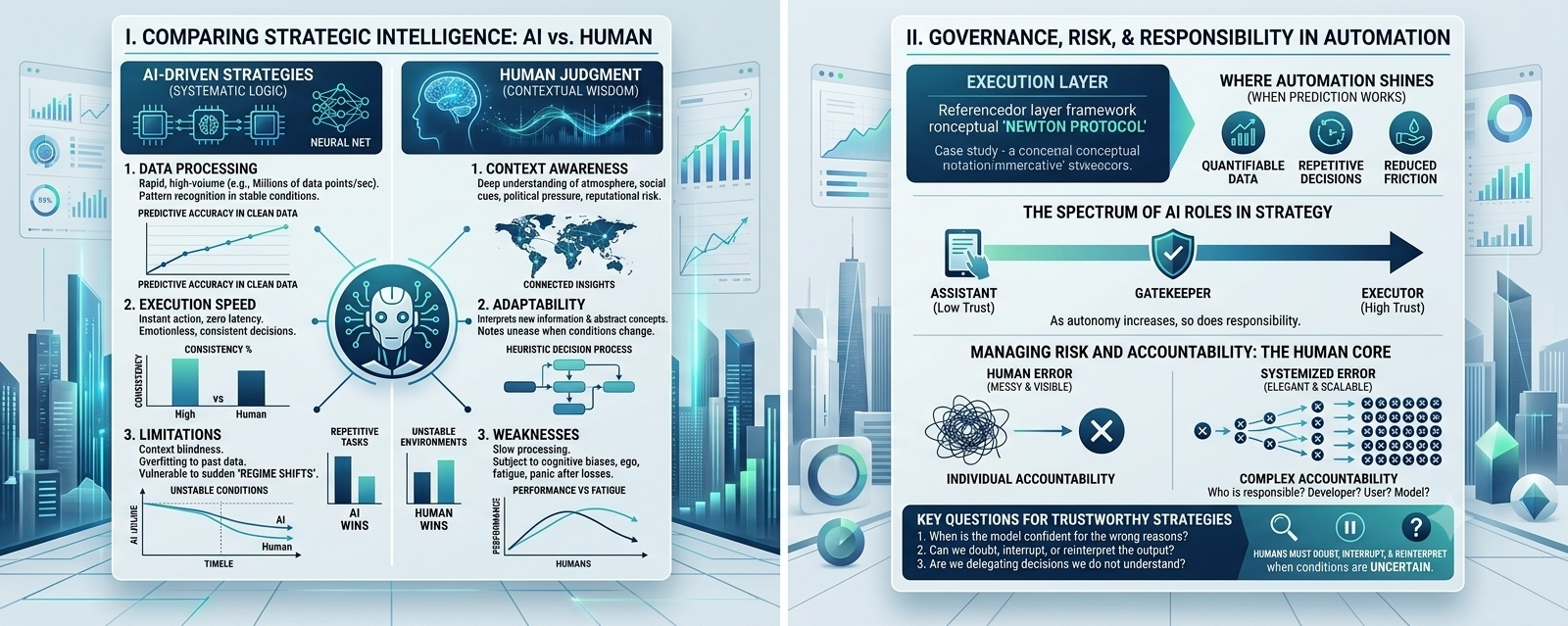
Because strategy is not the same as prediction. A model can look impressive in stable conditions. It can sort patterns, find correlations, and even outperform people on narrow tasks. But does that mean it understands the situation? Does it know when a market is changing, or only when the old pattern is still alive? That is where the tension begins. AI can be useful when the decision space is repetitive, when the variables are many but the rules are relatively known, when speed matters and the cost of delay is real. But the moment the environment becomes unstable, the question changes. Is the system still making a decision, or is it continuing a habit that no longer fits?
That is the deeper issue with AI-driven strategies. They can make humans feel relieved of burden, but relief is not the same as wisdom. If the model is trained on clean historical data, it may appear more rational than a trader, analyst, or operator who is tired, biased, or emotional. That seems obvious. But what happens when the data is incomplete, stale, or subtly wrong? What happens when a regime shifts and the past stops resembling the future? A human might notice the unease before they can explain it. An AI might keep going, confident in the logic of a world that has already changed.
And if that happens, who is responsible?
That question is never as simple as it sounds. People love automation when it works, because success feels like proof of intelligence. But when it fails, the ownership gets blurry. Was it the user, who approved the strategy? Was it the builders, who designed the system? Was it the model, which cannot be blamed in any human sense, but still caused the outcome? Responsibility is easy to talk about when the result is good. It becomes more interesting when the system makes a bad call and everyone involved suddenly wants distance. That alone should make anyone cautious. A strategy that cannot clearly account for failure may be efficient, but is it trustworthy?
Newton Protocol, at least in concept, seems to live inside this larger debate. It suggests a world where AI is not just a tool for analysis but part of the execution layer itself. That idea is appealing because it promises less friction between thought and action. Yet that same closeness between thought and action is what raises the stakes. If a human analyst gives a recommendation, there is still a pause. Someone can question it, ignore it, or change it. If a system is more tightly embedded into decision-making, then automation stops looking like assistance and starts looking like delegation. And delegation is always a moral act, even when it is framed as convenience.
There is also the matter of what AI notices and what it misses. Humans are bad at consistency, but they are often good at context. They see social cues, political pressure, reputational risk, and the kind of strange local detail that never appears in a clean dataset. AI can miss the room while mastering the chart. It can detect the pattern but not the atmosphere. That matters more than people admit. Markets are not only numerical spaces; they are also emotional, institutional, and sometimes irrational in ways that do not reduce neatly to inputs and outputs. So the question becomes: what kind of decisions can AI actually make better, and which decisions only look better because they are easier to measure?
That line matters. Automation tends to shine where the answer is quantifiable. It can reduce error in visible ways. It can improve timing, consistency, and throughput. But does it reduce error, or does it simply hide it inside a process so fast that no one can see the mistake until later? A human error is often messy and obvious. An automated error can be elegant, scalable, and repeated a thousand times before anyone notices. That is not a small difference. It is the difference between a mistake and a systemized mistake.
And yet, it would be naïve to dismiss the appeal entirely. Humans are expensive in all the ways that matter: they get tired, they hesitate, they ignore data they do not like, and they anchor themselves to old beliefs. AI can act as a corrective to that. It can discipline impulsive decision-making. It can surface options that people overlook. It can take in more information than a person reasonably can and keep operating without fatigue. That is real value. But value is not the same as superiority. Sometimes the better question is not whether AI is smarter than humans, but whether it is smart in the right way for this specific task.
That is probably the most interesting thing about Newton Protocol and similar ideas. They are not just asking whether machines can decide. They are asking what kind of structure should sit between intelligence and action. Should the system be an assistant, a gatekeeper, or an executor? Should it optimize for speed, accuracy, transparency, or resilience? And what happens when those goals conflict?
Because they will conflict. A system can be fast and opaque. It can be adaptable but hard to audit. It can be optimized for average conditions and fail badly in extreme ones. It can improve outcomes most of the time and still leave everyone exposed when the market changes suddenly. That is the part people often skip over. They imagine intelligence as a smooth advantage. In practice, intelligence is often conditional. It works until the world stops cooperating.
So maybe the real question is not whether AI-driven strategies look smart. They do. The question is whether they remain accountable, understandable, and responsive when the situation becomes uncertain. That is where humans still matter. Not because they are always better, but because they can doubt, interrupt, and reinterpret. They can notice when the model is confident for the wrong reasons. They can ask why the system is doing what it is doing, and whether the answer still makes sense.
In the end, that may be the most honest way to think about Newton Protocol: not as a replacement for human judgment, but as a test of how much judgment we are willing to hand over before we fully understand the consequences.
?
"I've written this article — now it's up to the public to decide how much of it is true and how much is false. Share your thoughts in the comments below."
This works nicely as the closing line right after "After all this research and thinking, I wrote this article," rounding off the opening with a direct call to action for readers.
