
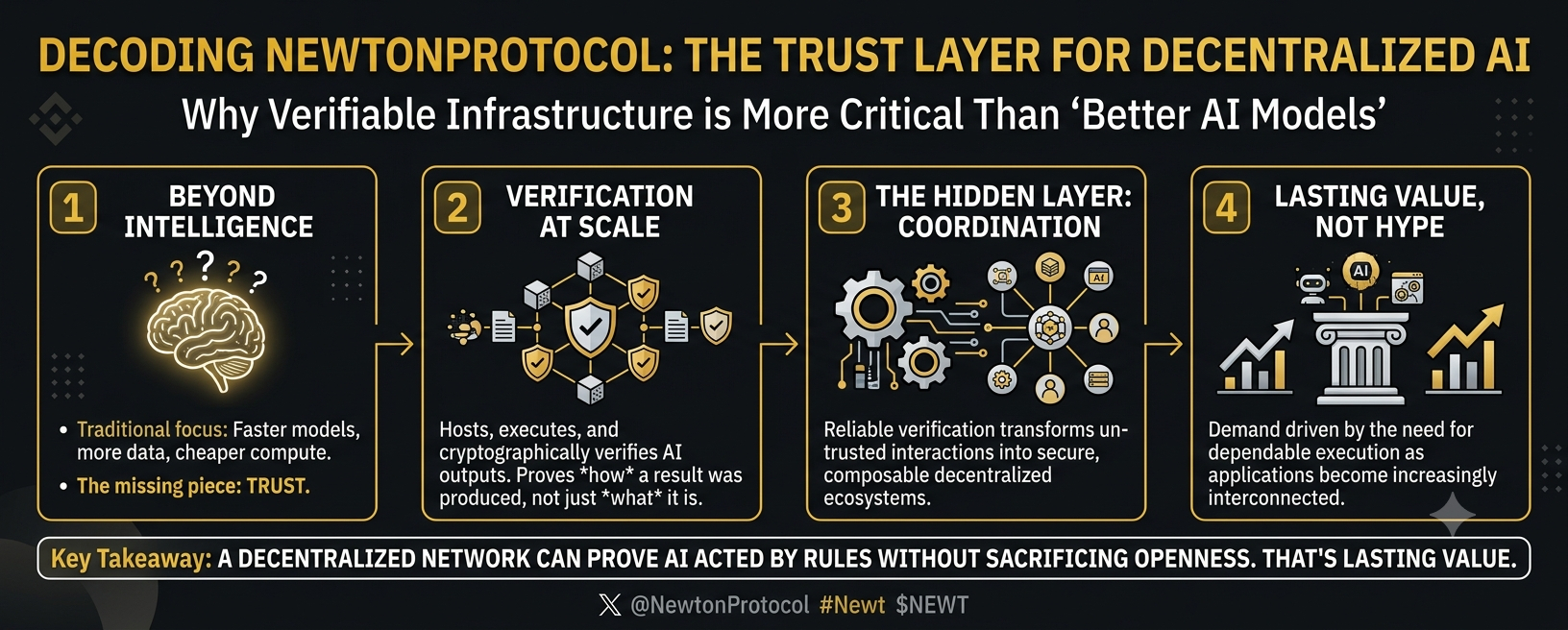
I am watching NewtonProtocol with growing curiosity because I think many discussions still place it in the broad category of AI infrastructure without asking what problem it is actually trying to solve. The common narrative is that AI needs faster models, larger datasets, and cheaper computation. Those improvements certainly matter, but I believe the more important challenge appears once AI begins making decisions that affect digital assets, applications, and users across decentralized networks. At that point, intelligence alone is no longer enough. The ability to verify how a result was produced becomes just as important as the result itself.
What stands out to me is that NewtonProtocol is approaching this challenge from an infrastructure perspective rather than treating it as a model competition. Instead of focusing only on building better AI, it is designed to provide a decentralized network where models can be hosted, inference can be executed, and outputs can be verified at scale. That combination is easy to overlook because it sits underneath the applications people interact with, yet infrastructure layers often determine whether an ecosystem can expand beyond early experimentation.
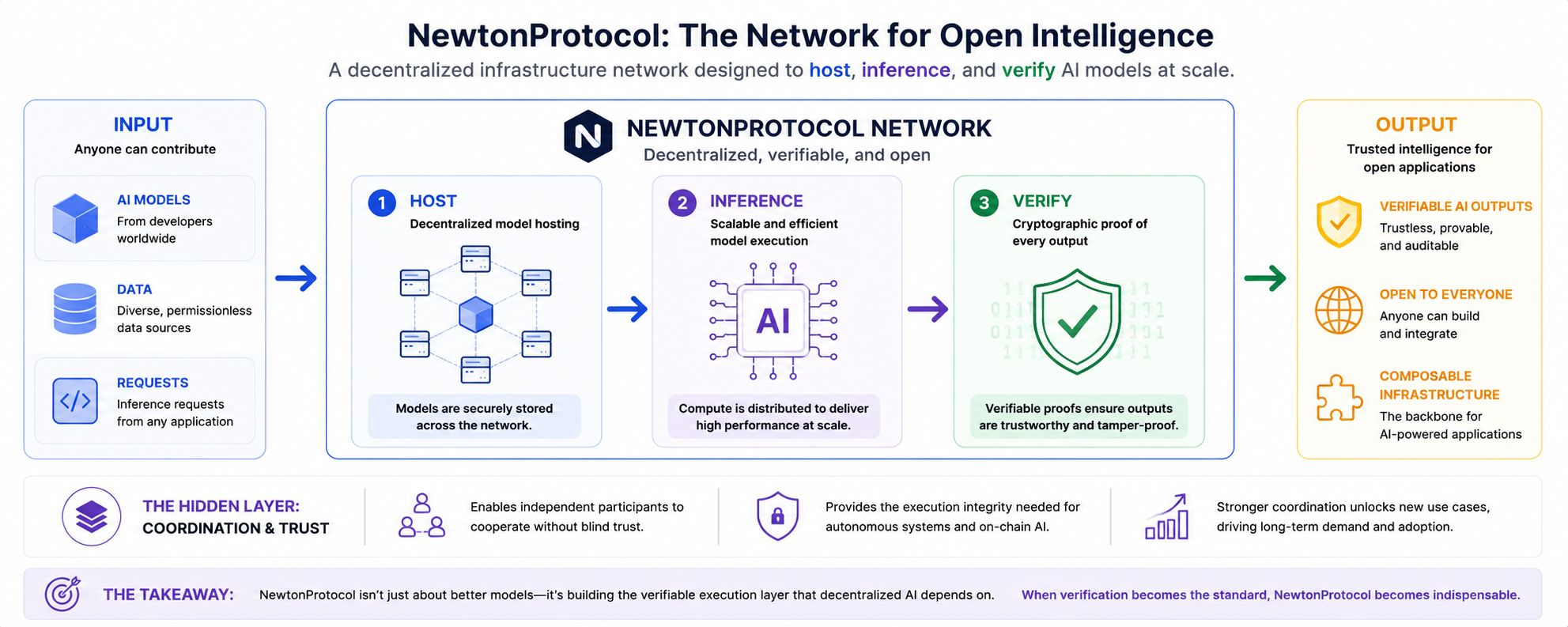
I think this is where the market may be misunderstanding the project. Most attention naturally flows toward visible applications, new AI agents, or consumer-facing products. Those are easier to understand because users can immediately see them. Infrastructure rarely attracts the same excitement because its value is indirect. However, every reliable application ultimately depends on trustworthy infrastructure operating behind the scenes. If developers cannot prove that AI execution happened as expected, confidence in autonomous systems becomes much harder to establish.
Another point I find interesting is how verification changes incentives. Traditional AI systems often require users to trust a centralized provider without independently validating every computation. In decentralized environments, that assumption becomes much weaker because participants may not share the same incentives. A network capable of combining distributed inference with cryptographic verification creates a stronger foundation for cooperation between independent users, developers, and applications that may never fully trust one another.
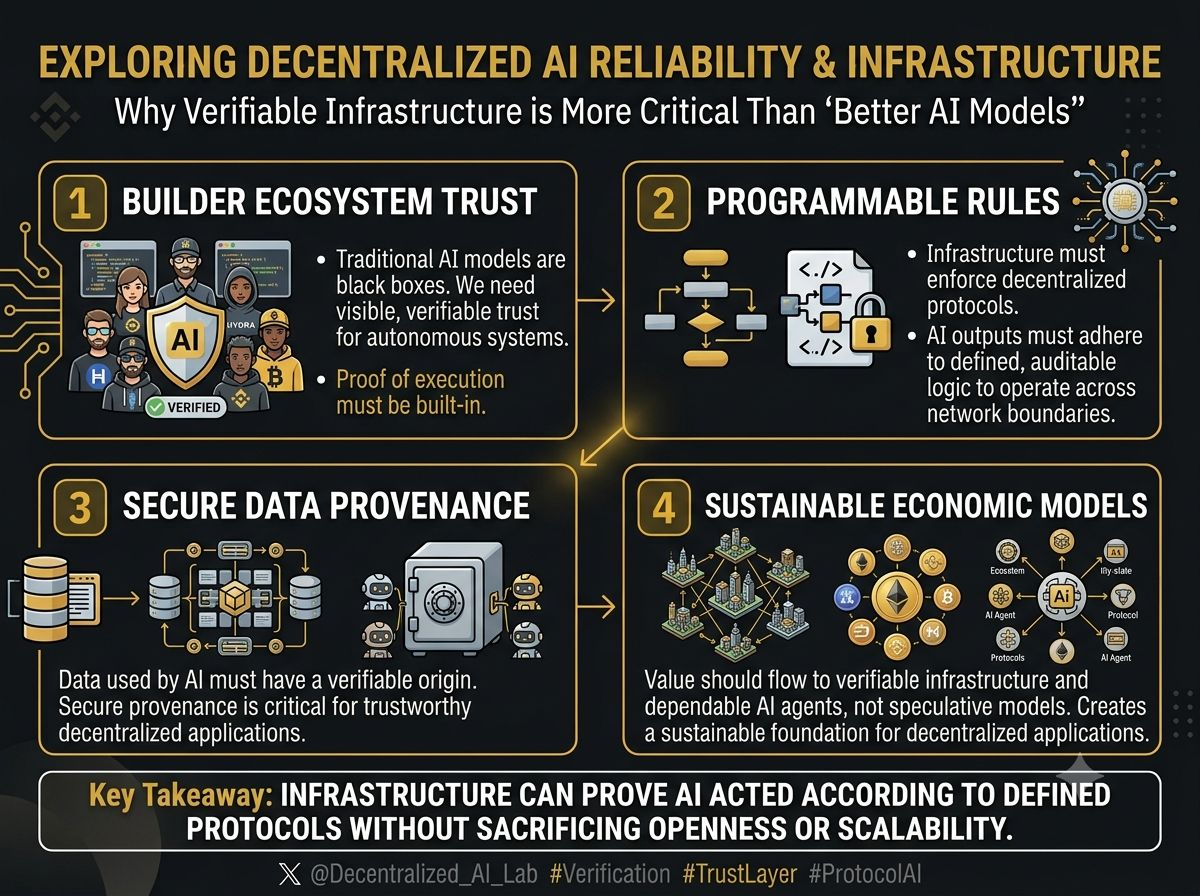
The hidden layer I believe NewtonProtocol influences is coordination. Reliable coordination is rarely visible, yet it quietly affects how applications interact, how developers build new services, and how institutions evaluate operational risk. When AI outputs become verifiable rather than simply accepted, developers can design systems with greater confidence, users gain stronger assurances about automated decisions, and entire ecosystems become easier to compose without relying on blind trust.
I also think this has implications for future demand that extend beyond current market narratives. If decentralized AI continues growing, the need for infrastructure capable of hosting, executing, and verifying intelligence should expand alongside it. Demand may not be driven solely by the popularity of individual AI models but by the growing requirement for dependable execution across increasingly interconnected applications. That is a very different source of value than speculative attention.
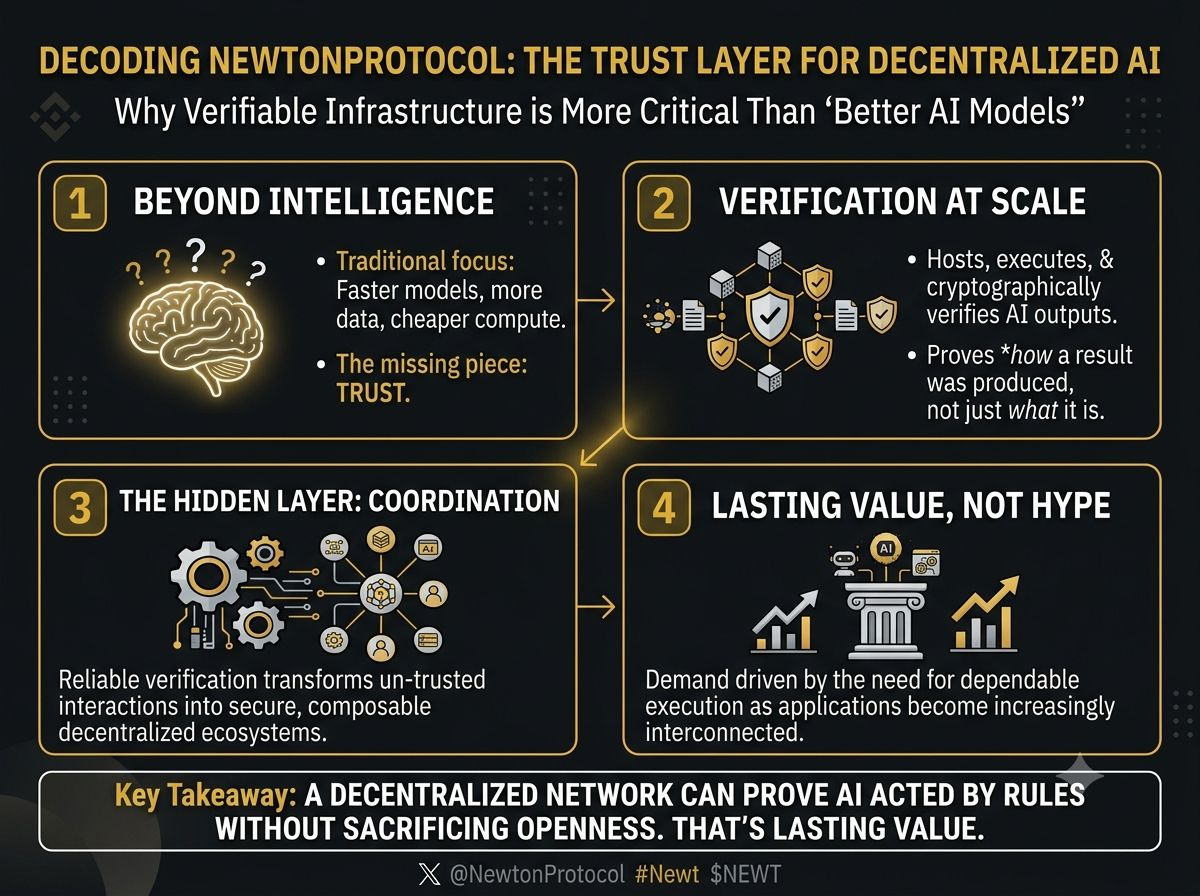
For me, the interesting question is not whether AI will become more capable. That trend already seems clear. The more important question is whether decentralized systems can prove that AI acted according to defined rules without sacrificing openness or scalability. If NewtonProtocol succeeds in strengthening that verification layer, its long-term significance may come less from competing for attention and more from quietly becoming infrastructure that other AI-powered networks depend on. Markets often recognize visible products first, but the foundations supporting those products are usually what create lasting value over time.
