
1. The real market state after the key resistance is blocked
From the recent trends of Bitcoin, the price attempted to break through the key resistance zone but ultimately closed with a long upper shadow on a volume candle, clearly indicating that selling pressure above remains heavy. This candlestick is not an ordinary fluctuation, but occurs at the intersection of a downtrend line and a supply zone, carrying significant technical meaning. In other words, the market does not lack the willingness to rise, but is still structurally constrained by bearish defense.
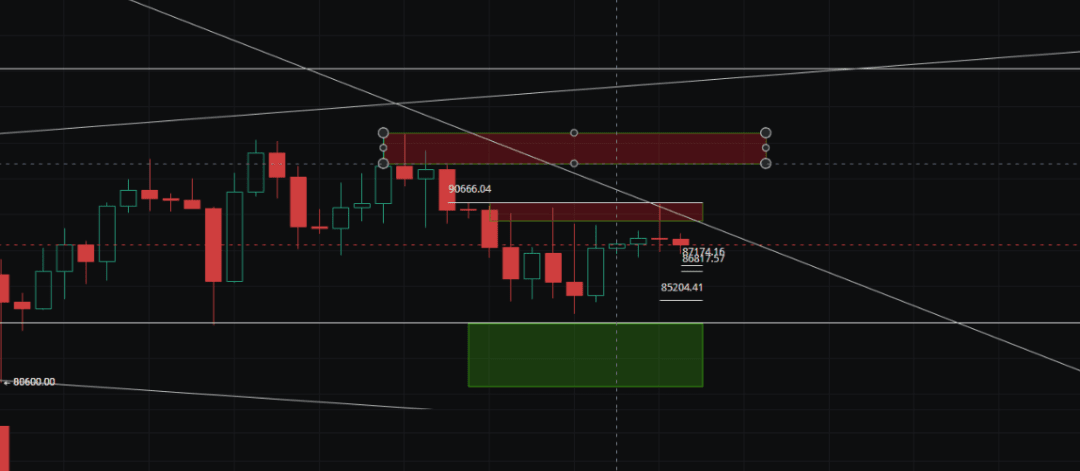
If the price can effectively break through the current supply zone in the future, then the target can naturally be set at the range of $92,000 - $95,000; however, before it breaks through, any rise seems more like a test. Once blocked again, the price is likely to retreat to around $86,000 to seek new support.

Two, why it is not suitable to recklessly chase longs in the short term
Although from a medium-term perspective, Bitcoin is still in a 'bullish structure', the current position is not ideal for chasing longs. If we review the prior analysis around $88,000, the logic for long positions was clear, targeting to take profit around $90,000, which was a trend-following trade; whereas now, both the position and the risk-reward ratio have changed.
Being bullish on the market in the medium term does not mean that any time point is suitable for going long. The real difficulty in trading lies in knowing when to wait, not when to buy.
Three, the true game between bulls and bears revealed by market data
From the perspective of market structure, in the previous phase, both spot and contract CVD have continued to rise; as prices increased, open interest also increased, indicating that many long positions entered. However, during the subsequent rapid price drop, open interest actually decreased, which is not a result of bears actively attacking, but rather a large number of long positions choosing to close.
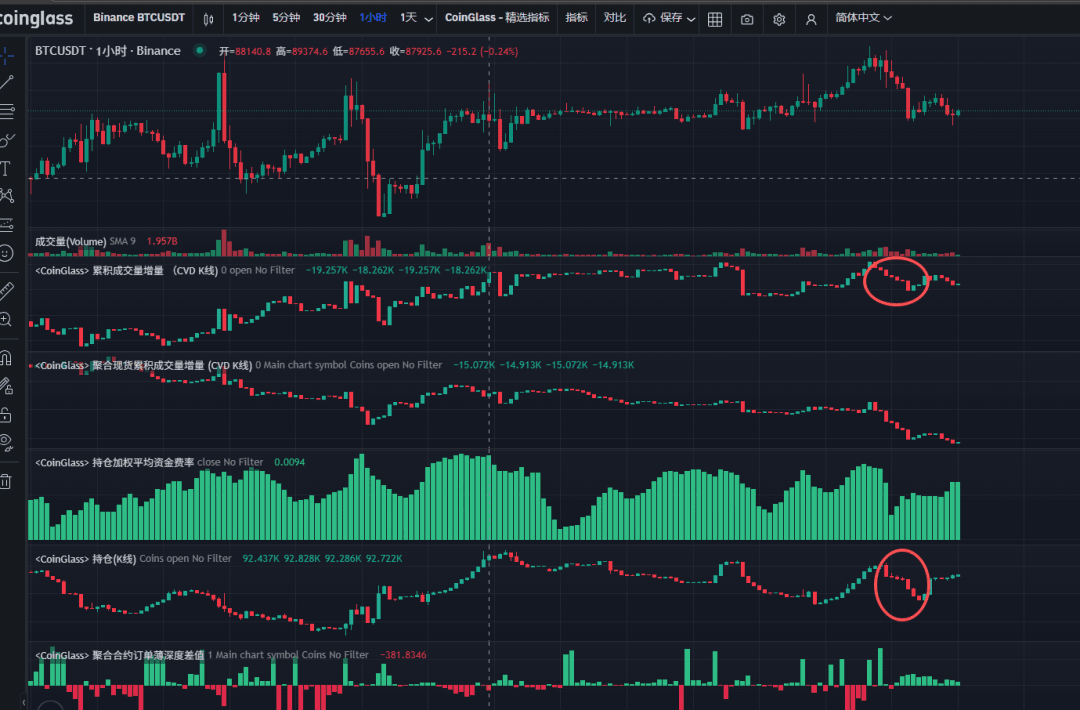
This point is very critical:
· The decline is not driven by a large number of new short positions
· Retail investors' willingness to actively short is not strong
· There is more limit sell pressure from institutions or large funds above
Such structures often favor subsequent medium-term rebounds.
Four, new changes in the current stage: short positions are beginning to appear
But returning to the present, we observe a new signal: CVD continues to decline, but the open interest has started to increase. This means that some retail investors have begun attempting to short at this position. At the same time, the funding rate remains relatively high.
These two indicators combined suggest that there is still room for the market to continue declining in the short term, at least it will not bottom out immediately.
Five, the spot indicators have not yet formed a bottom resonance
From the perspective of spot, multiple key indicators have not yet aligned:
· Coinbase premium rate remains negative
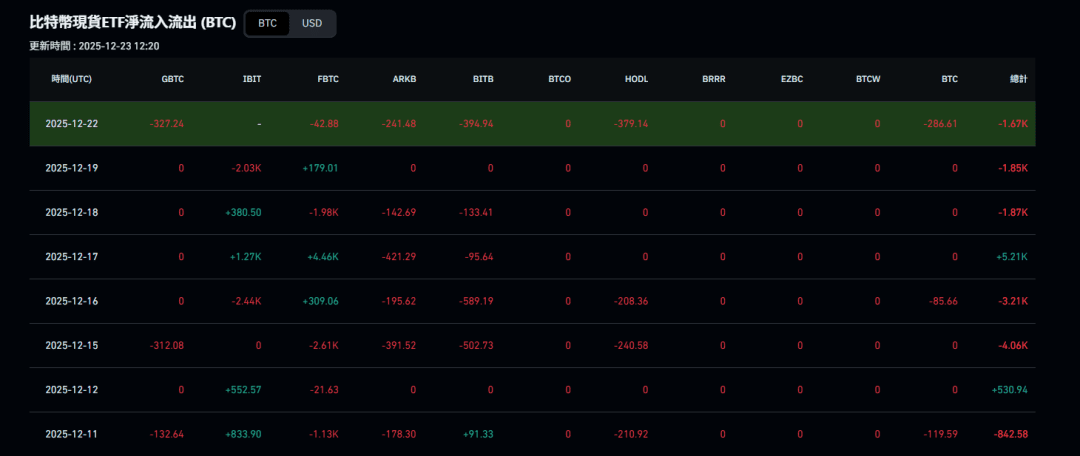
· Bitcoin ETF has seen capital outflows
· On-chain data shows that Bitcoin is experiencing a net inflow into exchanges
This means that the spot funds have not formed a consistent 'bottom-fishing behavior', and the market does not currently exhibit strong bottoming signals. Fortunately, this round of decline is not a cliff-like collapse, but rather a structural pullback.
Six, micro structure: the probability of a downward continuation is higher
Switching to the hourly structure reveals that this current decline has technically negated the previous round of upward structure. Although there is support in the previous consolidation area, from the downtrend structure, it looks more like a continuation downward after a 0.382 retracement, exhibiting typical characteristics of a downward continuation.
In other words, this is not a position where 'after falling, it reverses', but rather it is more likely preparing for the next downtrend.
Seven, key intervention intervals and batch trading ideas
By overlaying Fibonacci retracements from different periods with historical key points, we can find multiple potential support zones below that have a high degree of overlap. These positions do not require one-time precise bottom fishing but are more suitable for a gradual approach with unified risk control.
If the price rebounds at the first support zone, the probability of a deeper decline will decrease; but if it breaks and quickly recovers, it may instead signal a higher quality medium-term entry.
Eight, two possible paths and different response strategies
Currently, there are roughly two evolutionary paths in the market:
1. Slow decline - gaining support - technical rebound
In this case, the rebound height is limited, more like a 'dead cat bounce', with targets possibly only returning to the downtrend line or around $90,000.
2. Deep probing - gaining liquidity - structural reversal
If the price breaks and recovers below $80,600 or even lower, it will gain a large amount of liquidity; this 'bottom reversal' structure may actually lead to a larger level of increase, with targets possibly looking at $95,000 or even $98,000.
Nine, cyclical perspective: the significance of research is to foresee direction in advance
What truly determines long-term returns is never a single precise buy or sell, but the judgment of the cycle's position. Studying cycles is to see the true stage of the market when emotions are most chaotic.
In the short term, it leans towards a downward movement for the next day or two;
From this week to next week, it is more inclined to see a rebound;
However, after rebounding to gain liquidity, the market still needs to be vigilant about the possibility of further adjustments.
Ten, Ethereum and overall medium-term judgment
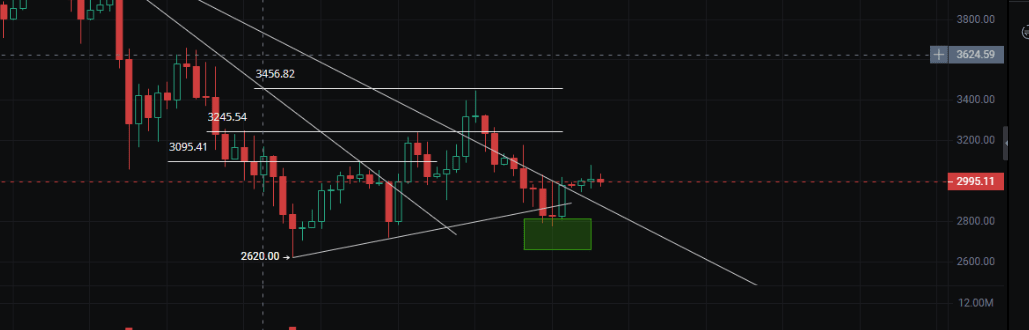
The trend of Ethereum essentially still follows Bitcoin. Even if there is a partial break of the downtrend line, the reference significance of such breaks is limited until the logic of the larger cycle changes. Overall, looking at the medium term until the first half of next year, we maintain a cautious or even bearish judgment.
Conclusion: Trading is not about predicting, but about responding
The market never operates according to anyone's will. A truly mature trader is not one who predicts correctly many times, but one who has prepared response plans for different scenarios.
In the short term, we see fluctuations and downward movement; in the medium term, we wait for a better structure; in the long term, we respect the cycle - this is the core logic for navigating bull and bear markets.

