
The trillion-dollar valuation myth of SpaceX reveals the harshest 'class barriers' of traditional finance — the largest profits are often divided up before the IPO. Platforms like @JarsyInc, representing private equity tokenization, are trying to bridge the gap between retail investors and top unicorns through technological and business model innovations.
1️⃣Crazy Valuation and the 'Locked-in' Excess Returns
According to the latest report from Bloomberg, SpaceX plans to go public (IPO) in 2026, with a target valuation of up to $1.5 trillion.
What is this concept? Looking back in history, in 2015, Google and Fidelity jointly invested $1 billion in SpaceX, with Google investing about $900 million for a 7.4% stake. At that time, SpaceX was valued at only $12 billion. Ten years later, if we calculate based on a valuation of $1.5 trillion, the value of Google's investment from back then would skyrocket to $111 billion. The return on investment (ROI) for this single investment reached as high as 123 times.
This potential book profit even exceeds the market value of an entire company like Adobe, and is even more than Google's quarterly revenue.
Why is SpaceX worth this money? Many people think it only makes rockets, but in the eyes of professional investors, it has evolved into a 'monopoly-level infrastructure giant'.
Dominant capacity: In 2024, SpaceX completed 134 launches, accounting for 90% of global orbital payload mass. In this field, its competitor is not Boeing, but gravity.
Cash cow Starlink: From PPT to 8 million users (data as of November 2025), annual revenue is expected to exceed $11.8 billion. It is no longer simply a space company, but the world's largest satellite telecom operator with its own launch capabilities.
Defense moat: Holding $22 billion in government contracts, from NASA to the Pentagon, it is the only core supplier of the US space strategy.
However, faced with such certain high-growth targets, retail investors in the secondary market are awkwardly facing an 'entry barrier'. Because in the traditional private equity PE market, entry tickets are reserved for institutions like Google and Fidelity that have billions in funds and top-tier networks. Ordinary people, even with a million in cash, are kept out due to the qualified investor threshold and the high minimum investment amount for single projects.
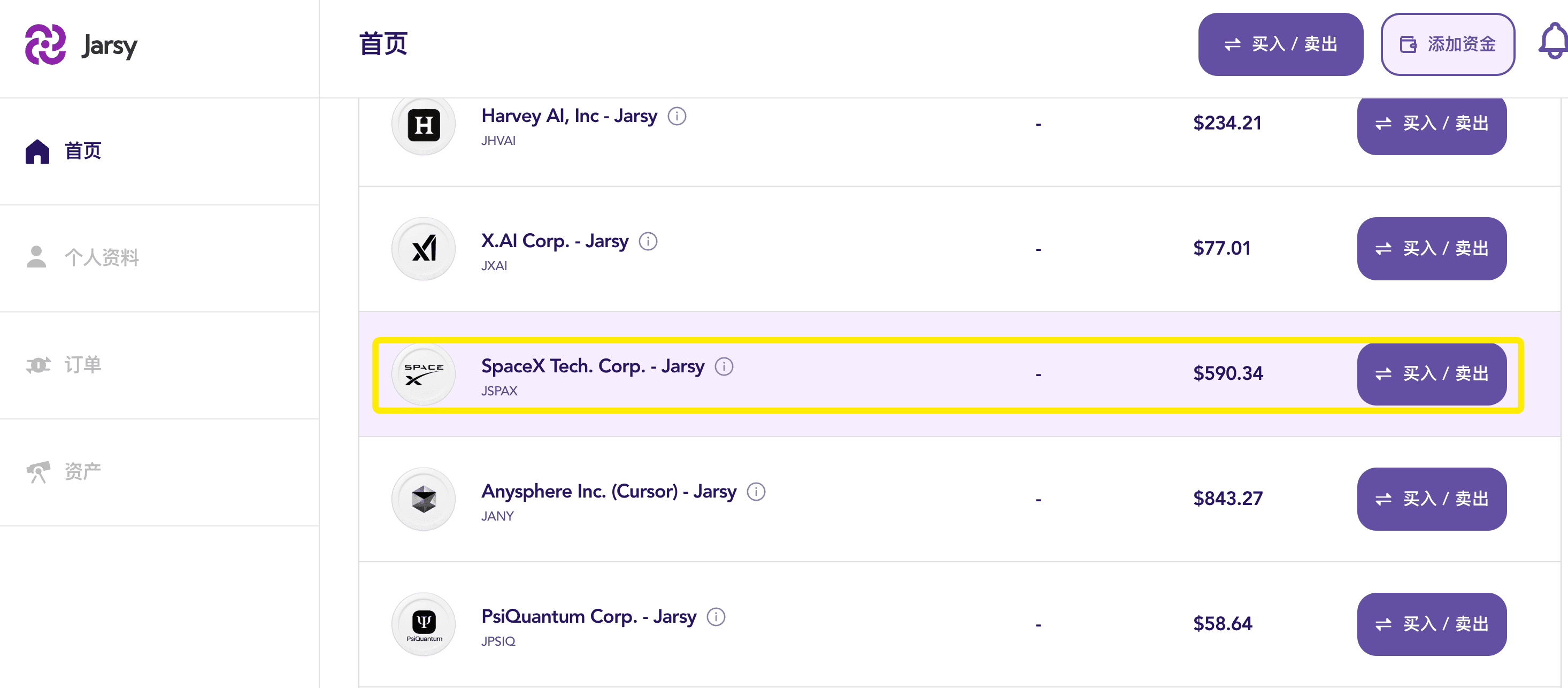
2️⃣ #Jarsy's #RWA breakthrough logic: Financial equality
Recently, whether it's the SEC or DTCC, they are vigorously promoting RWA, making RWA the most explosive core narrative of 2026, bringing real assets onto the chain.
@JarsyInc
What is being done is to use technical means to fragment the assets of SpaceX, the 'crown jewel'.
This is not just about 'issuing a coin'; the financial engineering logic behind it addresses three core pain points:
1. Regulatory arbitrage and compliance structure. Jarsy is not simply issuing tokens; it has established a rigorous SPV (Special Purpose Vehicle) structure. A 1:1 mapping is achieved, where every token held by users is backed by actual SpaceX shares held by SPVs registered in Delaware. Jarsy's registration and headquarters are also in the United States, providing better protection for investors.
Bankruptcy isolation: Even if the Jarsy platform itself faces operational risks, users' assets are still safely held in independent SPVs, retaining economic rights such as dividends, stock splits, and redemption.
2. Extremely low entry threshold. In the traditional private equity primary market, a single ticket size usually starts at $200,000 to $500,000. #Jarsy has violently reduced this threshold to $10. It has connected the Web2 account system (Google login) and fiat currency deposit channels (USDC/fiat), allowing ordinary investors to allocate assets previously accessible only to Sequoia and a16z as if buying and selling stocks.
3. Solving the 'liquidity discount' problem of private assets. The biggest risk in the primary market investment is 'liquidity lock-up'. Your money may be locked for 5-8 years until the company goes public or is acquired. Jarsy has introduced a 'Name Your Price' mechanism. This essentially establishes an OTC market on-chain. If you urgently need money, you can transfer tokens to others who are optimistic before the IPO. This gives unprecedented liquidity to private equity, turning what used to be 'dead money' into 'living money'.
Jarsy's selection strategy is also very restrained, focusing on core technology leaders in AI, aerospace, fintech, etc., such as the well-known SpaceX and Xai, as well as the recently popular prediction markets Polymarket, Kalshi, and financial unicorns like Stripe, Kraken, and Ripple. These companies have conducted due diligence through Silicon Valley executive networks, which to some extent helps retail investors filter out junk projects.
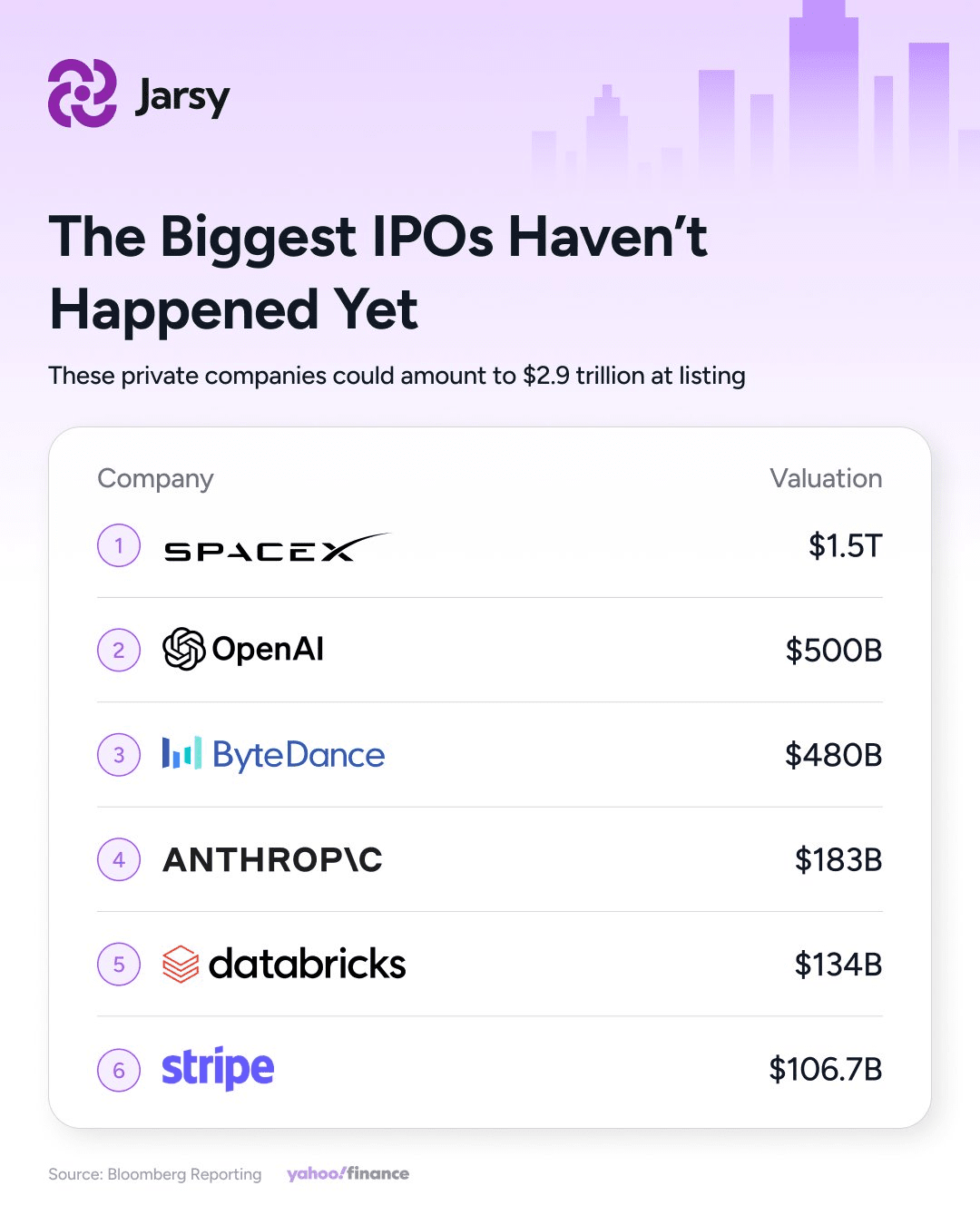
If the crypto circle's new coins are a gamble on 'narratives', Jarsy bets on 'industrial futures'. Bidding farewell to the thrilling world of air coins, Jarsy opens the door for us to the world's top unicorns Pre-IPO, allowing early locking in of original stock dividends from giants like SpaceX and OpenAI. Unlike the zero-risk of shanzhai projects in the crypto circle, Jarsy's targets are all mature enterprises, with real cash flow and moats, solid fundamentals, and strong anti-drawdown characteristics. Moreover, backed by a trillion-dollar global equity market, it can accommodate large capital inflows and outflows, making it the best place for seeking asset safe havens, transforming investment from 'high-risk gambling' to 'following giants for stable growth'. Such opportunities were once unimaginable for retail investors, but now #Jarsy has made it a reality through RWA equity tokenization.
👉Participation address: https://app.jarsy.com/?invite_code=4i7tqt
In summary, if in 2015, Google's investment in SpaceX was a carnival of top-tier capital, then in 2025, investing in #SpaceX through #Jarsy is a dimensionality reduction strike of Web3 technology against traditional financial privileges. It does not promise sudden wealth, but it has done something more important: it has torn down that wall. For retail investors, being able to hold shares as early shareholders before a great company goes public is an unprecedented financial experience, even if it's only a few hundred dollars. This may be the best annotation of blockchain technology empowering the real economy.
