

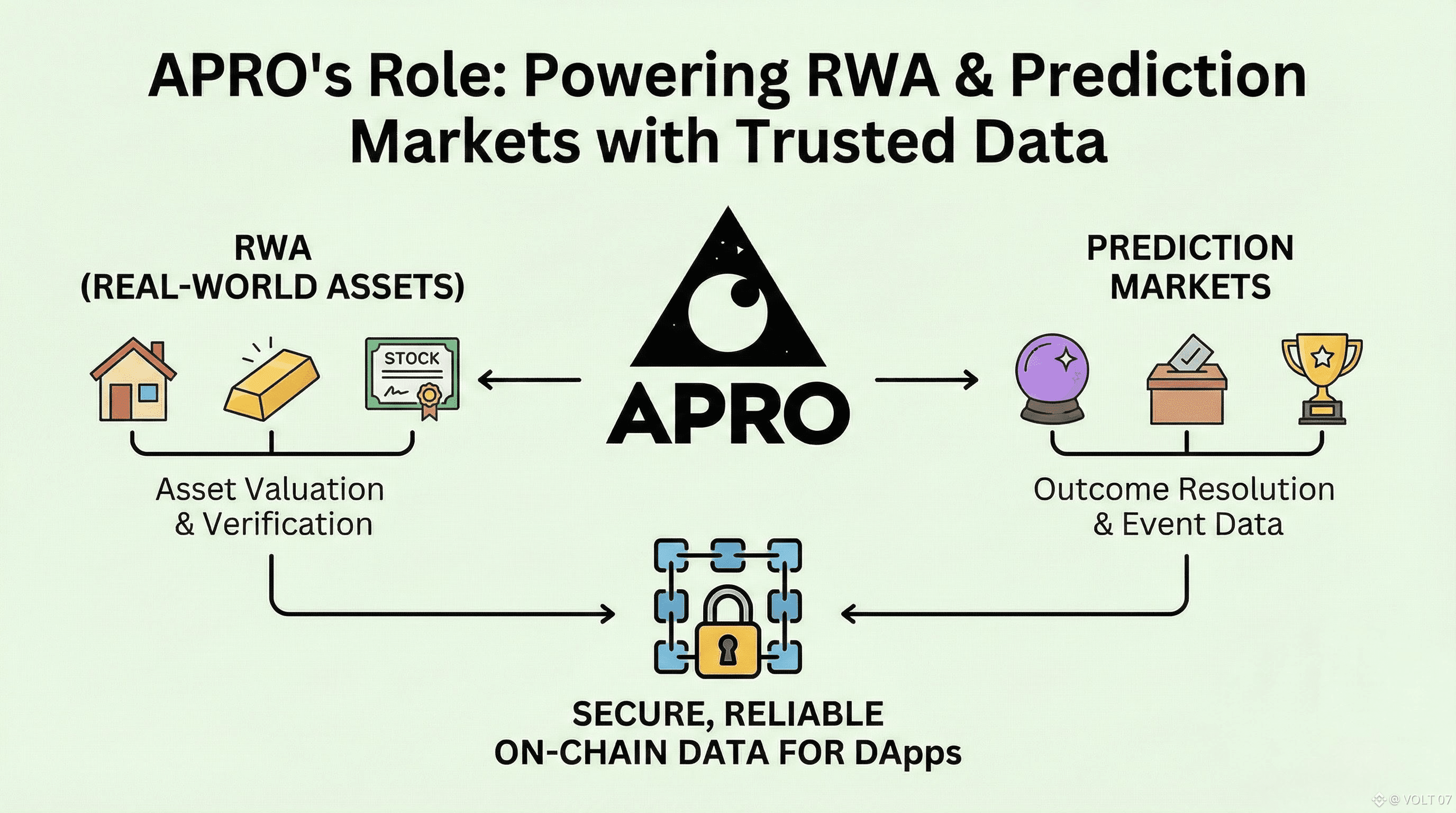
 Real-world assets and prediction markets sit at an uncomfortable intersection in crypto. They promise to connect blockchains with reality, yet reality is messy, slow, and often uncertain. Prices don’t update cleanly. Outcomes aren’t always binary. Data can be delayed, disputed, or influenced by forces outside the chain. As these use cases grow, the weakest link is rarely the smart contract logic itself it’s the trustworthiness of the information feeding into it. This is where APRO begins to matter in ways that go far beyond a traditional oracle role.
RWA protocols require data that doesn't follow crypto price behavior. Rate adjustments occur according to timetables. Asset values emerge from reported, not tickers, messages. News of legal events, such as defaults and settlements, occur over days or weeks, not blocks. But prediction markets also face similar scalability challenges, albeit from a slightly different viewpoint. They involve results that must be judged fairly, consistently, and clearly. In these situations, the essential, rather than the prompt, characteristic is credibility. APRO is designed to fully exploit this rather than resist it.
What makes APRO particularly well-suited for such environments is its focus on continuity and validation. Instead of viewing data as a point in time, APRO views it as a process. For RWAs, this enables the validation of updates in the context of expected timelines. For prediction markets, outcomes can be ensured not to be hurried into resolution based on incomplete data. The solution is designed to handle any uncertainties until they can be validated properly.
This shifts how developers can think about creating RWA and prediction market products. Rather than constructing elaborate safer guards against weak data streams, they can lean on a layer that already starts with the assumption that some places will be unclear. This assumption just so happens to be very good. It enables markets to stay open without being foolish and enables capital to participate without fearing that a single negative update will screw everything else over.
Another quiet strength is its role in facilitating coordination among the various actors. Many RWA platforms bring together various stakeholders such as issuers, auditors, liquidity providers, and governance organizations that all have to share the same information. For example, in a prediction market, everyone must agree that an event is finalized. APRO also plays the role of grounding such collective knowledge through predictable data behavior. There might be different opinions among participants on the outcomes, but how such outcomes are treated is not in dispute. Additionally,
there is the aspect of trust dynamics. Both RWAs and prediction markets are derailed by the perception that they are being manipulated and rushed into closure. The perception that something unfair is going on can result in the drying up of this participation and liquidity. It’s the virtue of APRO that slows this process down, that does not put a higher value on expediency than correctness, and that communicates this to the participatory user base that these markets must make to survive.
As crypto continues expanding beyond purely on-chain assets, infrastructure that can handle ambiguity becomes essential. APRO fits into that role not by trying to eliminate uncertainty, but by managing it. It allows for real-world timelines, debated results, and detailed verification to exist alongside on-chain automation.
In that sense, APRO isn’t just supporting RWA and prediction-market use cases it’s enabling them to mature. These markets don’t need louder mechanisms. They need quieter ones that hold up under scrutiny. And as more capital flows into products that touch the real world, trust layers like APRO will become less of a technical choice and more of a foundational requirement.

