
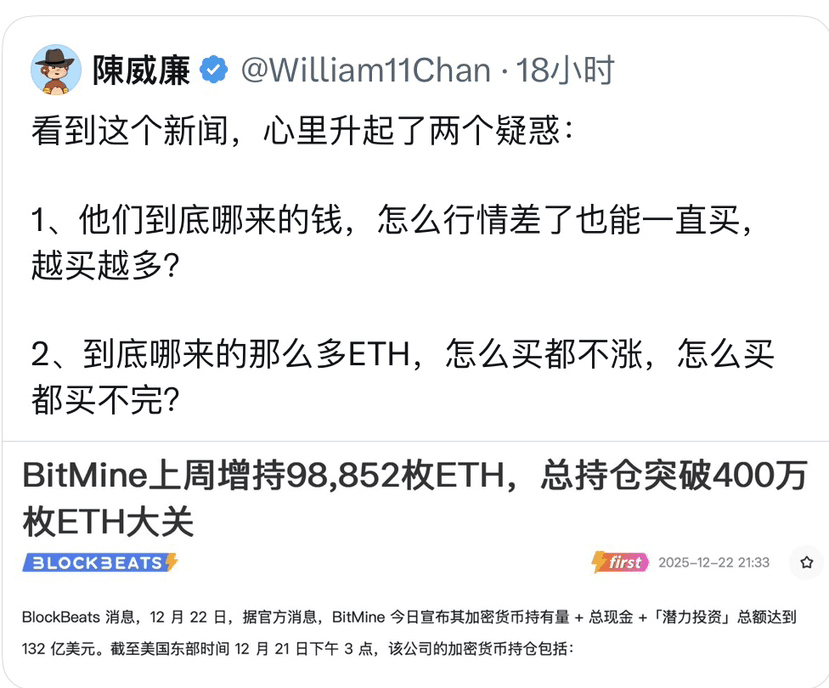
It is estimated that most people have such doubts 🤔❓
Let me clarify these two doubts:
The first question: Given such a poor market, where does the money 💰 come from?
- Financing mechanism: ATM equity issuance serves as a source of 'infinite ammunition':
BitMine finances through the At-The-Market (ATM) equity issuance plan, which is their main source of funding. As early as August 2025, they filed a $20 billion ATM plan with the SEC, along with $4.5 billion in financing from June to July, bringing the total potential funding to $24.5 billion.
The brilliance of the ATM lies in its ability to allow companies to sell stock at any time in the secondary market to raise money, rather than issuing at a fixed price. This means that even if the stock price is sluggish (BMNR's stock price has dropped by 81%), they can sell shares in batches as needed, with daily trading volumes still reaching $1-2 billion, supporting continuous purchases of ETH.
🌟 The cleverness of TOM LEE: Registering large plans at the peak of the bull market and then executing at low prices in the bear market avoids the problem of asymmetric market timing. The first question 'Where does the money come from?' is precisely aimed at this—it's not about printing unlimited money, but rather 'printing' funds through stock dilution of shareholder equity. Currently, they hold about 4 million ETH at a cost of $15 billion (average cost about $3,900 per coin), with nearly $10 billion in potential funds available.
The second question: Why has so much been purchased, but $eth doesn’t rise?
#Bitmine $ETH ETH accumulation strategy: OTC purchase + potential market manipulation
🌟 Core operation: BitMine mainly purchases ETH through over-the-counter (OTC) trading, which does not directly enter the public market, avoiding supply pressure. They may also combine with 'market dumping' techniques: for example, planning to buy 2 million ETH, first buying 100,000 OTC, then transferring 10,000 to the exchange to sell and pressure the price down, repeatedly operating to accumulate more at a lower price (this 'accumulation method').
- Why it doesn't rise: ETH has no fixed upper limit (though there is a burn mechanism, it can still be increased), plus with deep market liquidity, BitMine's purchase (accounting for 3.37% of supply) is substantial but its dispersed execution won't immediately drive up prices. Moreover, if they buy during a downturn, the overall weak market sentiment also suppresses price rebounds.
- Additional leverage: They use part of their ETH for staking to earn yields and plan to use ETH as collateral for structured credit to further amplify their holdings. Additionally, BitMine is not just hoarding; they plan to invest in projects that promote Ethereum adoption (such as bridging Wall Street with crypto businesses) to enhance ETH's long-term value.
😈 The brilliance of TOM LEE
This is a long-term bet on 'institutional-level exposure to #Ethereum': using cheap equity financing to buy low-priced assets, betting on a significant rise in ETH in the future (similar to MSTR's BTC strategy).
An important point‼️ He laid out plans in advance—bull market registration, bear market execution, avoiding funding shortages.
Currently, BitMine is the largest ETH treasury in the world (the second-largest overall crypto treasury, second only to MSTR's BTC), enhancing its narrative appeal and potentially attracting more institutional follow-up.
✍️ The operational technique is clever, but it is also a high-risk move: relying on equity financing, if the stock price continues to crash (down 81%, MNAV<1), the financing window shrinks; low staking yield (current ETH staking ~3-4%) cannot cover opportunity costs; NAV premium collapse exposes strategic flaws, and if ETH doesn’t rebound, it may evolve into a Ponzi cycle.
What does everyone think👀? Let's discuss together👇😃💓
