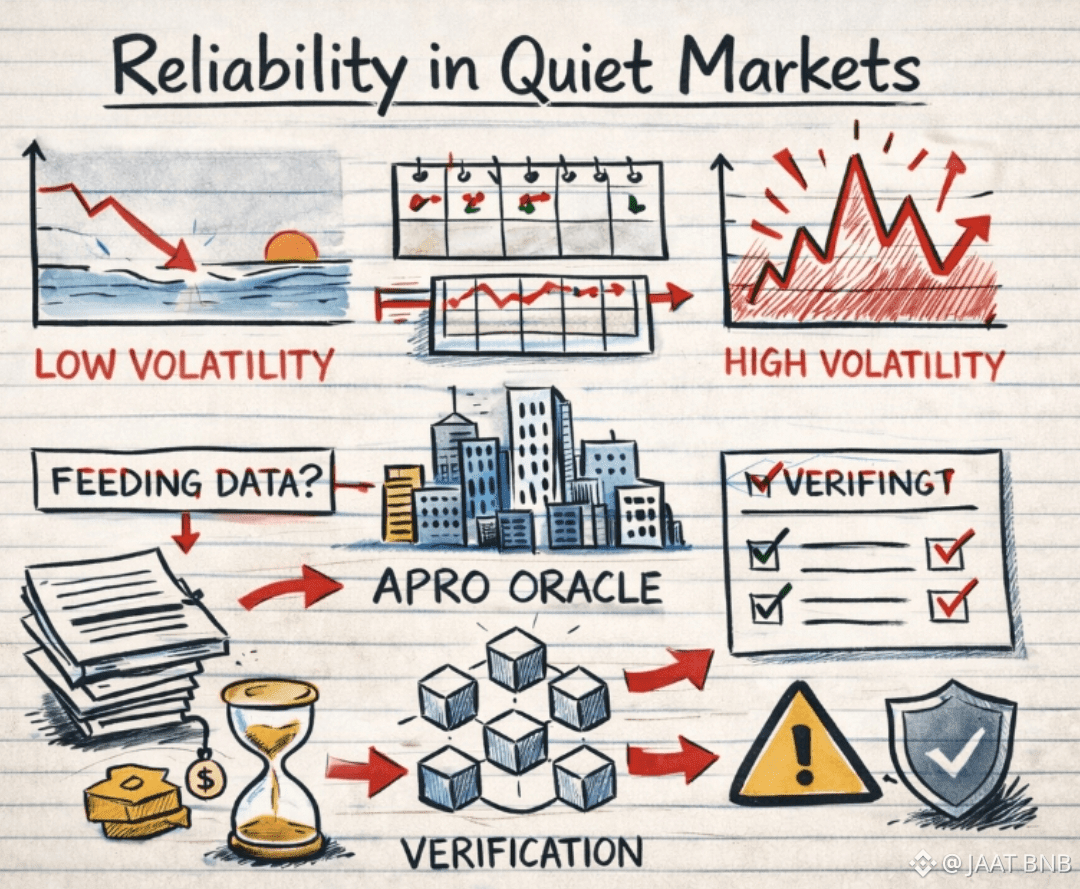
Most people think infrastructure is tested during chaos, sharp moves or during liquidation. That is when attention peaks, dashboards refresh constantly, and every system is actively watched. But in my experience, that is not when reliability truly reveals itself. The real test comes in quiet markets, when volatility fades, urgency disappears, and no one is paying close attention.
Quiet markets create a different kind of risk. Data updates slow. Assumptions harden. Systems start running on habit rather than scrutiny. This is where many oracle designs quietly drift out of alignment. Feeds keep pushing data because schedules say they should, not because conditions demand it. Costs accumulate unnoticed. Small inaccuracies compound because nothing dramatic forces a review. By the time volatility returns, fragility has already been baked in.
What stands out about @APRO Oracle #APRO is that it appears designed with this phase in mind. Rather than treating calm periods as downtime, APRO treats them as moments where discipline matters most. Data is delivered with intention, not just frequency. Pull based models allow applications to request updates when relevance justifies the cost, instead of assuming constant motion equals safety. In quiet markets, that restraint reduces noise and preserves signal.
Reliability during calm conditions also reshapes behavior. When data behaves predictably and costs remain stable, developers stop building defensive layers around uncertainty. They integrate with confidence instead of caution. Over time, this changes the ecosystem dynamic. Infrastructure fades into the background not because it is ignored, but because it’s trusted. That kind of trust can’t be rushed. It’s earned through consistency when attention is low.
There is also a governance dimension here. Quiet markets are when parameters tend to drift without challenge. APRO’s layered verification and explicit accountability slow that drift. Assumptions remain visible. Deviations surface as warnings rather than surprises. When markets eventually wake up, the system isn’t scrambling to remember why things were set the way they were. It already knows.
The uncomfortable truth is that most failures are seeded during periods of calm, not panic. They emerge later, when conditions change and hidden weaknesses are suddenly stressed. Systems built only for excitement rarely survive that transition. Systems built for quiet markets often do.
In that sense, oracle reliability is less about reacting fast when things move, and more about behaving correctly when they don’t. APRO design suggests an understanding of that reality. It doesn not try to impress when nothing is happening. It tries to stay correct. And in infrastructure, especially at the data layer, that discipline is what allows trust to compound long after the noise returns.