
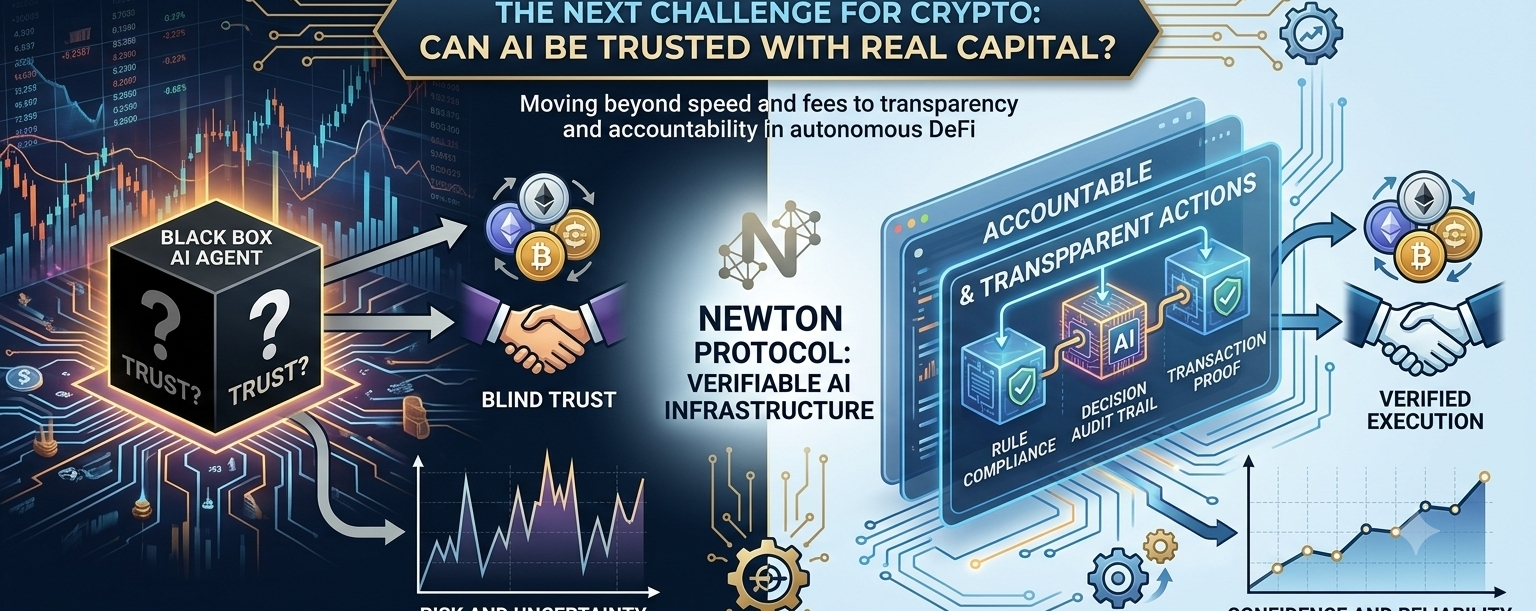
When I first started reading about Newton Protocol (NEWT), what immediately stood out to me wasn't another promise of faster transactions or lower fees. I've seen countless blockchain projects compete on performance, but I think the next challenge for crypto is much bigger than speed. To me, the real question is whether AI can be trusted when it's no longer just helping people make decisions but actually making those decisions on its own.
Over the past few years, I've watched AI become a valuable assistant for traders and investors. It started by generating content, analyzing market trends, interpreting data, and suggesting trading strategies. Those use cases were impressive, but AI was still playing a supporting role. Now I see AI moving into a completely different phase. It's beginning to execute trades, manage liquidity, rebalance portfolios, interact with decentralized applications, and control digital assets without constant human involvement. I think that's a fundamental shift because AI is no longer just advising people—it's becoming an active participant in the financial system.
As exciting as that future sounds, it also raises an important question in my mind. If AI is responsible for moving real money, how do I know every decision follows the rules? How can I verify that an autonomous agent stayed within predefined limits and didn't make unexpected choices? I don't think asking users to blindly trust a black-box system is enough, especially when real capital is involved.
That's one of the biggest reasons Newton Protocol caught my attention. What I find interesting isn't simply that it integrates AI with blockchain. I like that it's focused on creating infrastructure where AI actions can be transparent, accountable, and verifiable. Instead of expecting me to trust the system, I see it working toward giving users the ability to verify what happened. To me, that's much closer to the original purpose of blockchain, where verification matters more than blind trust.
I also think the crypto industry is gradually shifting its priorities. For years, most conversations centered around transaction speed, scalability, and lower fees. Those improvements are valuable, and they've helped blockchain technology mature, but I don't believe they'll be the defining factors in the next phase of adoption. If AI eventually manages billions of dollars across decentralized finance, people won't only care about how fast transactions are processed. I think they'll care even more about whether every automated action can be audited and proven afterward.
One principle has always attracted me to blockchain technology: it replaces trust with verification. Instead of relying on intermediaries, users can independently verify transactions and data. I believe that same philosophy should extend to AI. If autonomous systems are going to execute financial strategies on my behalf, I want to know there are clear rules, transparent processes, and verifiable records behind every action.
Another thing I've noticed is that many discussions around AI focus almost entirely on intelligence. Everyone talks about larger models, more powerful algorithms, and better predictions. Those advancements are exciting, but I personally think accountability is just as important as intelligence. Financial markets have shown time and time again that consistency often matters more than brilliance. A system that reliably follows predefined rules through different market conditions may ultimately prove more valuable than one that occasionally makes exceptional predictions but lacks transparency.
That's another reason I continue following Newton Protocol. I believe reliable execution infrastructure could become just as important as the AI models themselves. Even the smartest AI won't earn my trust if I can't understand or verify how it reached its decisions. For me, transparency creates confidence, and confidence is essential when real financial value is involved.
I've also noticed that investor expectations seem to be evolving. It feels like more people are looking beyond short-term excitement and asking tougher questions. Are returns sustainable? Can automated systems remain reliable during periods of extreme volatility? Can every decision be reviewed afterward if something goes wrong? I think those are healthy questions because long-term confidence in decentralized finance will depend on accountability rather than hype.
Another aspect I find interesting is how Newton Protocol changes the way I think about Layer-2 networks. Instead of viewing them only as scaling solutions that reduce costs and improve speed, I can imagine them becoming secure environments where AI agents operate under clearly defined and verifiable rules before interacting with the broader blockchain ecosystem. To me, that's a much more meaningful use case because it combines efficiency with trust.
Of course, I know this vision won't become reality overnight. Building trustworthy AI infrastructure is a complex challenge that will require strong technology, careful design, and widespread adoption. But I believe the projects that focus on transparency from the beginning will have a stronger foundation than those relying solely on performance or marketing.
In the end, that's why Newton Protocol continues to interest me. I don't see it as just another blockchain project trying to improve transaction efficiency. I see it as a project exploring one of the most important questions facing AI and decentralized finance: how can autonomous systems remain transparent, accountable, and verifiable while managing real value? If that challenge is solved, I believe it could shape the future of on-chain automation and help build greater trust in AI-powered finance. That's why I'll be watching Newton Protocol closely as the ecosystem continues to grow.
