$BANK #LorenzoProtocol $BAN @Lorenzo Protocol
As a project founder, I always look at on-chain data not only to grasp market trends but also to deeply assess the sustainability and user protection capabilities of the smart contract itself. The market for BANK is presenting a complex picture, where recent price growth is supported by derivative inflows but faces potential selling pressure in the spot market. The central argument here is: current data shows a strong tug-of-war between bullish expectations and underlying selling pressure, raising high demands for the efficiency and transparency of protective mechanisms in smart contracts to maintain stability and long-term user trust.
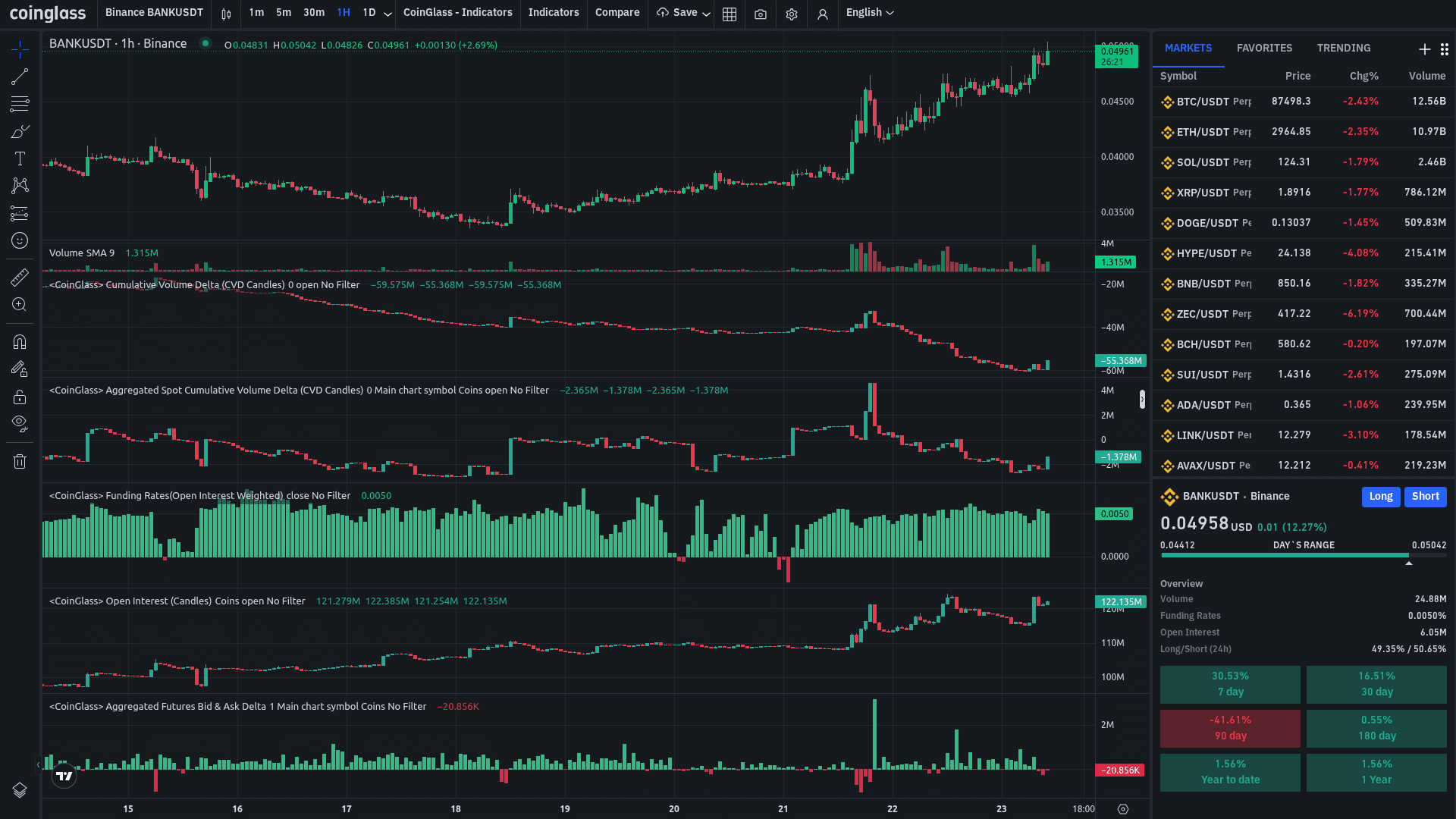
The price of BANK has seen a notable recovery in the short term, increasing by 2.69% in the last hour and 12.27% over the day, bringing the current price to 0.04961 USD. This is a positive signal, indicating that interest and new capital are returning to the market after a period of adjustment. At the same time, Open Interest – the total value of open derivative contracts in the market – is also trending upward, reaching approximately 121.279 million USD. The alignment between rising prices and increasing Open Interest suggests that new capital is flowing into the derivatives segment, reinforcing confidence in the recovery trend and reflecting investors' willingness to take risks. However, we cannot overlook an important reality: the 90-day performance of BANK is still at -41.61%, indicating that the long-term trend is still in a deep correction phase before this price increase. This underscores the importance of mechanisms within contracts to manage price volatility, prevent sudden "dumping," and protect the long-term value of assets, for example through stable reserve funds or liquidity lock mechanisms.
The Funding Rate index, which is the fee that long position holders pay to short position holders (or vice versa) to balance the derivatives market, is currently at a positive 0.0050. This positive level indicates that the majority of the derivatives market expects prices to rise and is willing to pay fees to hold long positions. This is an optimistic signal regarding short-term market sentiment, suggesting that most traders are positioning for an upward trend. However, the Long/Short ratio over the past 24 hours has been relatively balanced, with 49.35% long positions and 50.65% short positions. This relative balance, combined with the positive Funding Rate, shows that although there is certain buying pressure, the market has not completely tilted to one side, creating an environment that is potentially volatile and could swing sharply in either direction. In this context, protective mechanisms in contracts such as maximum leverage limits, dynamic margin requirements, or liquidation insurance funds will play a crucial role in minimizing risks for users when the market fluctuates significantly, preventing domino liquidation chains that could cause severe damage.
One notable point is that the Cumulative Volume Delta (CVD) – which measures actual buying and selling pressure through market orders – is showing a different picture. Both the CVD in the futures market (-59.575 million USD) and the CVD in the spot market (-1.378 million USD) are significantly negative. This means that, despite rising prices and expanding Open Interest, there is still a large amount of active sell orders being executed in the market. Similarly, the Aggregated Futures Bid & Ask Delta is also at a negative -20.856K, reinforcing the view of existing selling pressure, especially from market sell orders in derivatives. This paradox could be explained by large investors possibly placing limit buy orders to absorb selling pressure or this could result from the liquidation of losing short positions pushing prices up. Regardless of the scenario, rising prices in the context of negative CVD indicate a market that is not entirely sustainable without strict risk management from smart contracts. Mechanisms such as active liquidity management, controlling excessive price volatility through temporary ceiling/floor thresholds, or staking programs encouraging long-term token holding can help stabilize the ecosystem during these periods, limiting the impact of sudden sell-offs.
Although the liquidation heatmap is not detailed in this data, with the price fluctuations and increasing Open Interest, we can speculate that potential liquidation zones will be more distinctly formed on both the upward and downward sides. The relative balance between long and short positions (50.65% Short, 49.35% Long) indicates that a significant amount of liquidity could be affected if there is a strong price shock in either direction. A well-designed smart contract needs to be capable of handling widespread liquidation events smoothly, avoiding a domino effect that could lead to significant user losses. Mechanisms such as reliable Oracles to provide timely and accurate prices, slippage protection for large transactions, and well-funded contingency insurance funds are core factors to protect users from extreme volatility and ensure the fairness of the system.
In summary, the BANK market is at a challenging yet potential moment. Prices are recovering, Open Interest and Funding Rate indicate renewed interest from derivative investors, presenting a positive outlook for the short-term trend. However, the actual selling pressure reflected through negative CVD indicators and negative Futures Bid & Ask Delta cannot be overlooked, reminding us that the market still has factors that need to be carefully managed to ensure stability. To answer the question of whether the contracts have mechanisms to protect the ecosystem and users, we need to delve deeper into the technical structure of the contract, especially the terms related to risk management, supply control, and how to handle market volatility situations. A robust contract will be able to regulate liquidity, minimize the impact of widespread liquidation events, and build trust through transparency in governance. In all circumstances, we must always prioritize stability and sustainable development for the project. Small profits are still better than big dreams.
This is not investment advice. Please do your own research and make your own investment decisions.