
After reaching its all-time high of approximately $125,000 in October 2025, Bitcoin is back in the spotlight. The question that is driving the market now is different: will it be able to strongly regain the $100,000 and maintain this level before the end of 2026?
This value has ceased to be merely a symbolic goal. It represents a concrete reference, achieved after years of technological evolution, institutional maturation, and intense cycles of highs and corrections. Bitcoin's history shows that it has already faced turbulent phases, with significant drops, and has still managed to recover and set new records. It is precisely this cyclical behavior that maintains the confidence of many long-term investors.
To understand if we are facing yet another one of these recoveries, it is essential to analyze the scenario in more depth. Prediction markets, global macroeconomic conditions, and institutional capital movements help outline what may happen in the coming months and indicate whether Bitcoin is ready for a new leap.
What Prediction Markets Are Indicating
Prediction Markets as a Thermometer of Expectations
Prediction markets are platforms where participants “bet” on future outcomes based on implied probabilities in contract prices. For example, contracts that pay if Bitcoin is above $100,000 in December 2025 show how much the market believes in this possibility.
Currently, these markets are divided on the break above $100,000:
Some contracts indicate moderate chances — generally between 40% and 60%
Others show lower probabilities, reflecting caution in the face of current volatility.
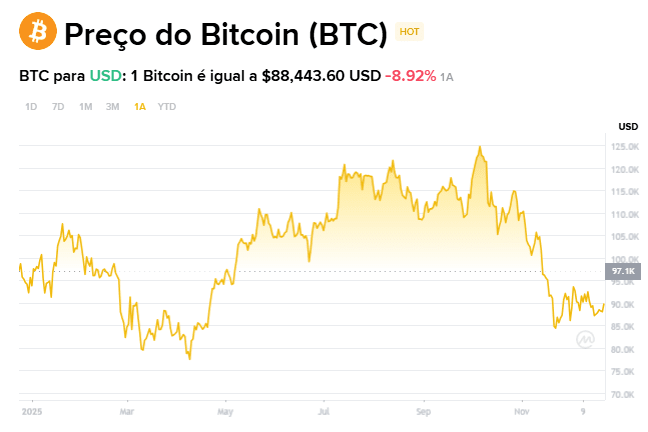
This does not mean that the goal is impossible, but rather that the market consensus is mixed, without a dominant conviction that it will occur.
What This Means for Investors
If prediction markets assign significant probability to this scenario, it shows that there is capital and expectation embedded in this possibility. At the same time, percentages below 50% suggest that many participants still see challenges to reach this level within the timeframe.
Macro Trends: Inflation, Interest Rates, and the Impact on Risk Assets
Global Inflation and Perception of Value
Inflation data continues to be a central factor for global investors. When inflation is high or seems persistent, many seek assets considered as protection or store of value.
In the case of Bitcoin, there is an ongoing debate about its effectiveness as “protection against inflation.” Some investors see it as an alternative to fiat money, especially in the face of expansive monetary policies. Therefore, if inflation data shows stability or consistent decline, part of this protection argument may lose strength, while higher inflation may attract more interest in alternative assets.
Federal Reserve Policy and Cost of Capital
What the Federal Reserve (Fed) does with interest rates directly influences risk markets — including cryptocurrencies.
Interest rate cuts tend to reduce the cost of capital, encouraging investors to seek returns in higher-risk assets.
High rates over long periods can restrict risk appetite, reducing the liquidity available for assets like Bitcoin.
Therefore, if the Fed signals substantial cuts before the end of 2025, this could create a more favorable environment for Bitcoin's price to rise — possibly towards $100,000.
Flows in Bitcoin ETFs and Institutional Participation
Bitcoin ETFs: New Capital Entry Points
The regulated Bitcoin ETFs in developed markets have served as a mechanism for institutional investors to enter the crypto market in a more traditional and regulated way.
What to observe here:
Net capital inflows into ETFs suggest growing institutional interest.
Significant outflows may indicate reduced risk appetite or strategic reassessment.
With more institutional capital flowing into these products, buying pressure on Bitcoin itself may increase — an important component if we want to see $100,000 before 2026.
Market Sentiment and News that Move Price
Sentiment as a Catalyst
The price of Bitcoin is strongly influenced by the overall market sentiment. This includes reactions to news, fear and greed indicators, and the behavior of large investors (the so-called “whales”).
Positive news, such as institutional adoption or regulatory clarity, tends to boost sentiment.
Negative news, such as severe regulatory restrictions, can trigger declines and increase volatility.
Even with technical indicators pointing to potential bullish trends, hesitant sentiment can slow down or limit more aggressive price movements.
Risks that Could Hinder the Journey to $100,000
Regulation Remains a Point of Attention
Sudden changes in regulatory policies in major economies can significantly impact the price of Bitcoin. Custody restrictions, high tax requirements, or limitations on access to crypto products can hinder adoption and liquidity.
Competition and Evolution of the Crypto Market
Even being the leading cryptocurrency, Bitcoin faces internal competition from the digital market itself. Innovations in DeFi, other blockchains, and tokenized assets can redirect capital away from Bitcoin at certain times.
What to Watch Closely Until 2026
Indicators that May Signal Strong Movement
To understand if Bitcoin is on the path to $100,000, follow:
Monetary policy decisions (especially from the Fed)
Regular inflation reports
Capital flows in Bitcoin ETFs
Sentiment indicators and regulatory news
Movements of large Bitcoin holders
These factors, when analyzed together, provide a more complete picture of the risk and opportunity environment.
Bitcoin Has Surprised Before and Can Do It Again
The possibility of Bitcoin reaching $100,000 before 2026 is more than just an optimistic dream — it is a realistic scenario, albeit challenging. Prediction markets point to significant chances, and macro fundamentals such as interest rate policy, inflation, and institutional capital inflow are laying the groundwork for a new bullish cycle.
Most importantly: Bitcoin has faced deep declines in the past — often being discredited — only to later reach new all-time highs. The asset has shown impressive resilience in previous cycles, overcoming resistances and expectations.
If history serves as a guide, underestimating Bitcoin could be a mistake. The question, then, may not be whether it will return to $100,000.
But when.
#BTCVSGOLD #BTC #bitcoin #FOMCWatch
---
Image generated using Sora AI
