
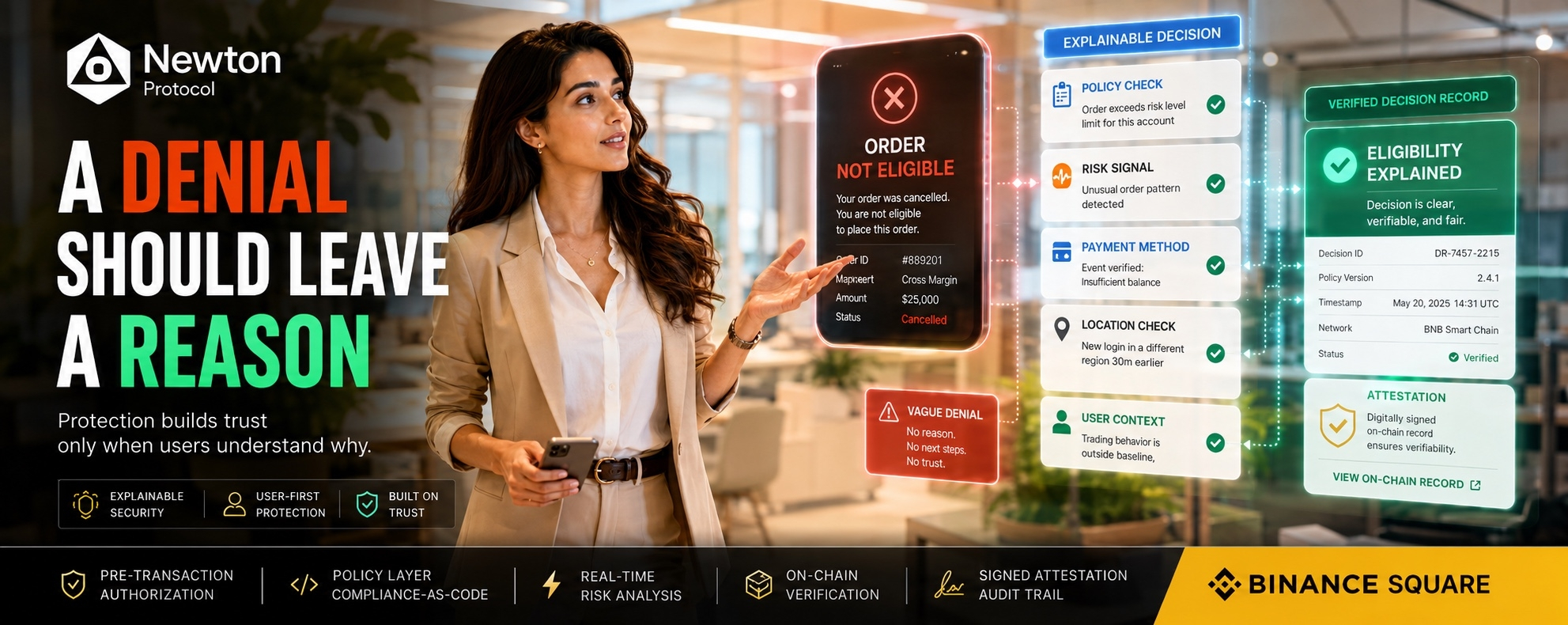
The Problem With “Not Eligible”
Last month, I ordered something online and the app canceled the order a few minutes later.
The message was simple:
“Order not eligible.”
That was all.
Not eligible because of what?
The address?
The payment method?
The seller?
The stock?
The delivery area?
A system error?
A risk check?
I stared at the screen longer than I should have, because the answer felt almost useless.
The app had made a decision, but it had not explained the decision in a way I could act on.
So I did what users usually do.
I tried again.
Changed the payment method.
Changed the address format.
Opened the app again.
Checked the seller page.
Asked support.
Nothing about that process felt like trust.
It felt like guessing around a closed door.
That small experience is why I think many automated systems have the same hidden weakness.
A decision is not useful just because it is fast.
A rejection is not useful just because it happens before damage is done.
If the system cannot explain the reason clearly enough, the user only sees power, not protection.
This is the part of onchain finance I think people still underestimate.
Crypto is very good at proving that something happened.
A transaction hash proves that a transaction existed.
A signature proves that someone approved an action.
A smart contract can prove that code executed.
But many systems are still weak at proving why an action was allowed, why it was blocked, which rule mattered, which data source was used, and whether the decision happened under the right conditions.
That gap becomes much more serious as finance becomes automated.
A failed swap with a vague error is annoying.
A vault withdrawal blocked without useful reason is worse.
A stablecoin payment rejected without context can become a business problem.
An AI agent stopped mid-action without a readable policy record creates confusion for users, developers, and auditors at the same time.
This is where @NewtonProtocol stands out to me.
Newton is not just trying to make transactions faster.
That is not the impressive part.
The impressive part is that Newton focuses on the decision before execution.
Not only “can this transaction be signed?”
But:
Is this action allowed under the policy?
Is the actor inside the right permission boundary?
Is the risk signal acceptable?
Is the data fresh enough?
Did the transaction intent match the rule?
Can the result be attested before settlement?
That is a much more serious infrastructure problem than normal AI hype.
A lot of projects talk about autonomous agents moving money.
Newton is asking what those agents should be allowed to do before they touch money.
That is why keywords like policy layer, pre-transaction authorization, AI agent security, compliance-as-code, stablecoin payments, vault limits, risk controls, signed attestation, operator evaluation, audit trail, and onchain verification actually matter here.
They are not just technical decoration.
They describe a shift from “we will check it later” to “this action must prove it belongs here before value moves.”
That is the part I personally like about Newton.
It is solving an unsexy problem, but unsexy problems often become the most valuable infrastructure once real capital arrives.
Nobody wants to think about authorization until the wrong action already happened.
Nobody cares about audit trails until an auditor asks for proof.
Nobody talks about permission boundaries until an AI agent crosses one.
Newton is building directly in that uncomfortable zone.
And I think that is a strong sign.
But the design challenge is not simple.
A system that explains too little becomes another black box.
The user sees “denied” and has no idea what to fix.
The developer sees a failed action and has to guess which rule broke.
The auditor sees a transaction months later and cannot easily verify why it passed.
In that world, the policy layer may be technically correct but still useless to the people who need to trust it.
At the same time, a system that explains too much creates another risk.
If every rejection reveals the exact threshold, the exact risk pattern, the exact data weakness, or the exact route that failed, then the explanation can become a bypass guide.
A bad actor does not need the whole system to be open.
Sometimes they only need enough feedback to learn where the edge is.
That is why I do not think the future of authorization is simply “more transparency.”
The better goal is useful transparency.
A normal user should know enough to understand the rejection.
A developer should know enough to debug the integration.
A vault manager should know enough to prove the mandate was respected.
An auditor should know enough to review the decision later.
But an attacker should not receive a free tutorial on how to bypass the next evaluation.
This is why Newton is interesting beyond a simple gas narrative.
If every policy evaluation has a cost, and every evaluation can produce a verifiable decision record, then the token is tied to something more important than raw execution.
It is tied to the cost of making automated finance safer, more accountable, and more inspectable before settlement.
That matters because the faster money moves, the more valuable it becomes to know why it was allowed to move.
Stablecoin payments will become more automated.
Vault strategies will rebalance faster.
AI agents will request more permissions.
Institutions will need more audit evidence.
Developers will need clearer policy feedback.
Users will need to know whether a rejection was protection or a mistake.
The canceled order on my phone was harmless.
Worst case, I wasted ten minutes.
But in finance, a vague “not eligible” can mean capital is stuck, a strategy is paused, a payment is rejected, or an agent is blocked without anyone understanding the real reason.
That is not good enough for serious onchain systems.
A decision layer should not only say yes or no.
It should leave enough evidence for the right people to understand the decision.
That is the part of Newton I want to keep watching.
Not only whether it can block the wrong action.
But whether it can make the reason behind that block trustworthy, useful, and verifiable.
Because in autonomous finance, the best system will not be the one that simply closes the door fastest.
It will be the one that can explain why the door closed without handing the keys to the wrong person.
