
There is a pattern I keep noticing whenever a new technology promises automation. At first everyone debates what machines will be capable of doing.
Years later the important question quietly replaces it: who decides what those AI agents are allowed to do?
That shift feels subtle until you realize history keeps repeating it.
Cars became safer not simply because engines improved,. Because traffic rules matured.
Financial markets became more scalable not merely because computers became faster. Because execution followed increasingly strict policies.
I find myself wondering whether AI agents are now approaching that crossroads.
Most conversations about AI agents revolve around intelligence.
We compare **reasoning models** **memory systems** planning abilities. Autonomous workflows* as though better thinking automatically leads to better outcomes.
But intelligence without boundaries has always been a combination.
An AI capable of making decisions also becomes capable of making expensive mistakes especially once it begins interacting with blockchains where transactions are irreversible.
That is why I have become more interested in execution than reasoning.
Reasoning happens inside a model.
Execution happens in the world.
Those two environments obey different rules.
An AI can revise its thoughts endlessly before reaching a conclusion.
A blockchain transaction offers no luxury.
Once signed and confirmed the decision becomes part of history.
That asymmetry feels surprisingly underappreciated.
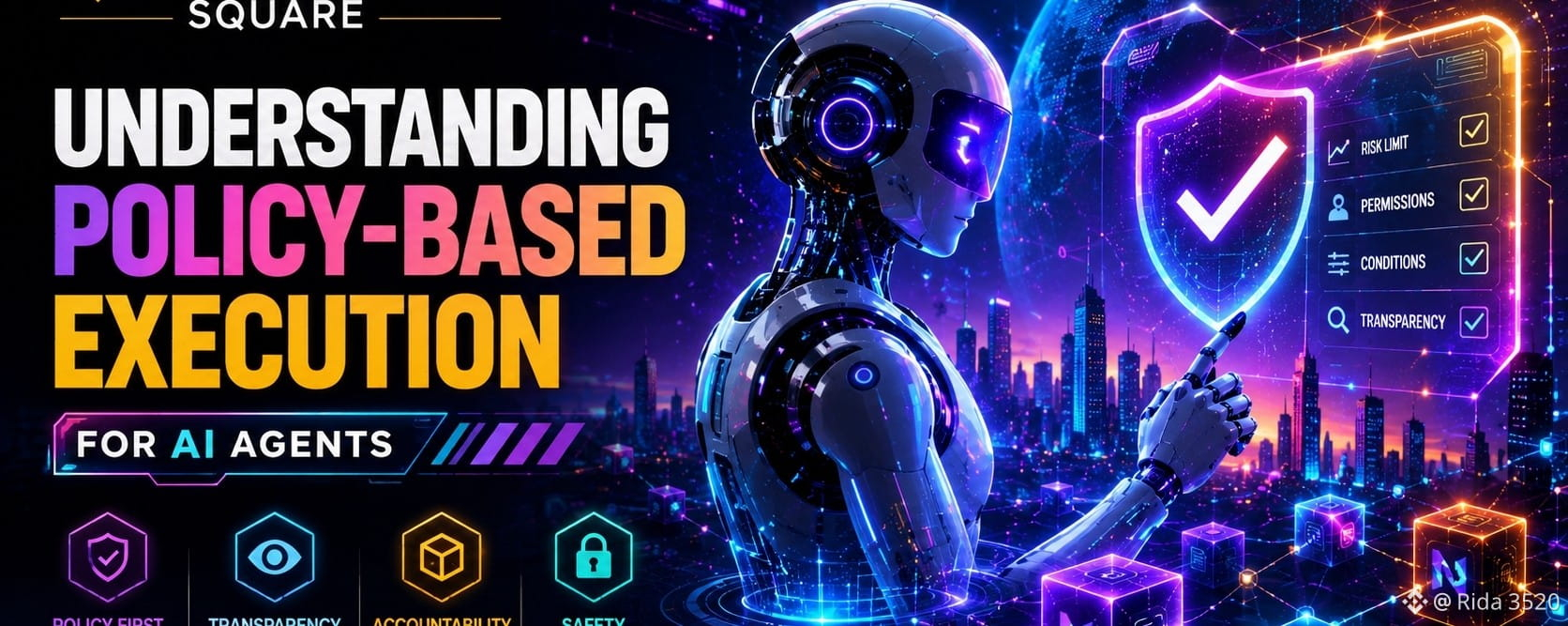
This is where I think ideas around *policy-based execution** deserve attention particularly when considering frameworks such as Newton Protocol that are exploring how AI agents interact with decentralized systems.
* The fascinating question is not whether an agent can perform an action.
It is whether every action should first satisfy a set of constraints before it ever reaches *execution**.
That distinction changes the conversation.
For years software permissions have been relatively simple.
An application. Has access or it does not.
AI agents complicate this because access alone says little about appropriate behavior.
Imagine giving a investment assistant* permission to manage capital.
Permission answers who can act.
Policy answers under what circumstances action becomes acceptable.
Those are different problems.
I keep thinking about traditional finance because the industry learned this lesson decades ago.
Professional traders rarely operate with discretion.
Risk departments define exposure limits.
Compliance teams establish restrictions.
Internal systems reject trades that violate predefined policies even if the trader intentionally submits them.
Judgment exists inside institutional guardrails.
Why should autonomous AI agents operate differently?
Blockchain has traditionally emphasized removing intermediaries, which has been an innovation.
Yet removing intermediaries also removes many of the checkpoints society has relied upon for generations.
That creates a paradox.
Decentralization increases freedom. AI* dramatically increases the speed at which that freedom can be exercised.
Freedom multiplied by automation creates a different risk profile.
Perhaps this is why execution policies feel like infrastructure than application logic.
They become the bridge between intelligence and accountability.
Of asking whether an AI can execute a sequence of transactions we begin asking what conditions must remain true throughout the entire process.
I suspect developers may eventually spend time optimizing prompts and more time designing constraints.
That sounds counterintuitive because the AI industry often celebrates capability.
Yet mature systems are usually remembered for predictability than raw power.
Commercial aviation is remarkable not because pilots possess skill but because thousands of layered procedures reduce uncertainty before every flight.
Maybe AI agents require a philosophy.
There is another implication that seems important.
Users often assume decentralization automatically produces trust.
I am no longer convinced that assumption holds once AI enters the picture.
If an autonomous agent makes decisions continuously on behalf of users transparency cannot simply describe what happened after execution.
It must explain why execution became permissible in the place.
That "why" may ultimately matter more than the transaction itself.
From a developers perspective this also changes incentives.
Of building increasingly autonomous agents teams may compete on designing more understandable governance around autonomy.
Clear execution policies become part of the user experience because confidence often emerges from limitations rather than unlimited possibilities.
There is also a dimension that receives surprisingly little attention.
Markets function because participants develop expectations about behavior.
If AI agents begin representing millions of users across applications, policy consistency may become as economically valuable as computational intelligence.
Predictable agents create markets.
Unpredictable agents amplify volatility beyond what existing systems were designed to absorb.
Maybe the next competitive advantage in AI will not be reasoning depth.
Maybe it will be disciplined execution.
I realize there is a trade-off here.
Stronger policies inevitably reduce flexibility.
Every safeguard introduces friction.
Every constraint prevents some action alongside potentially harmful ones.
History suggests that finding the balance is rarely straightforward.
Yet perhaps that is the point.
Technology often advances by making things possible.
Institutions evolve by deciding which possibilities deserve to become reality.
AI agents seem to be pushing those two forces faster than ever before.
When I think about Newton Protocol I find myself less interested in whether execution becomes technically achievable and more interested in how execution can remain accountable once intelligence becomes widely distributed.
That feels like the problem.
All, the future of AI, on blockchain may not be determined by how intelligently agents think.
It may be determined by how they are allowed to act. @NewtonProtocol $NEWT, #Newt @NewtonProtocol $NEWT #Newt