Original title: (Hyperliquid personally reconciles accounts, behind perfect public relations is a fundamental siege against competitors)
Original author: angelilu, Foresight News
On December 20, 2025, a technical article published on blog.can.ac (Reverse Engineering Hyperliquid) directly dismantled Hyperliquid's binary file through reverse engineering, accusing it of having nine serious issues ranging from 'insolvency' to 'God mode backdoor.' The article bluntly stated:
'Hyperliquid is a centralized trading platform disguised as a blockchain.'
In the face of FUD, Hyperliquid's official response came in the form of a lengthy article, perhaps this is not just a simple rebuttal, but a declaration of war on 'who is the true decentralized trading facility.' Although the official statement successfully clarified the issue of fund security, it still left intriguing 'gaps' in certain sensitive areas of decentralization.
Where did the 362 million dollars go? 'Dual ledger' audit blind spot
The most damaging point in the allegations is: user assets within the Hyperliquid system are 362 million dollars less than the on-chain reserves. If true, this means it is a 'chain-based FTX' operating with partial reserves.
But upon verification, this is a misreading caused by 'architectural upgrades' leading to information asymmetry. The questioner's auditing logic is: Hyperliquid reserves = USDC balance on Arbitrum cross-chain bridge. According to this logic, he checked the cross-chain bridge address and found that the balance was indeed less than the total deposits of users.
Hyperliquid stated that it is undergoing a complete evolution from 'L2 AppChain' to 'independent L1'. During this process, asset reserves have become dual-track:
The accuser completely ignored the native USDC located on HyperEVM, according to on-chain data (as of the time of publication):
· Arbitrum cross-chain balance: 3.989 billion USDC (checkable on Arbiscan)
· HyperEVM native balance: 362 million USDC (checkable on Hyperevmscan)
· HyperEVM contract balance: 0.059 billion USDC
Total solvency = 3.989 billion + 0.362 billion + 0.059 billion ≈ 4.351 billion USDC
This figure matches exactly with the total user balances on HyperCore. The so-called '362 million gap' is precisely the native assets that have been migrated to HyperEVM. This is not a disappearance of funds, but a flow of funds between different ledgers.
9-point allegation reconciliation: What has been clarified? What has been avoided?
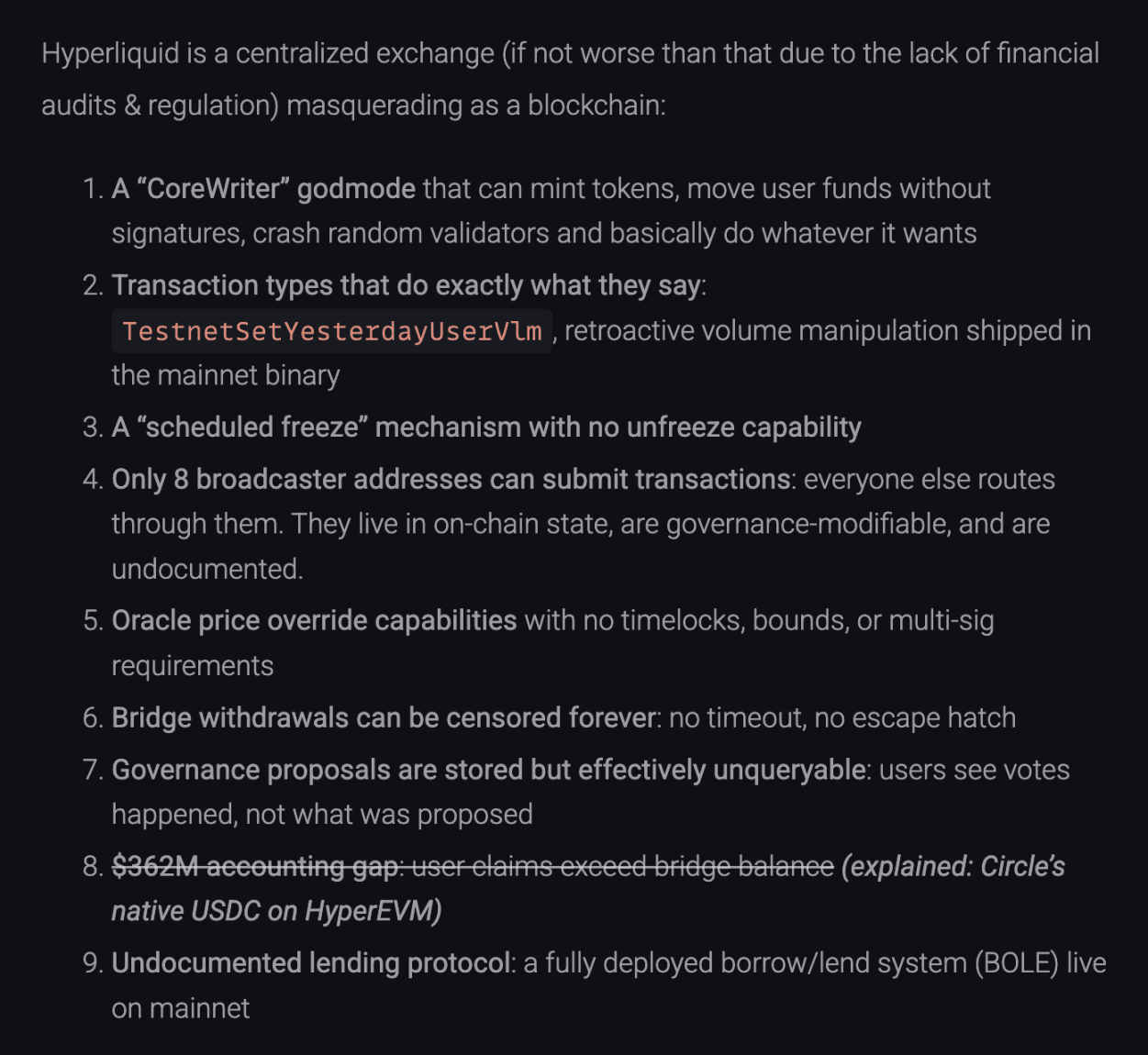
Allegations that have been clarified
Allegation: 'CoreWriter' God mode: Allegations claim it can print money out of thin air and misappropriate funds.
Response: The official explains that this is the interface for interaction between L1 and HyperEVM (such as staking), with limited permissions, and does not have the ability to misappropriate funds.
Allegation: 362 million funding gap.
Response: As mentioned above, Native USDC was not counted.
Allegation: Unpublished loan agreements.
Response: The official pointed out that the spot/loan function (HIP-1) document has been made public, is in the pre-release stage, and is not secretly operated.
Allegations that have been acknowledged but have reasonable explanations
Allegation: Binary file contains 'modify transaction volume' code (TestnetSetYesterdayUserVlm).
Response: Acknowledged that it exists. But explained as testnet (Testnet) residual code used to simulate fee logic, the mainnet nodes have physically isolated this path and cannot execute.
Allegation: Only 8 broadcast addresses can submit transactions.
Response: Acknowledged. Explained as an anti-MEV (Maximum Extractable Value) measure to prevent users from being front-run. Promised to implement a 'multiple proposer' mechanism in the future.
Allegation: The chain can be 'planned to freeze' and has no rollback function.
Response: Acknowledged. Explains that this is the standard process for network upgrades, requiring a full network pause for version switching.
Allegation: Oracle prices can be instantly overwritten.
Response: Explained as a system security design. In order to liquidate bad debts in timely fashion during extreme fluctuations like 10/10, the validator oracle indeed did not set a time lock.
Response missing / vague
In our checks, there are two allegations that were not directly mentioned or fully resolved in the official response:
Allegation: Governance proposals are unqueryable; users can only see that voting occurred, but on-chain data does not include the specific text content of the proposals.
Response: The official did not address this point in the long article. This means that Hyperliquid's governance is still a 'black box' for ordinary users; you can only see the results, not the process.
Allegation: The cross-chain bridge has no 'escape hatch', withdrawals may be subject to indefinite review, and users cannot force withdrawals back to L1.
Response: Although the official explained that the locked bridge in the POPCAT incident was for security, it did not refute the architectural fact of 'no escape hatch'. This indicates that at the current stage, users' assets' movement is highly dependent on the release of the validator set, lacking the anti-censorship forced withdrawal capability of L2 Rollup.
'Pulling down' competitors
The most interesting part of this incident is that it forced Hyperliquid to reveal its bottom line, giving us a chance to re-examine the landscape of the Perp track. The official response rarely 'pulled down' competitors, targeting Lighter, Aster, and even industry giant Binance.
It stated that 'Lighter uses a single centralized sequencer, whose execution logic and zero-knowledge proof (ZK) circuits are not publicly available. Aster uses centralized matching and even provides dark pool trading, which can only be realized in a single centralized sequencer with an unverifiable execution process. Other protocols with open-source contracts do not have verifiable sequencers.'
Hyperliquid bluntly categorizes these competitors as relying on 'Centralized Sequencers'. The official emphasized: on these platforms, apart from the sequencer operators, no one can see the complete state snapshot (including order book history, position details). In contrast, Hyperliquid attempts to eliminate this 'privilege' by having all validators execute the same state machine.
And this wave of 'pulling down' may also be due to Hyperliquid's concerns about its current market share. According to DefiLlama's trading volume data for the past 30 days, the market landscape has shown a three-way stalemate:
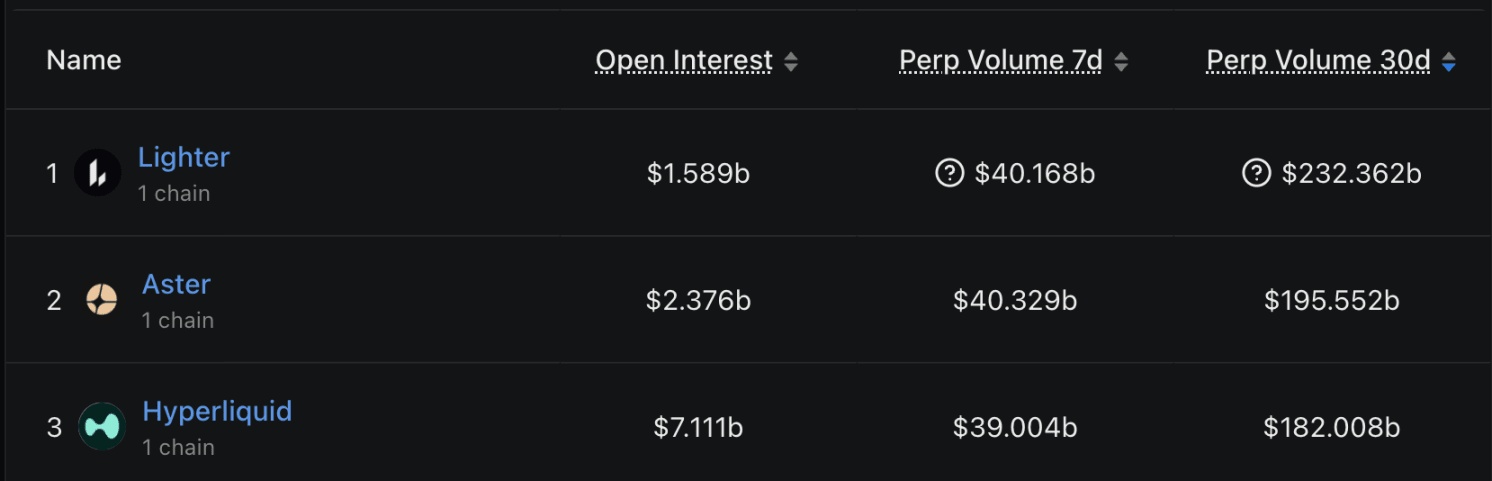
· Lighter: Transaction volume 232.3 billion dollars, currently in first place, accounting for about 26.6%.
· Aster: Transaction volume 195.5 billion dollars, ranking second, accounting for about 22.3%.
· Hyperliquid: Transaction volume 182 billion dollars, ranking third, accounting for about 20.8%.
Faced with the later entrants Lighter and Aster's rising transaction volumes, Hyperliquid is attempting to play the 'transparency' card — that is, 'although I have 8 centralized broadcast addresses, I have full state on-chain that can be checked; while you cannot even check'. However, it is worth noting that although Hyperliquid is slightly behind the top two in transaction volume, it presents a crushing advantage in open interest (OI).
Public opinion response: Who is shorting HYPE?
In addition to technical and financial issues, the community is also highly concerned about the recent rumors that HYPE tokens are suspected to be shorted and dumped by 'insiders'. In response, a member of the Hyperliquid team provided qualitative feedback in Discord for the first time: 'The shorting address starting with 0x7ae4 belongs to a former employee', who was once a team member but was dismissed in early 2024. The personal trading behavior of this former employee is unrelated to the existing Hyperliquid team. The platform emphasizes that extremely strict HYPE trading restrictions and compliance reviews are currently in place for all employees and contractors, prohibiting insider trading.
This response attempts to downgrade the allegation of 'team wrongdoing' to 'former employee's personal behavior', but the community may still expect more detailed disclosures regarding the transparency of token distribution and unlocking mechanisms.
Don't Trust, Verify
Hyperliquid's clarification tweet this time is a textbook-level crisis management — not relying on emotional output, but on data, code links, and architectural logic. It did not stop at proving its innocence but turned the tables by comparing the architecture of competing products, reinforcing its brand and advantages of 'full state on-chain'.
Although FUD has been debunked, the implications of this incident for the industry are profound. As DeFi protocols evolve into independent application chains (AppChain), architectures are becoming increasingly complex, and asset distribution is becoming more fragmented (Bridge + Native). The traditional method of 'taking a glance at contract balances' has become ineffective.
For Hyperliquid, it proves that 'money is in' is just the first step. How to gradually transfer the authority of those 8 submission addresses while maintaining high performance and anti-MEV advantages, truly achieving the transition from 'transparent centralization' to 'transparent decentralization', is the path it must take to reach 'ultimate DEX'.
And for users, this incident once again confirms the iron law of the crypto world: do not believe any narrative, verify every byte.
Original link