

 been remembering the time when i first started reading through newton protocol's privacy model, i expected another familiar story about encryption and identity. instead, i kept coming back to a different thought. crypto has spent years proving who owns assets, but much less time figuring out how people can prove something about themselves without exposing everything else. that difference feels small until you imagine using blockchain for everyday financial activity.
think about checking into a hotel. the receptionist needs to know you're the person who made the booking, but they don't need access to your banking history, medical records, or every place you've ever stayed. in real life, we naturally accept that people should only see the information they actually need. onchain systems haven't always worked that way. too often, privacy has been treated as something added later instead of becoming part of the foundation.
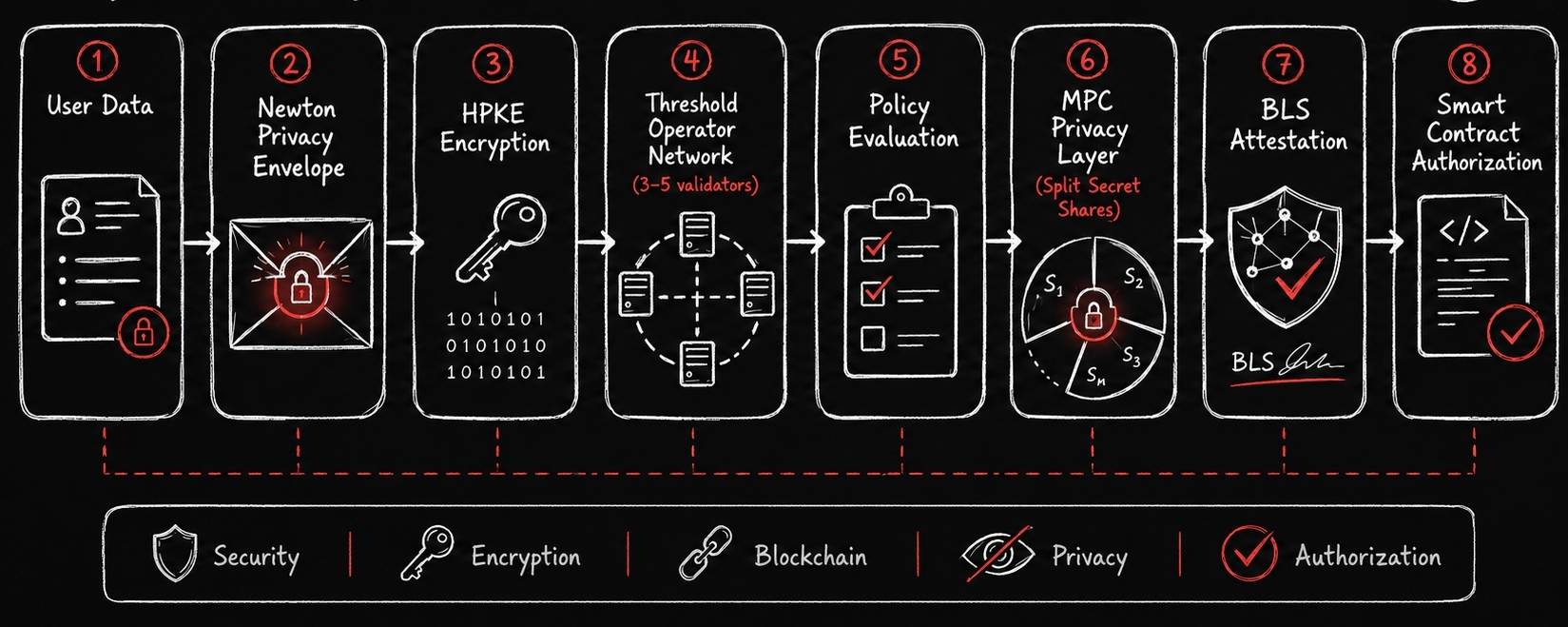
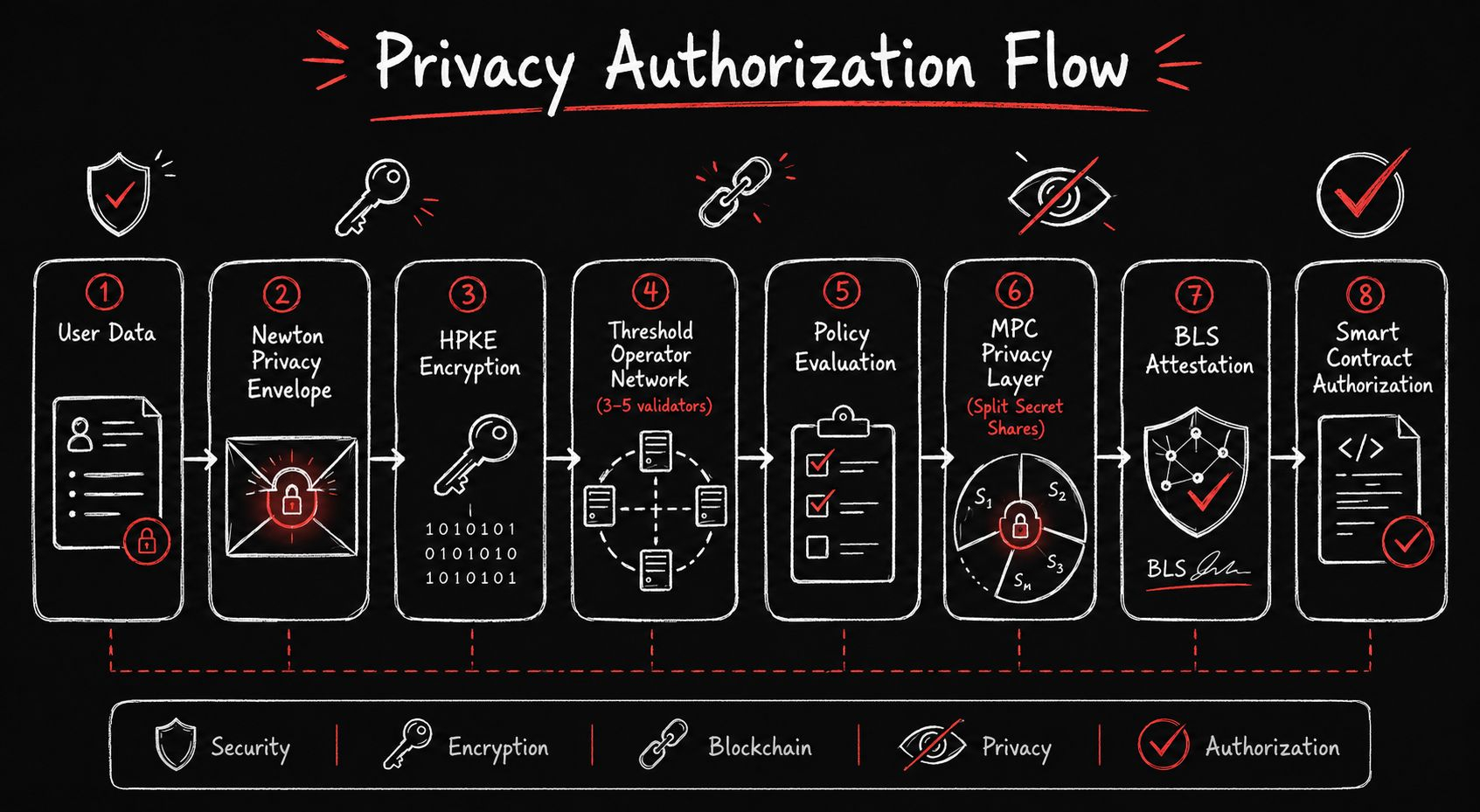
that's what made me pause while looking at newton's architecture. the protocol isn't trying to hide transactions from the blockchain. it's trying to limit who ever sees sensitive information during the authorization process itself. underneath that idea sits something called the newton privacy envelope. rather than simply encrypting information and sending it across the network, it binds encrypted data to a specific application, a specific blockchain, and even a specific authorization request. if someone intercepts that data or attempts to reuse it elsewhere, it no longer fits the original context. the encryption isn't just protecting information. it's protecting intent.
understanding that helps explain why the protocol uses hybrid public key encryption based on rfc 9180. every encryption creates a fresh ephemeral key, meaning each request stands on its own instead of relying on a permanent secret. the threshold decryption key is generated collectively through distributed key generation rather than sitting inside one server or organization. no single operator can unlock private information alone. only when a quorum of operators contributes their partial decryption shares can the original data be reconstructed. that changes the trust model quite a bit because compromising one participant doesn't expose the system.
but there is another layer underneath that story.
during today's implementation, once enough operators reconstruct the encrypted information, they can still see the plaintext while evaluating authorization policies. i actually appreciate that the design acknowledges this openly instead of pretending privacy is already perfect. many projects stop after saying data is encrypted. this one describes where visibility still exists and where improvements are expected to arrive.
that next step is probably the most interesting part.
instead of reconstructing sensitive information first, newton is working toward multi-party computation, or mpc. rather than revealing the data before making a decision, operators evaluate encrypted pieces together without any individual party ever seeing the original information. only the final answer appears. authorized or denied. nothing more.
on paper that sounds almost impossible.
in practice, recent research shows honest-majority three-party computation exceeding one billion logic gates per second under local network conditions. that number only matters because it changes the old assumption that privacy-preserving computation is automatically too slow for real applications. early signs suggest that gap is becoming much smaller, although real-world performance across decentralized infrastructure remains something worth watching.
that momentum creates another effect.
identity itself starts looking different. instead of repeatedly uploading documents every time a new application asks, users can present verifiable credentials proving only the necessary fact. maybe residency. maybe kyc completion. maybe accreditation status. selective disclosure means proving one statement without exposing the entire credential underneath. in everyday life, it's closer to showing a security guard that you're over eighteen instead of handing over every page of your passport.
there are more pieces supporting that model. trusted execution environments isolate sensitive verification tasks away from the host system. zero-knowledge proofs make it possible to prove conditions like having a balance above a threshold or being above a certain age without revealing the actual numbers. each technique solves a different problem, but together they create texture rather than relying on one privacy mechanism to solve everything.
still, privacy systems create their own risks.
threshold encryption depends on enough honest operators participating. multi-party computation depends on coordination. trusted execution environments rely on hardware assumptions. zero-knowledge systems introduce computational overhead. privacy isn't free. it shifts complexity into different parts of the infrastructure. whether that trade-off feels acceptable depends on the application.
meanwhile, the broader market seems to be changing in a way that makes this conversation more relevant. institutions continue experimenting with tokenized assets. regulated stablecoins are expanding. ai agents are beginning to interact with financial protocols. every one of those trends increases the amount of sensitive information flowing through decentralized systems. settlement alone no longer answers every question. authorization and privacy increasingly move together.
what struck me most wasn't the cryptography itself. it was the philosophy underneath it.
for years, blockchain discussions often assumed transparency automatically created trust. i'm starting to think the opposite can also be true. sometimes trust comes from revealing less, provided everyone can still verify the outcome independently.
whether newton ultimately becomes an important piece of that future remains uncertain. the protocol still has to prove that these layers work together under real demand, not just inside technical papers. adoption always tests ideas differently than design documents do.
but if this direction holds, i think the next competition in blockchain won't simply be about moving assets faster. it will be about deciding who gets to know what, and making sure everyone else never has to. that's a much quieter race, but it may end up becoming one of the most important ones.
#Newt || #newt || $NEWT || @NewtonProtocol
