Original title: (The trillion-dollar stablecoin battle, Binance decides to enter the arena again)
Original author: Lin Wanwan, Dongcha Beating
In 2024, the total on-chain transfers of stablecoins reached $27.6 trillion, surpassing the total of Visa and Mastercard for the first time.
This figure was $300 billion five years ago and close to zero ten years ago.
On December 18, a project named United Stables launched a new stablecoin $U in Dubai. Its reserves are not in US dollar cash or government bonds, but a combination of three stablecoins: USDC, USDT, and USD1. Using stablecoins to collateralize stablecoins is referred to in the industry as 'Russian nesting dolls.'
Binance Wallet integrated immediately, with official endorsement from BNB Chain, and full support from PancakeSwap and Four.Meme.
This configuration has a clear meaning in the crypto circle: Binance is personally stepping in.
$U itself may be insignificant. But the trend it represents: stablecoins are transitioning from wild growth to territorial disputes, and new battles are beginning.
Stablecoin 1.0 era: monopoly of first movers
The essence of stablecoins is 'on-chain dollars'; users deposit 1 USD with the issuer and receive 1 token, which can circulate on any blockchain globally 24/7, with funds arriving within seconds and transaction fees of a few cents.
Compared to Alipay or bank transfers, the core advantage of stablecoins is that they do not require real-name registration, bank accounts, or regulatory approval. A wallet address is all the threshold needed.
In 2014, when Tether issued USDT, the entire crypto market had a market value of less than 5 billion USD. Therefore, the opportunity window that Tether seized was: traditional banks generally refused to provide services to cryptocurrency companies. After making profits from trading, the only way to secure those gains was to exchange crypto assets for USDT, locking in dollar-denominated earnings.
The rise of USDT is not only due to its excellent product but also because users have no other choice. This kind of 'passive monopoly' has continued to this day. As of December 2025, the market value of USDT is approximately 199 billion USD, accounting for 60% of the stablecoin market.
In 2018, Circle partnered with Coinbase to launch USDC, focusing on compliance: publishing reserve audit reports monthly, with funds held in regulated financial institutions, embracing the U.S. securities regulatory framework. The implication is that Tether's black box model will eventually face problems.
In 2022, USDC's market value once approached 70% of USDT's. Wall Street bets that the compliant faction will ultimately prevail.
In March 2023, Silicon Valley Bank collapsed. Circle had 3.3 billion USD in reserves stored there. USDC briefly decoupled to 0.87 USD, an asset that promised to always equal 1 USD, losing 13%.

The lesson from the market is clear: compliance is a plus, but not a moat. Banks can go bankrupt, regulations can shift, and the real barrier is network effects—when your user base and liquidity are large enough, you are effectively the standard.
The survival rule of the stablecoin 1.0 era is simple: first-mover advantage outweighs everything.
Binance's three turns
Trading platforms are the traffic hubs of the crypto world, and stablecoins are the pricing units of transactions. Whoever controls the mainstream stablecoins controls the pricing power. Binance cannot give up this position.
In 2019, Binance partnered with the New York-licensed trust company Paxos to issue BUSD. This is a compliant stablecoin regulated by the New York Department of Financial Services, peaking in market value at 16 billion USD, second only to USDT and USDC.
BUSD once accounted for 40% of Binance's trading volume. It is the core tool for Binance to establish its own 'currency issuance rights.'
In February 2023, the SEC issued a Wells Notice to Paxos, accusing BUSD of being an unregistered security. On the same day, the New York Department of Financial Services ordered Paxos to stop minting new BUSD. Nine months later, Binance founder CZ pleaded guilty in the U.S. and Binance paid a fine of 4.3 billion USD.
16 billion USD in stablecoin assets went to zero under regulatory pressure.
Binance's response was swift. Shortly after BUSD was halted, Hong Kong company First Digital launched FDUSD, just in time for the launch window of Hong Kong's virtual asset licensing system. FDUSD quickly became one of the main stablecoins on the Binance platform, although neither party has publicly confirmed the partnership.
From BUSD to FDUSD is passive survival; from FDUSD to $U is proactive layout.
The design logic of U is completely different from the previous two: it does not directly compete with USDT, USDC, or USD1, but integrates them into its own reserve pool. In a sense, U is the 'stablecoin of stablecoins', or 'stablecoin ETF'.
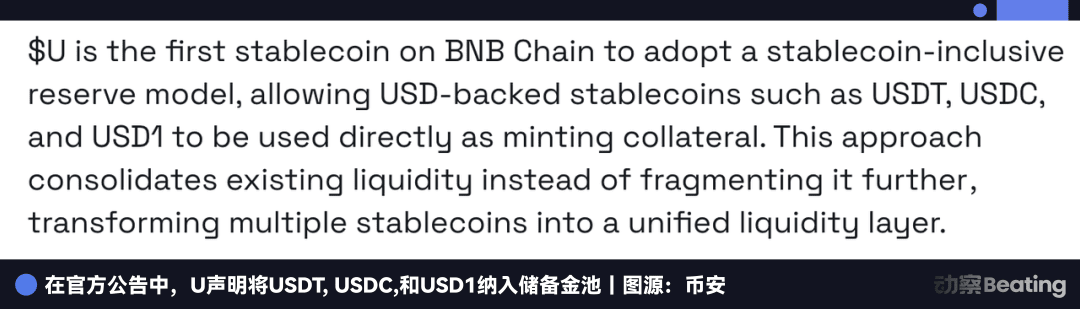
Binance's lesson is that stablecoins reliant on a single regulatory framework always have their lifeline in someone else's hands.
Presidential family enters the arena
$U's reserves, the most noteworthy, is USD1.
In March 2025, the Trump family issued the USD1 stablecoin through World Liberty Financial. It has been publicly disclosed that entities related to the Trump family hold 60% of the parent company and receive 75% of net income. Trump himself serves as the 'Chief Cryptocurrency Advocate,' while his sons Eric and Donald Jr. serve as 'Web3 Ambassadors.'
By December 2025, the Trump family had profited over 1 billion USD from the project.
Two months after USD1 was issued, it welcomed its first big order: the Abu Dhabi sovereign fund MGX invested 2 billion USD in Binance, using USD1 as the payment tool.
This is the largest cryptocurrency payment in history, instantly giving a new stablecoin a 'real-world endorsement' of 2 billion USD.
As of December, USD1's market value is approximately 2.7 billion USD, ranking seventh among stablecoins and becoming one of the fastest-growing stablecoins.
Now, USD1 has also been incorporated into $U's reserves. This implies a hidden利益链: the trading volume in the Binance ecosystem partially translates into usage scenarios for USD1; the usage scenarios for USD1 partially translate into income for the Trump family.
The deeper game lies in the realization of political capital. After Trump returns to the White House, the SEC suspended investigations into multiple crypto projects, including cases involving major investor Sun Yuchen of World Liberty Financial. Treasury Secretary Becerra clearly stated at the White House crypto summit: 'We will use stablecoins to maintain the dollar's position as the world's reserve currency.'
Stablecoins are no longer just financial tools; they are becoming carriers of political resources.
The logic of nesting
Using stablecoins to collateralize stablecoins seems redundant. However, there are three considerations behind this design.
Risk diversification. The hidden dangers of USDT lie in the opacity of its reserves; the hidden dangers of USDC lie in its excessive reliance on the U.S. banking system, and the Silicon Valley Bank incident has already sounded the alarm; the hidden dangers of USD1 lie in its deep binding to Trump's political fate. Holding any one of them alone incurs specific risks. Combining the three theoretically allows for risk hedging.
Liquidity aggregation. The pain point of the stablecoin market is liquidity fragmentation; USDT has its own liquidity pool, USDC has its own liquidity pool, and funds are scattered across dozens of public chains and hundreds of DeFi protocols. $U aims to connect these isolated pools, providing users with a unified liquidity entry.
Narrative upgrade. The competition dimensions of stablecoin 1.0 are 'who is more transparent' and 'who is more compliant'; this narrative has been told for ten years. $U attempts to provide a new narrative framework: 'settlement currency designed for the AI era' and 'supports gasless signature transfers.'
Of course, gasless transfers are the EIP-3009 standard, which has existed since 2020 and USDC has long supported. Therefore, 'AI native' is an all-purpose label that any on-chain stablecoin can be called upon by smart contracts, enabling automatic payments between machines. The true differentiation of $U lies not in technology but in ecology and aggregation architecture.
Of course, the nested structure also means risk transmission; if one layer has a problem, all layers are affected.
If USDT collapses one day, $U will not go to zero completely, but it will certainly bear the impact: reserves shrinking, redemption pressure surging, and decoupling risks rising.
What is referred to as 'diversifying risk' is more accurately 'diversifying the intensity of impact from single points of failure,' allowing holders not to lose everything when any of the underlying assets have problems. This is a kind of baseline thinking, rather than a risk-free design.
From gray areas to great power games
2025 is the regulatory year for stablecoins.
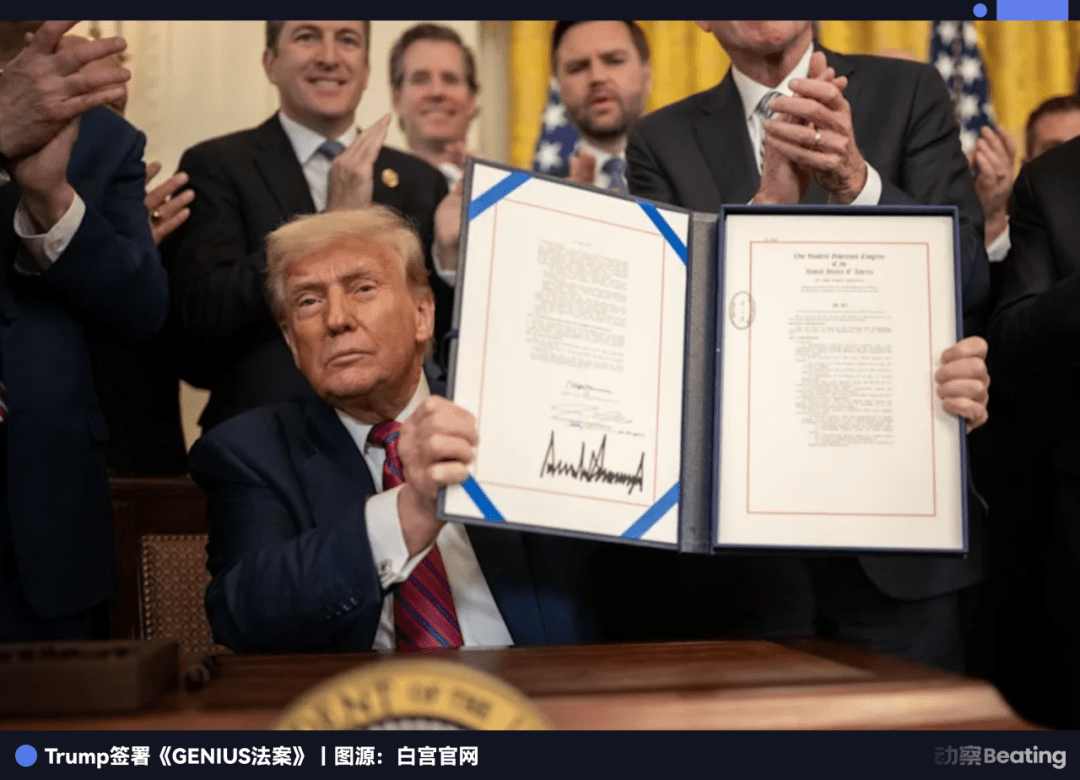
In June, Circle went public on the NYSE, with an IPO price of 31 USD, closing at 69 USD on the first day, with a market value approaching 20 billion USD, becoming the 'first stock of stablecoins.' In the same month, the U.S. Senate passed the GENIUS Act with 68 votes in favor, establishing a federal regulatory framework for stablecoins for the first time. The EU MiCA regulation came into full effect, and Hong Kong, Japan, and Singapore successively introduced licensing systems.
For the past decade, stablecoins have been in a gray area, with regulators lacking grounds for intervention. Now, when the transfer volume exceeds that of the largest global payment networks, no government can pretend not to see.
Data shows: 34% of adults in Turkey hold USDT to hedge against the depreciation of the lira; nearly 30% of remittances in Nigeria are completed through stablecoins; tech workers in Argentina commonly use USDC to receive salaries, bypassing domestic currency inflation. In these countries, stablecoins have become a de facto 'shadow dollar.'
The foundation of dollar hegemony is not the Federal Reserve's ability to print money, but the inertia of global trade being settled in USD. If stablecoins become the new generation of cross-border payment infrastructure, controlling stablecoins means controlling the dollar hegemony in the digital age.
This is the deep logic behind the Trump family's entry, and why the GENIUS Act was able to pass with rare bipartisan consensus: in Washington, stablecoins are no longer a niche topic in the crypto circle but a strategic resource related to national interests.
Imminent
$U's success is still uncertain. Its current circulating market value is negligible compared to USDT's nearly 200 billion and USDC's nearly 80 billion.
But it represents a new paradigm in stablecoin competition.
The competition in the 1.0 era is solitary: Tether established a monopoly with its first-mover advantage, Circle attempted to leverage compliance to penetrate the market, and Binance competed for pricing power through BUSD. The core question of competition is 'who can survive.'
The competition in the 2.0 era is about alliances. PayPal issued PYUSD, Ripple launched RLUSD, and Robinhood partnered with Galaxy Digital and Kraken to form the USDG alliance. Traditional financial giants, crypto-native players, sovereign capital, and political forces have all entered the arena.
The new core question has become 'who can bind more people together.'
$U's strategy is to achieve aggregation through 'nesting': not to be an enemy of any party, but to turn everyone into their 'underlying assets.' Binance's intention is to build a 'decentralized centralized' system: using aggregation architecture to disperse regulatory risks while maintaining control over the core ecosystem.
This battle among hundreds has no end. The regulatory balance is still wavering, the boundaries of technology are still expanding, and political variables are still accumulating.
The only certainty is that stablecoins have transitioned from being a supporting role in cryptocurrencies to a key infrastructure in the global financial system. An annual trading volume of 27 trillion USD is enough to make anyone who underestimates it pay the price.
Original link