

U.S. President Trump drew a red line on social media: anyone who disagrees with the view of not cutting interest rates when the economy is performing well will never become the chair of the Federal Reserve.
The game between the White House and the Federal Reserve has escalated again due to Trump's direct pressure. On December 10 local time, the Federal Reserve announced a 25 basis point cut to the target range for the federal funds rate to 3.5%-3.75%. This marks the third consecutive rate cut this year, with a total reduction of 75 basis points.
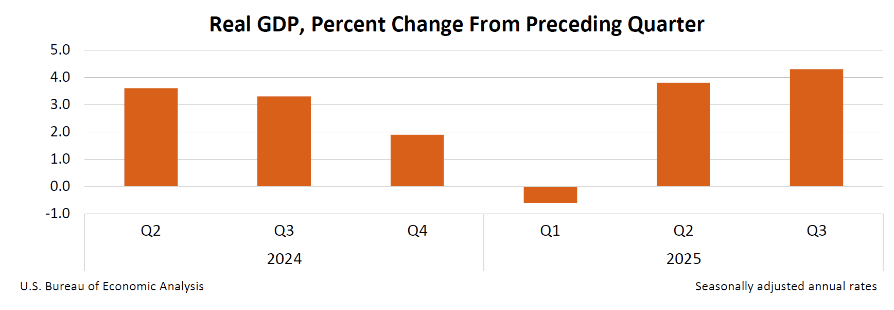
The next day, data released by the U.S. Department of Commerce showed that the U.S. gross domestic product grew at an annualized rate of 4.3% in the third quarter of this year.
In the face of unexpected economic growth and ongoing interest rate cuts, Trump criticized on social media: 'In the past, when there was good news, the market would rise; today, when there is good news, the market falls because everyone believes interest rates will be raised immediately to address “potential” inflation.'
 I. Latest Pressure
Since Trump's return to the White House, his conflicts with the Federal Reserve have rarely ceased. Recently, this dispute has become more specific and intense due to a news item and an economic data release.
● On December 23, the U.S. Department of Commerce released its initial estimates, showing that the U.S. GDP grew by an annualized rate of 4.3% in the third quarter of this year. This figure exceeds the expectations of most economists, indicating that the U.S. economy still maintains strong growth momentum.
● Just the day after the economic growth data was released, Trump again pressured the Federal Reserve on social media. He hopes the Federal Reserve will 'lower rates when the market performs well, rather than destroying the market for no reason,' and clearly stated: 'Anyone who disagrees with my views will never become the Federal Reserve Chair!'
● This is not Trump's first public pressure on the Federal Reserve. He has criticized Federal Reserve Chair Powell as 'terrible' multiple times and threatened to have Powell 'removed.' Trump believes Powell is too slow to cut rates, which does not align with his policy orientation of stimulating economic growth through low interest rates.
II. Pressure Hierarchy
Trump's pressure on the Federal Reserve is not a momentary whim but a layered progression, forming a complete political pressure system.
● The most public and direct form of pressure is the public opinion pressure, as Trump continuously criticizes the Federal Reserve's interest rate policy through social media and public statements. He has stated multiple times that even without rate cuts, the U.S. is doing well, but it would be better after a cut.
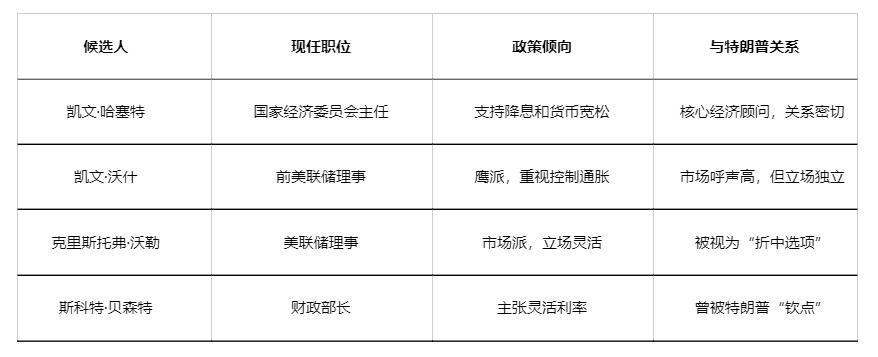
● A deeper level is the personnel layout. Trump has repeatedly expressed his intention to break recent market trends and is eager to nominate a chairperson committed to lowering borrowing costs. According to the Financial Times, Trump has narrowed the list of candidates to three or four, including former Federal Reserve Governor Kevin Walsh, Treasury Secretary Scott Basset, White House National Economic Council Director Kevin Hassett, and Federal Reserve Governor Christopher Waller.
● The most radical step is the legal challenge. According to the New York Times, Trump drafted a letter to dismiss Federal Reserve Chair Jerome Powell. Although Trump later denied this claim, the move is seen as the most direct challenge to the independence of the Federal Reserve in U.S. presidential history.
III. Political Differences
The game between the White House and the Federal Reserve has sparked polarized reactions in American politics, directly reflecting the deep contradictions within the U.S. economic governance system.
● Within the Republican Party, lawmakers in charge of financial and budgetary matters hold a distinctly reserved attitude towards this. Banking Committee member Tom Tillis clearly stated: 'Ending the independence of the Federal Reserve would be a huge mistake,' warning that if the chair were indeed dismissed, the Senate would 'respond quickly.'
● Democrats generally believe this move undermines the U.S. economic governance mechanism and international credibility, signaling a dangerous sign of 'political interference in finance.' Several Democratic senators have explicitly stated that Trump's actions undermine the independence of the Federal Reserve.
● Wall Street and the financial community have expressed widespread concern. Analysts from several financial institutions believe this move will lead to market volatility and may trigger investor concerns about the dollar and the credit of U.S. Treasury bonds.
IV. Economic Predicament
The current decision-making dilemma faced by the Federal Reserve stems from the contradictory situation of 'stagnation' and 'inflation' coexisting in the American economy.
● Strong growth contrasts with sticky inflation. The U.S. GDP grew by 4.3% in the third quarter, but inflation pressure has not eased. The Fed-preferred PCE index rose by 2.8% year-on-year in September, slightly below expectations but far above the 2% policy target.
● Meanwhile, signs of cooling have emerged in the job market. In October, the number of layoffs and dismissals by U.S. employers reached 1.854 million, the highest since January 2023. This combination of 'employment downturn + sticky inflation' has put the Federal Reserve in a dilemma between 'job preservation' and 'inflation control.'
● The voting results of the Federal Reserve's latest interest rate meeting also reflect this internal contradiction. Of the 12 voting members, 9 supported a rate cut, while 3 voted against it, marking the first time since September 2019. This 'stagflation-type' contradiction will long test policymakers, and the Federal Reserve's 'wait and see' stance may become a common choice for central banks globally, with policy response delays exacerbating market volatility.
V. Succession Competition
As Powell's term is set to end in May 2026, the competition for the next Federal Reserve chair has quietly begun.
Trump has narrowed the list of candidates to 'three or four.' Among the many potential candidates, several key figures have distinct characteristics:
● Kevin Hassett, as the Director of the National Economic Council, is Trump's core economic advisor and supports interest rate cuts and monetary easing.
● Kevin Walsh, former Federal Reserve Governor, is referred to in public opinion as a 'hawkish representative,' emphasizing the control of inflation and financial stability.
● Christopher Waller, currently a Federal Reserve Governor, has a policy stance leaning towards 'market-oriented' and is relatively flexible between tightening and easing, seen as a 'compromise option.'
● Scott Basset, the current Treasury Secretary, has a market-oriented style, advocating for flexible interest rates and fiscal coordination, and was 'appointed' by Trump.
The following is a comparison of the potential Federal Reserve chair candidates' policy stances:
Regardless of who ultimately receives the nomination, this new chair will face the immense challenge of finding a balance between political pressure and professional judgment.
The S&P 500 index rose for the fourth consecutive day after the GDP data was released and set a new historical high. This market reaction contradicts Trump's description of the 'good news being bad news' paradox, seemingly indicating that the market is self-regulating.
Trump stated in early December that he had narrowed the list of candidates for the Federal Reserve chair nomination to 'three or four' and expected to make a decision soon, with an announcement in 'the coming weeks.' Kevin Hassett and Kevin Walsh are considered the frontrunners for the position, while Christopher Waller has also been interviewed by Trump and received praise.
Join our community, let's discuss and become stronger together!
Official Telegram community: https://t.me/aicoincn
AiCoin Chinese Twitter: https://x.com/AiCoinzh
OKX benefit group: https://aicoin.com/link/chat?cid=l61eM4owQ
Binance benefit group: https://aicoin.com/link/chat?cid=ynr7d1P6Z