
Recommended reading for large capital ⬇️
Whale Club: Building a robust crypto trading system for large capital users
Are you always torn between whether to go long or short on this trade? Do you find yourself winning once and losing once, with your account always treading water?
Today, let's talk about a leap in thinking levels. For large capital, the core isn't 'betting on the right direction', but 'managing risk'.
While you are still struggling with whether the next K-line will rise or fall, professional players are already building a system that can reduce risk and smooth returns regardless of market fluctuations.
In this episode, I share the core principles of managing large funds—the art of hedging in trading frameworks. This isn't about slapping you in the face, but teaching you how to put a bulletproof vest on your main positions.
Hello everyone, I am Ha Ge. Today let's talk about something serious: why do your trades always offset each other, going nowhere?
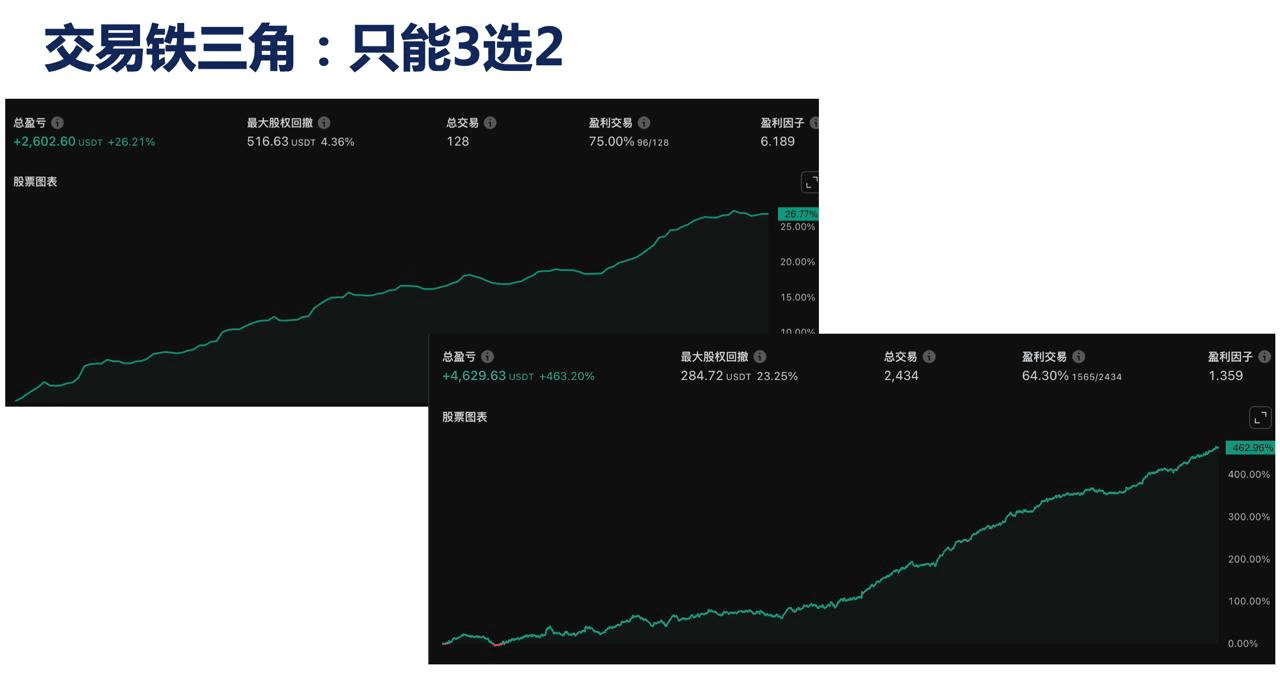
Because all your energy is spent thinking about a question that has no answer: 'Will it go up or down next?' You treat it as a true or false question.
But to me, this is a math and probability problem. Every trading framework I manage has a positive mathematical expectation in the long run and can make money.
But the key is that no framework is perfect. High win rates come with low risk-reward ratios; high risk-reward ratios come with low win rates. Letting them fight alone, your account will be on a roller coaster.
So, my solution is: don't let them fight alone, let them work as a team, protecting each other. This is called 'framework hedging.'
For example, my cornerstone strategy 'Fibonacci DCA' when going long, the cost is the intraday average price with a very high win rate. At this time, if the system issues a signal for 'counter-trend shorting.'
Ordinary people think: if the direction is opposite, I won't do it.
But my operation is: this short position must be taken.
I enter this short position not to guess the top, but for a more important purpose: to buy 'insurance' for that winning long position.
There are only three possible outcomes:
Eating both sides, making money on both ends, perfect.
Take profit on one side, stop loss on the other. The money lost in stop loss is the 'insurance premium' I willingly pay for this profit.
Both sides loss? Through calculations, the probability is extremely low, and total losses are strictly controllable.
So, retail investors think about profit and loss, while we think about risk exposure. Small funds seek a knockout blow, while large funds seek systematic stability.
Is your trading a bet, or are you running a controllable risk business?
I am Ha Ge, a trader who manages risk with mathematics. Tell me in the comments, have you ever bought 'insurance' for your trades?


