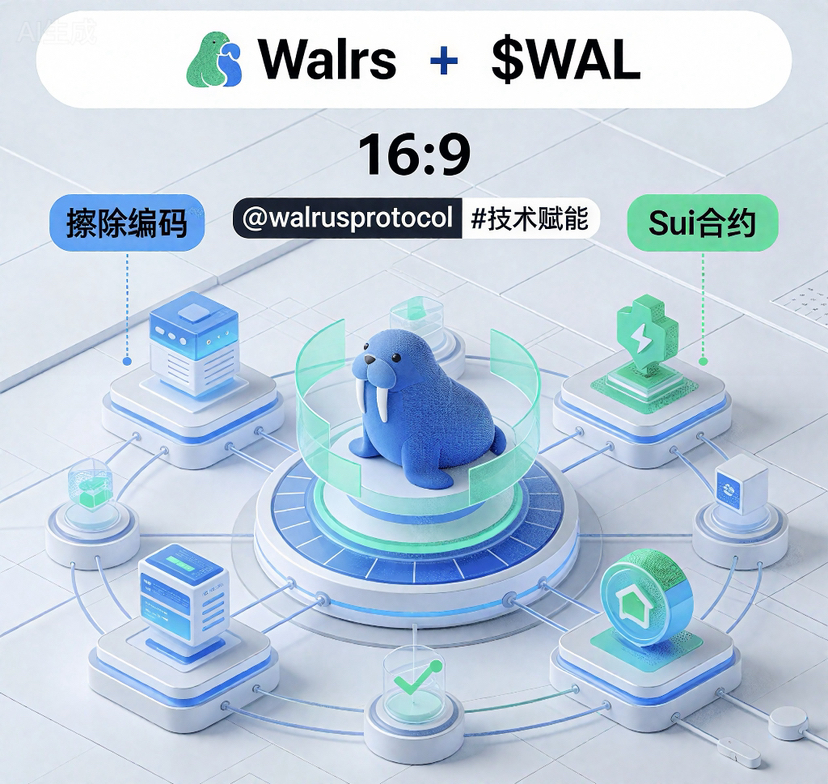
@Walrus 🦭/acc is currently one of the most closely watched infrastructures in the Sui ecosystem, and what makes it most attractive isn't the three words 'decentralized,' but rather—truly, the storage cost is much lower than other solutions. How does it achieve this? Let's do a quick introduction~~~~~~
💡① Use erasure coding instead of full replication
Traditional decentralized storage (such as early chain-based file storage) does something crude:
Replicate the file N times and distribute them across multiple nodes
→ Secure, but costs are skyrocketing
Walrus's approach:
Keep only the fragments that mathematically allow file reconstruction
→ Data security remains unchanged
→ Space usage drops significantly
📦② Blob storage, optimized for large files
Blockchain is inherently unsuitable for storing tens of MB or GB of data
Walrus directly splits files into blobs
Only location indexes are stored on-chain
Off-chain sharded storage
→ cheaper → faster → doesn't burden chain performance
$
🌐③ Data reuse & sharing incentives
If nodes in the Walrus network store popular data
Not only does it consume less, but it also earns more
→ The more active the ecosystem, the lower the cost
Reverse flywheel effect
⛽④ $WAL Used for payments and incentives
Users pay for storage
Node allocation rewards
Network costs are tied to contributions, achieving natural economic balance
📌 One-sentence summary
Walrus is not 'free storage', but rather cost-controlled, transparent, and scalable storage layer
For Web3, this is revolutionary progress
In the future, all chains may need solutions like Walrus
And it's currently leading the way 🚀