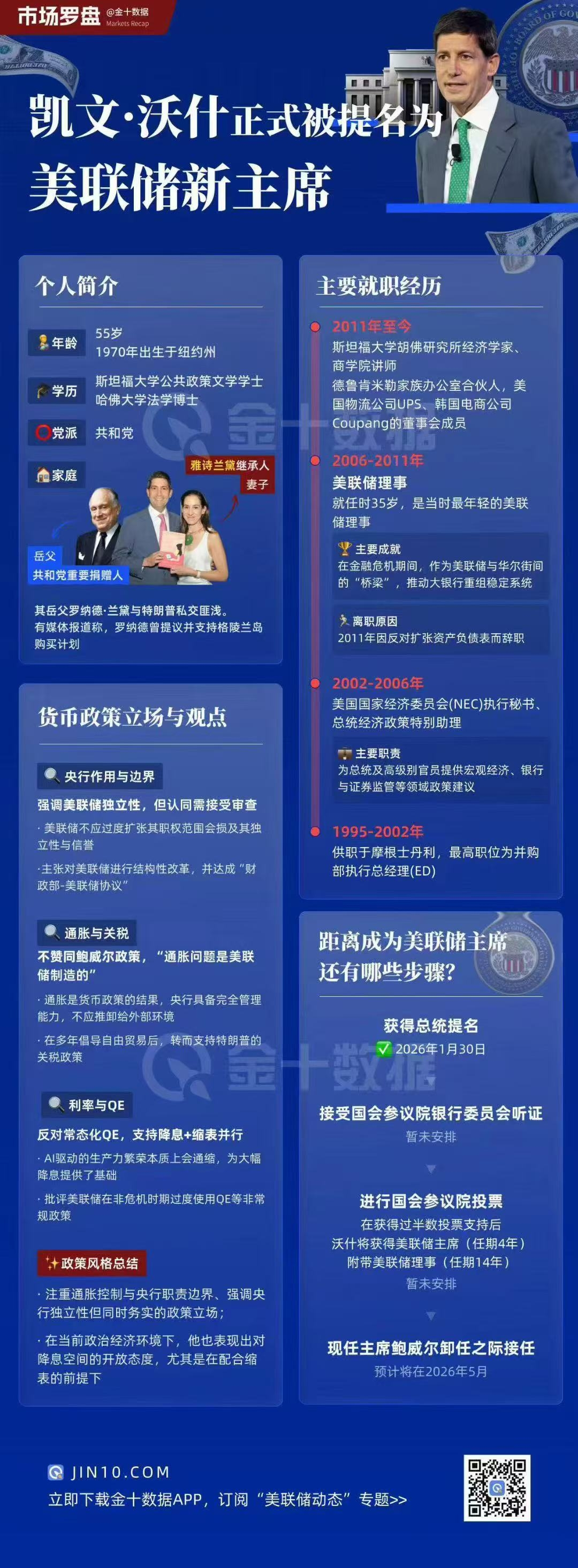
Trump just named Kevin Warsh as the next chairman of the Federal Reserve. I checked what kind of person Kevin is.
Simply put:
He is not the type of central bank official who just reads papers in an academic manner, nor is he a politician who only knows how to engage in political mudslinging. Instead, he is someone who has actually worked on Wall Street, made decisions in the White House, and endured the financial crisis at the Federal Reserve.
Warsh entered the Federal Reserve at 35, making him one of the youngest governors in history, right in the midst of the 2008 financial crisis. He experienced that round of QE, liquidity firefighting, and global central bank coordination firsthand; he is not a commentator who analyzes after the fact. This is very important—he has muscle memory regarding 'systemic risk' and 'market dislocation.'
After leaving the Federal Reserve, he didn't retreat into an ivory tower, but instead went to a family office with a hedge fund background, served as a director of a public company, taught at Stanford, and wrote articles at the Hoover Institution. In short, he has always stood at the intersection of the market front line and policy center.
Many people label him as 'hawkish', but that's not entirely accurate.
He indeed opposed unrestrained QE in his early years, criticized the Federal Reserve's balance sheet expansion and moral hazard, but in recent years he has clearly shifted: not to blindly trust models, not to engage in technocracy, and to emphasize policy transparency and market expectation management.
To put it simply:
Don't always fix the data after the fact; clarify the rules first.
Regarding crypto and Bitcoin, he is not part of the 'all in crypto' crowd, but within the Federal Reserve system, he already has a relatively open attitude. At least, he doesn't treat every new thing as a threat.
If he really takes the chair position, the biggest changes may not be 'immediate massive liquidity', but three points:
First, decisions are more market logic-oriented rather than academic models;
Second, the policy path is more predictable;
Third, sensitivity to liquidity and financial conditions will significantly increase.
In summary:
Kevin Warsh is not here to make a revolution, but he is likely here to correct course.
In a Federal Reserve system long dominated by technocrats, he may be the most 'trader perspective' candidate for chairman in recent years.
For the market, this itself is a huge variable.