

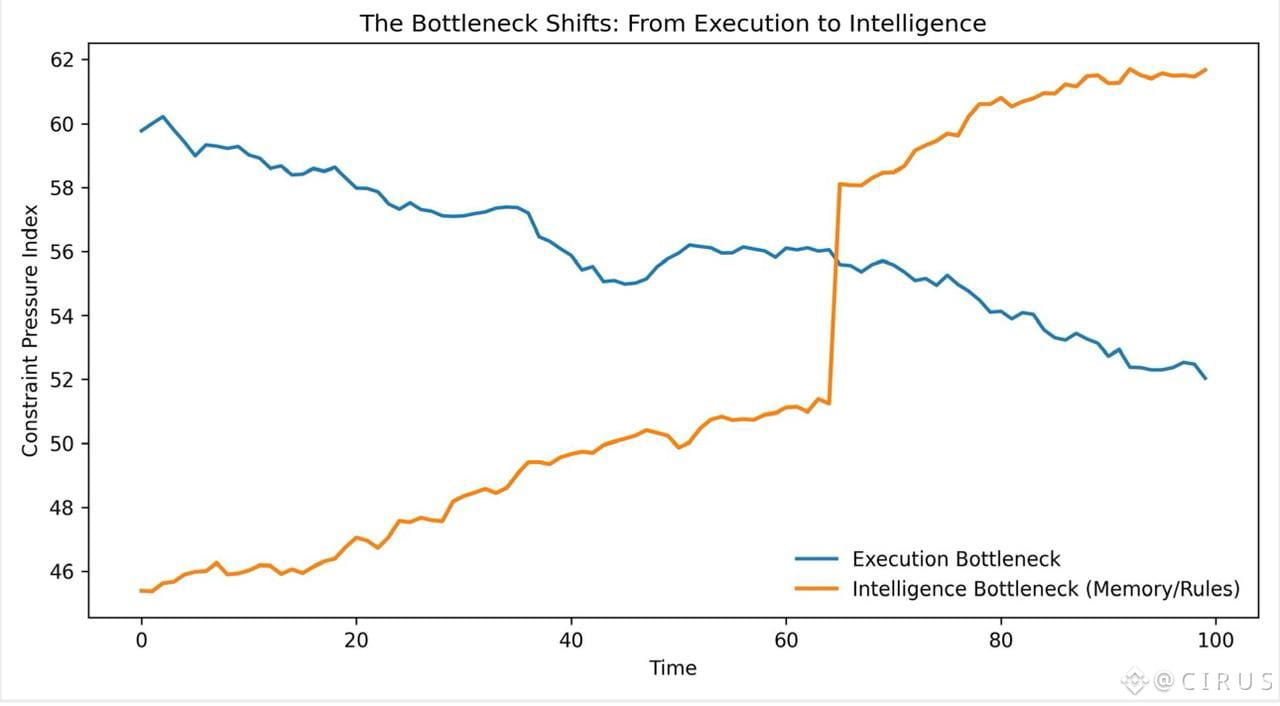
Most chains still behave like calculators. You give them an input, they produce an output, and they forget almost everything about the interaction the moment it’s done. That model worked when blockchains were mainly financial pipes: move tokens, execute swaps, settle trades. Speed and cost were the obvious constraints, so speed and cost became the obsession.
But the moment the primary users stop being humans and start being autonomous systems, that framing collapses.
This is the angle from which Vanar starts to make sense. VANAR is not trying to be a faster calculator. It is trying to become something closer to a manager: a system that can coordinate, remember, and enforce behavior across time.
Why AI Changes the Role of Infrastructure
AI agents don’t behave like wallets. They don’t show up, act once, and leave. They operate continuously. They learn from prior states. They adapt strategies. They coordinate with other agents. Most importantly, they need their environment to be consistent.
A fast but forgetful system is not helpful to an autonomous agent. An agent doesn’t just need execution; it needs continuity. It needs to know what it already did, what rules still apply, and what outcomes are locked in.
This is where VANAR diverges from execution-first chains. It treats the blockchain not as a transaction engine, but as a persistent coordination layer for intelligent actors.
Memory as Coordination, Not Storage
Memory in VANAR’s context is not just about storing data. It’s about preserving decisions. Most chains store facts: balances, contract state, logs. VANAR’s direction suggests something deeper: preserving the context in which actions happened.
For AI-driven systems, context is everything. An agent deciding what to do next needs to reference prior commitments, past failures, earlier signals, and historical constraints. If that context lives offchain, trust breaks. If it lives onchain but is expensive or fragile, systems degrade.
By treating memory as part of the core stack rather than an application hack, VANAR turns history into a shared coordination surface. Agents don’t just act; they act with awareness of the past, enforced by the same system that settles the present.
Reasoning Is About Boundaries
A common mistake is to equate reasoning with computation. Computation answers “can this be done?” Reasoning answers “should this be done now, under these conditions?”
Most blockchains only care about the first question. They will execute whatever logic fits the rules of the VM. VANAR’s angle is different. It is building toward systems where rules, constraints, and permissions evolve, and where agents must operate inside those evolving boundaries.
That matters because autonomous systems without boundaries don’t scale. They either conflict, loop, or exploit unintended paths. Reasoning layers allow systems to interpret state, not just process it. They turn raw execution into governed behavior.
In this sense, VANAR is less about raw intelligence and more about structured intelligence. Intelligence that can be audited, constrained, and coordinated.
Enforcement Turns Intelligence Into Reality
An AI agent can reason perfectly and still be useless if its outcomes are not enforced. Offchain systems rely on APIs, centralized servers, or legal agreements to enforce decisions. Onchain systems must enforce outcomes cryptographically.
VANAR treats enforcement as inseparable from intelligence. Rules are not advisory. If an agent violates constraints, the system responds. If an outcome is finalized, it cannot be quietly reversed. This gives autonomous behavior weight.
Without enforcement, AI remains experimental. With enforcement, it becomes operational.
A Chain Designed for Non-Interactive Users
Most blockchains assume interaction. A human signs a transaction. A user confirms an action. A UI explains what happened. VANAR implicitly assumes a different user: software that never sleeps and never clicks “confirm.”
That assumption changes priorities. Predictability beats flexibility. Consistency beats optionality. Stable behavior beats peak performance. An agent does not care about novelty. It cares about reliability.
This is why VANAR doesn’t frame itself around raw speed. Execution that is fast but inconsistent is worse than execution that is slightly slower but stable. For autonomous systems, variance is risk.
$VANRY as a Coordination Cost
Seen through this lens, $VANRY is not just a gas token. It is the cost of coordination. Every action an agent takes—storing memory, reasoning over state, triggering enforcement—consumes shared resources.
As systems scale, this cost scales with them. Demand for the token grows not because people speculate on narratives, but because intelligent systems keep running. That is a very different demand profile from most crypto assets.
It also aligns incentives. Operators, builders, and agents are all economically exposed to the health of the same system. Short-term extraction becomes less attractive when long-term coordination is the primary value.
Why This Angle Matters
The future of onchain systems is not just more users. It is different users. Autonomous agents, DAOs with persistent memory, AI-driven services that operate continuously and interact with each other.
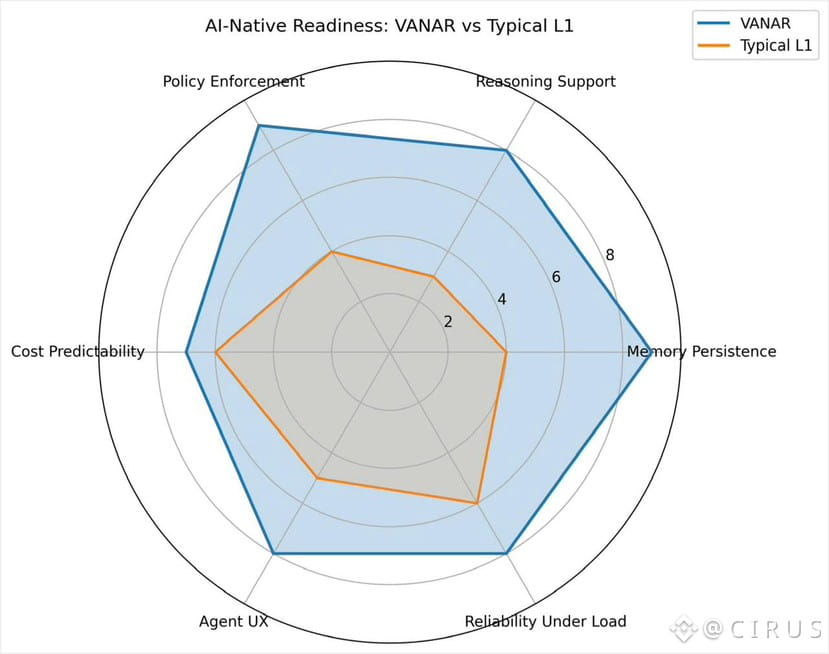
Infrastructure built only for execution will struggle in that environment. Infrastructure built for coordination will not.
VANAR’s bet is that blockchains are evolving from engines into environments. From places where things happen once into places where systems live over time.
Closing Perspective
Execution was the bottleneck when blockchains were tools. It stops being the bottleneck when blockchains become habitats.
VANAR is positioning itself as a place where intelligence can persist, reason, and act with consequences. Not faster for the sake of speed, but structured enough to support systems that don’t rely on humans to babysit them.
If AI agents are going to be real economic actors, they will need more than execution. They will need memory, boundaries, and enforcement.
That’s the problem VANAR is actually trying to solve.
