
1. Why do we say it will drop further? (Historical Patterns)
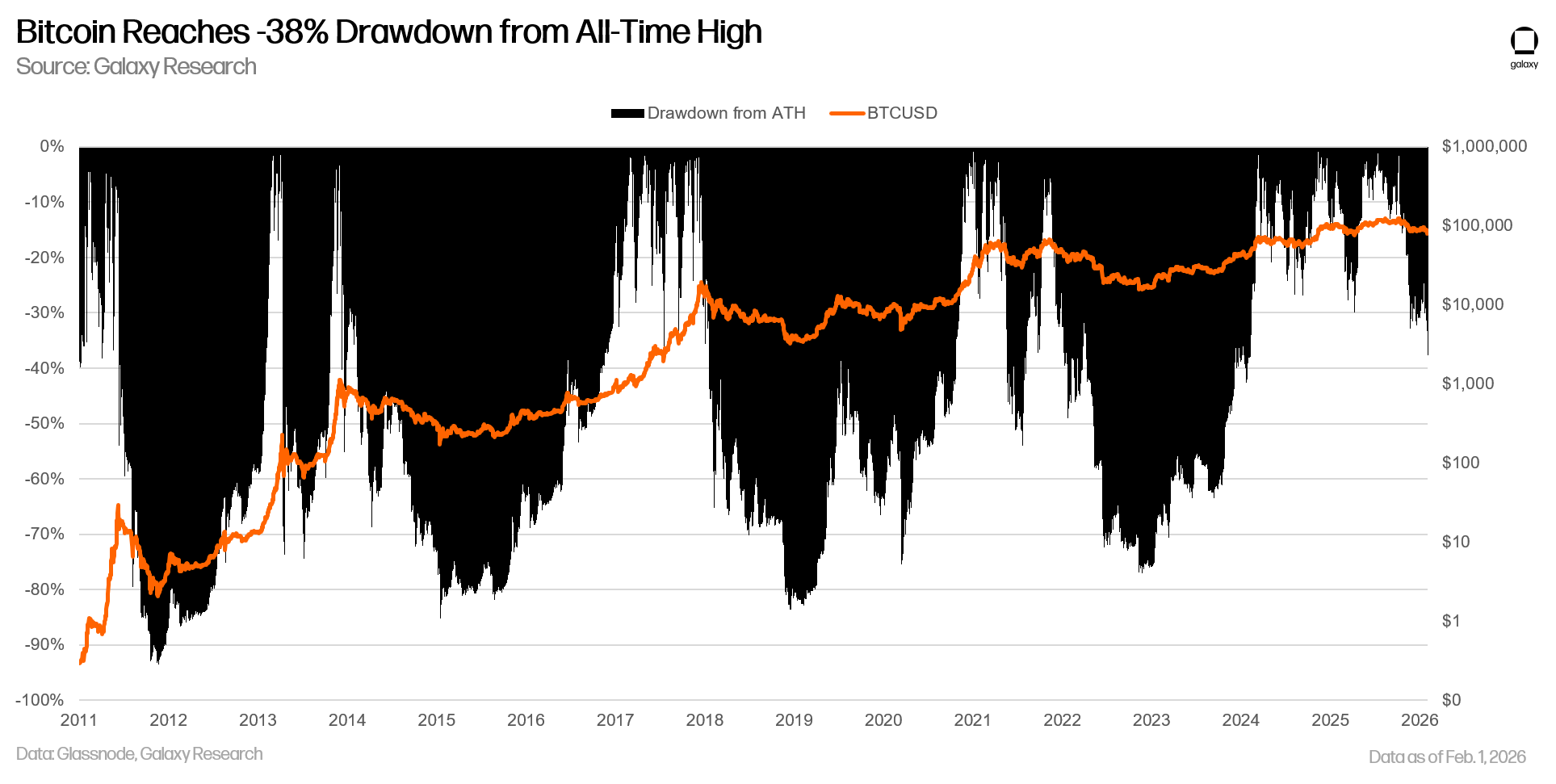
Currently, Bitcoin has dropped by 38% from its historical high of 126,000 in October 2025.
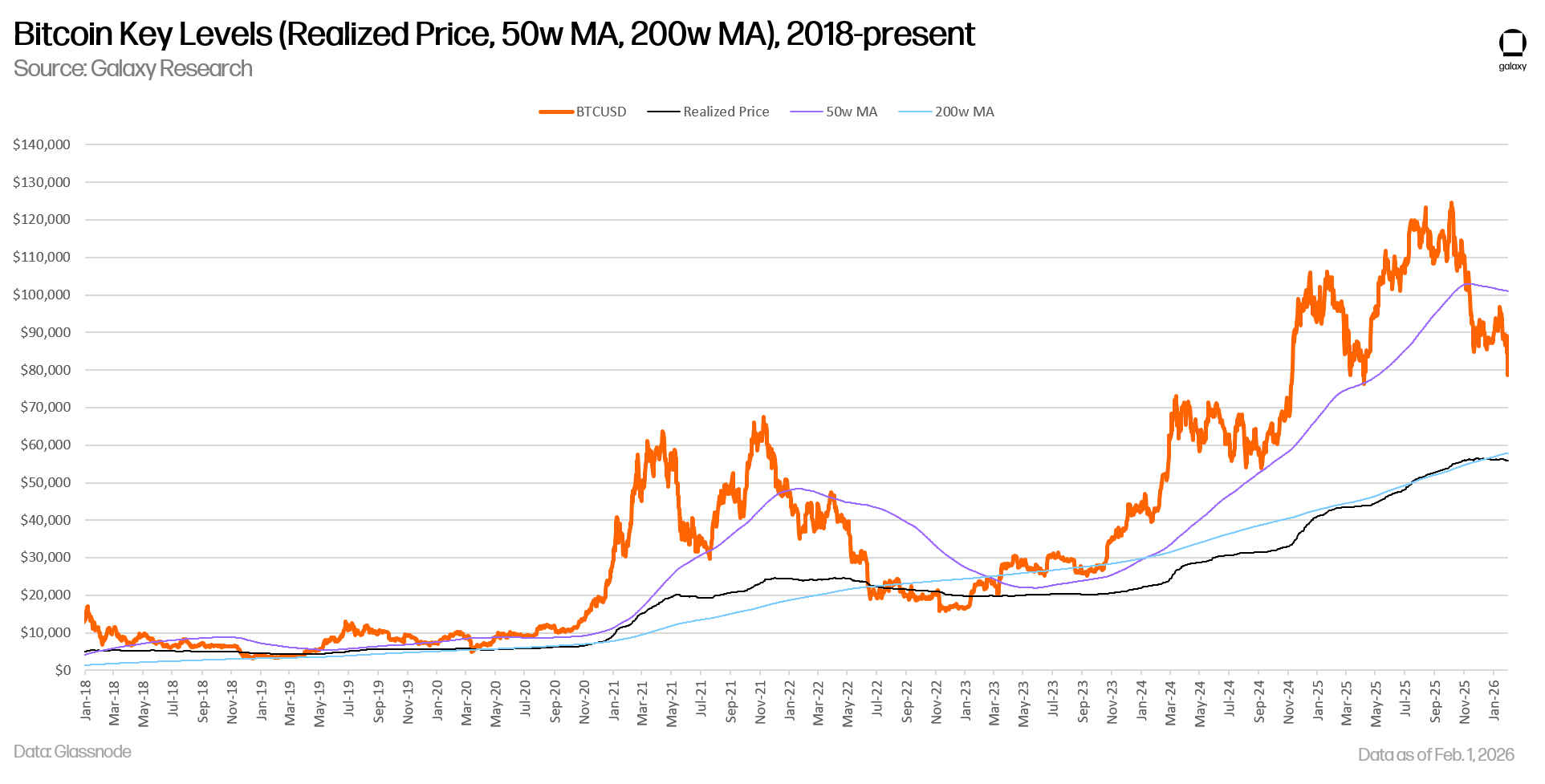
In previous bull markets (2013, 2017, 2021), the 50-week moving average was a lifeline; once it was broken, it usually fell to the 200-week moving average for support.
The current situation is: the 50-week moving average was broken back in November last year, and the 200-week moving average is waiting at $58,000.
2. ETFs are all losing money
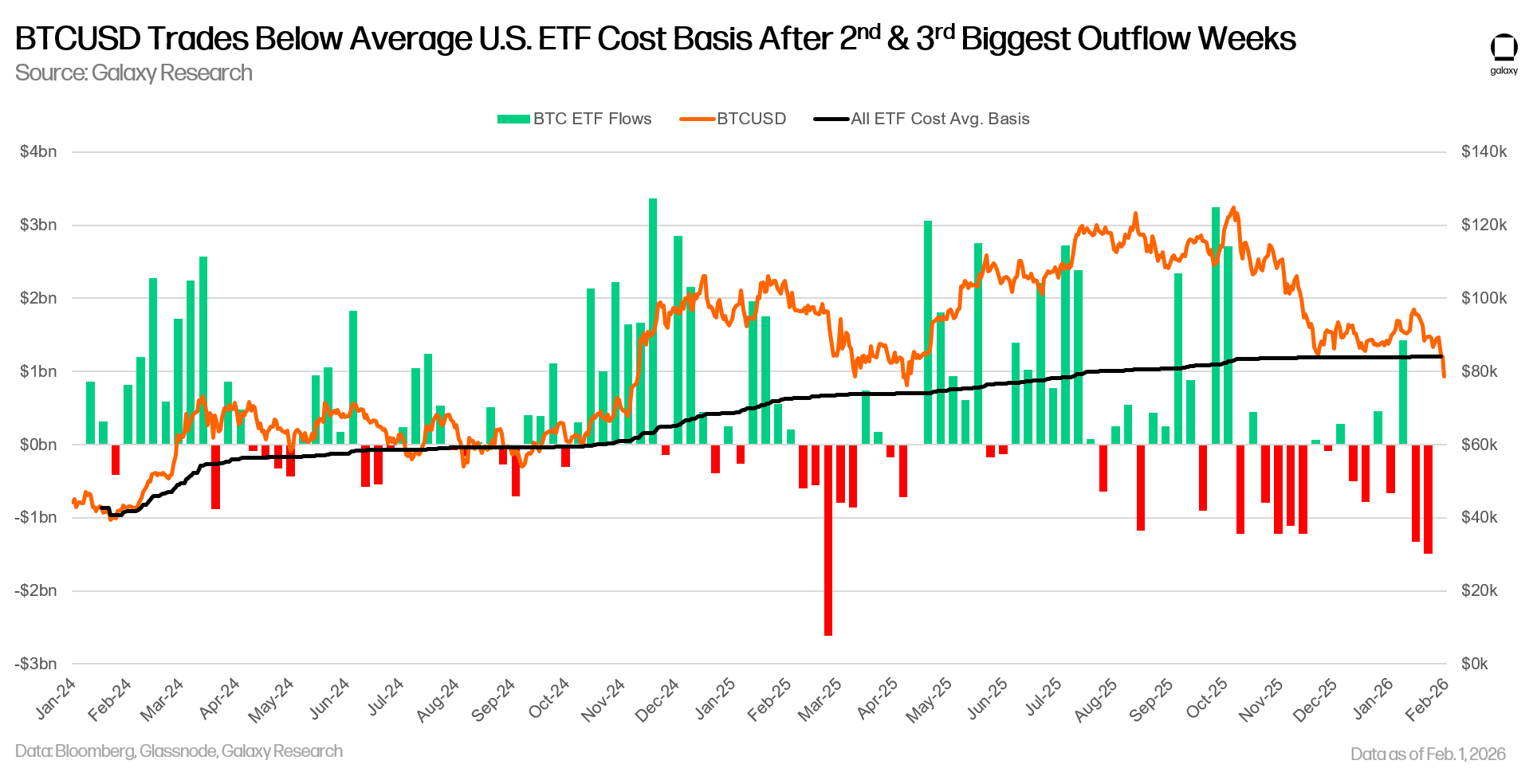
The Bitcoin ETFs in the U.S. were once glorious, attracting $54 billion. However, in the past two weeks, there has been a serious withdrawal, with $2.8 billion flowing out.
The most awkward part is that the average buying cost for ETF users is $84,000. The current market price is far below this number, and everyone is holding underwater positions. This $84,000 may become a heavy resistance level (people want to run as soon as they break even).
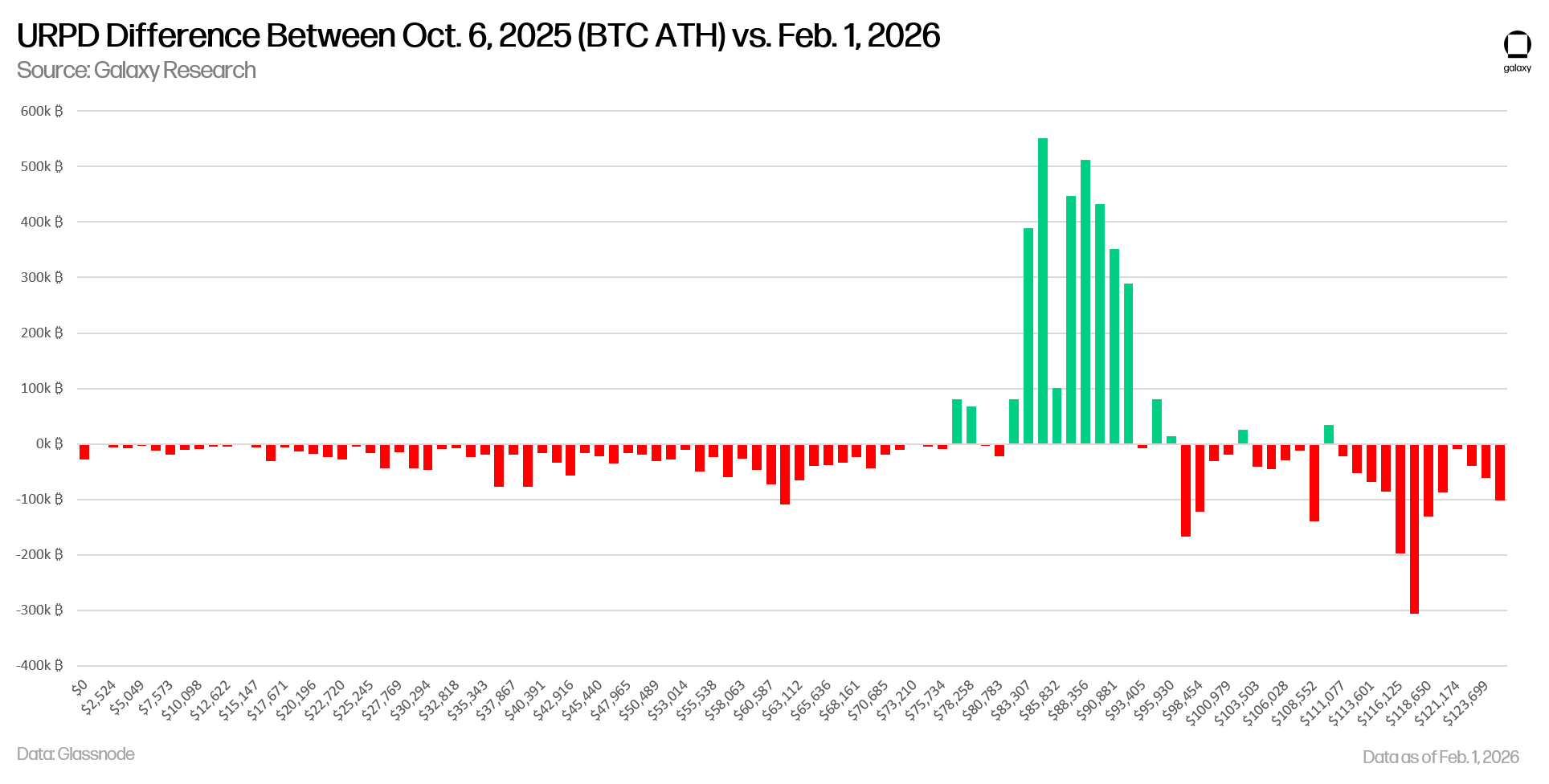
3. Chip vacuum area (70,000-80,000).
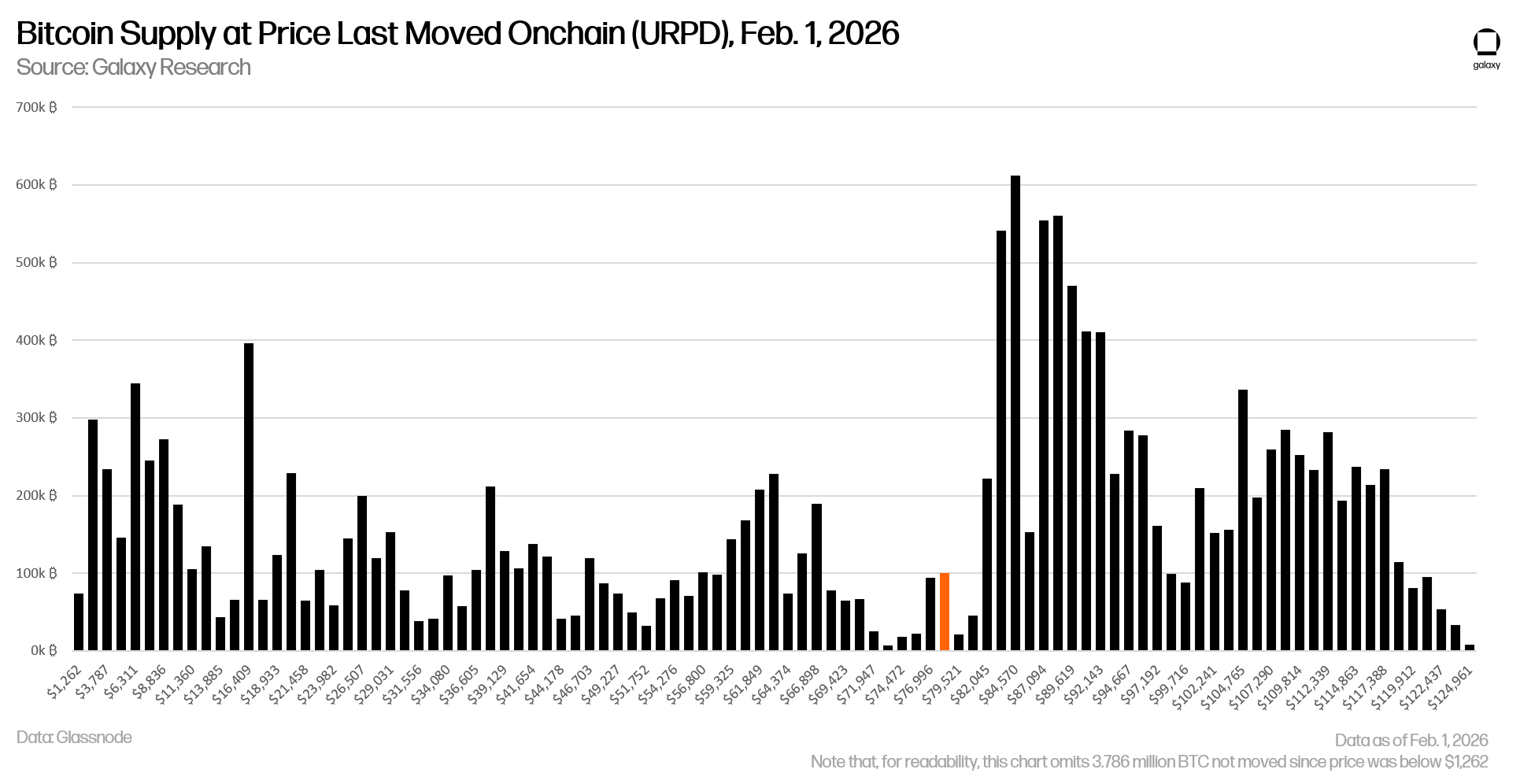
Looking at on-chain data, in the range of $70,000 to $80,000, there has historically been very little turnover (either it skyrocketed through or plummeted through). This means there is no strong support in this range, and the price can easily slide directly to the bottom of $70,000.
Most of the selling pressure comes from those who bought at $80,000 to $92,000, as well as those who bought above $110,000.
4. The profit-loss ratio is approaching the critical point.
Currently, 56% of the coins are profitable, and 46% of the coins are at a loss.
Historical experience tells us that when the ratio of profits to losses approaches 50/50, it usually signifies the bottom of a bear market. We are now very close to this ratio.
5. Is 'digital gold' failing?
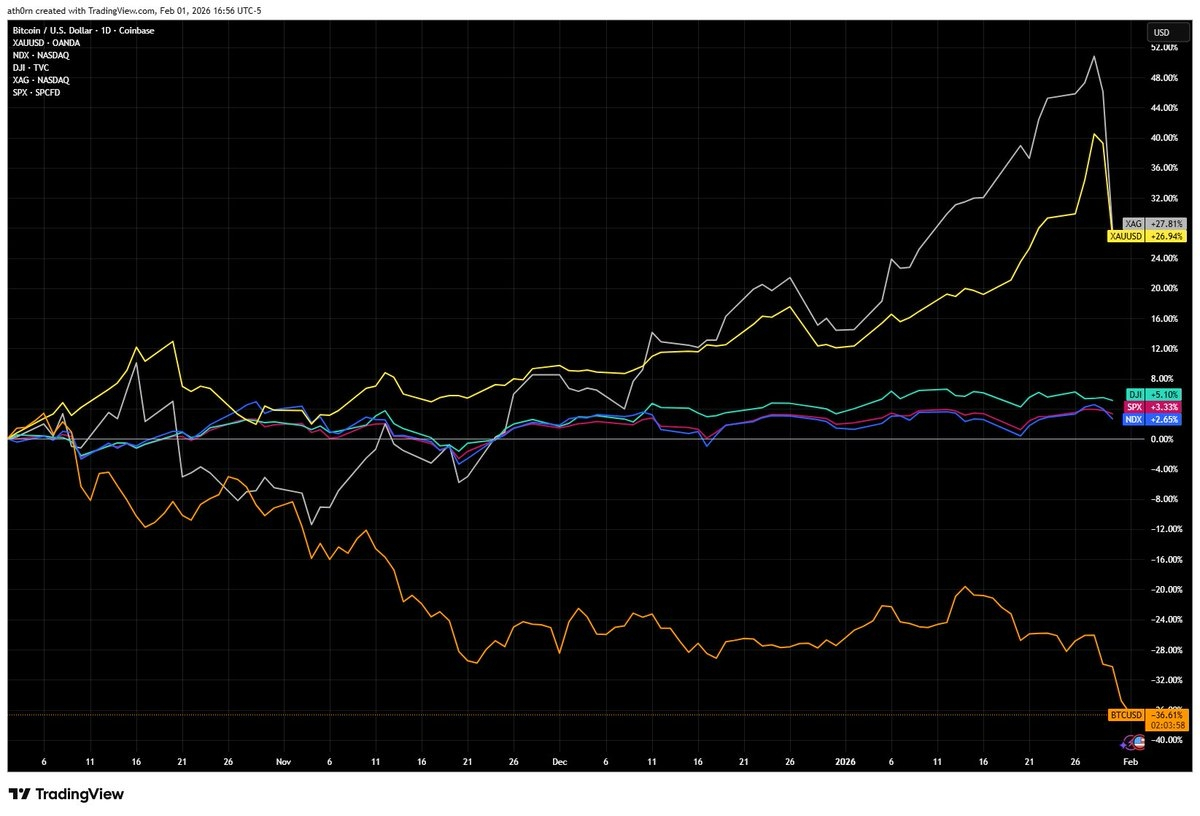
Since the fourth quarter of last year, the global situation has been turbulent, with tariffs and debt crises everywhere. This was supposed to be the time for Bitcoin to shine, but it has disappointed. Funds are more willing to buy traditional gold, silver, and commodities. In chaotic times, everyone seems to have temporarily forgotten Bitcoin's 'hedge attribute.'
6. The only consolation: veterans are not selling off.
In the past two years, long-term holders (those who have held coins for a long time) have been cashing out frantically, selling an average of $500 million daily.
But recent data shows that this sell-off has finally stopped. Although they haven't started buying back yet, at least they are not selling, which is an important signal for the market to build a bottom.
Market outlook.
The current situation is very clear: the trend is downward, and after losing $80,000, there is weak support below.
Although we have not yet seen signals of large funds entering to buy the dip, fortunately, the force of the sell-off is also weakening. In the coming weeks or even months, if Bitcoin really drops towards $56,000 - $58,000 (around the 200-week moving average), based on historical experience, this presents an excellent opportunity for long-term investors to enter.
(Note: This report is for clients from Galaxy Digital and is for reference only; it does not constitute investment advice.)
Speaking of good projects, Snow King recommends one.@Vanarchain a good project.
$VANRY: Rejecting 'patch-style' narratives, defining a truly AI-native public chain.
In the year 2026, where Web3 and AI are deeply intertwined, the market has long been tired of new L1 infrastructures that rely solely on TPS to tell stories. The true competitive advantage is shifting towards an 'AI-first' underlying architecture. Vanar Chain, with its core token $VANRY, is becoming the leader in this technological paradigm shift.
1. Reconstructing from the ground up: AI native vs. patch-style AI.
Traditional blockchains attempt to 'piece together' AI functionality through external interfaces, which has inherent flaws in response speed and data consistency. The core logic of Vanar Chain is that: AI must be native. * Technology readiness: $VANRY is not chasing trends but has built a smart stack that includes native memory, reasoning, and settlement capabilities.
myNeutron and semantic memory: Through myNeutron, Vanar has proven that AI's persistent context can exist at the infrastructure level, allowing AI agents to have 'memory.'
Kayon and on-chain reasoning: Kayon has achieved transparency and interpretability in the reasoning process, transforming the black-box logic of AI into verifiable behaviors on the chain.
2. Cross-chain integration: Unlocking the scale growth of the Base ecosystem.
The vitality of AI lies in its liquidity. $VANRY is no longer isolated within a single network; by achieving cross-chain availability in mainstream ecosystems like Base, Vanar's AI technology stack can reach millions of new users. This liquidity not only increases the actual usage rate of the token but also positions Vanar as the 'smart brain' of full-chain AI applications.
3. Payment: The last piece of the puzzle for AI agents.
The future on-chain entities will be AI agents. They do not need complex wallet UX but require compliant and automated settlement tracks. Vanar's Flows module transforms intelligence into secure execution, combined with the global settlement capabilities of $VANRY, completing the loop from 'concept demo' to 'real economic activity.'
Core viewpoint: While the market is still debating scaling solutions, $VANRY has already completed full readiness from infrastructure to intelligent execution layers. This is not just a narrative shift but a fundamental reshaping of financial settlement and reasoning logic in the AI era.