


The bedrock of the US economy—the American consumer—is showing signs of deep psychological fatigue. A closer look at demographic data reveals that the erosion of consumer confidence is not an isolated event; it is a broad-based, multi-generational decline. From retirees on fixed incomes to prime-age workers navigating a complex economy, pessimism is taking root, driving confidence indices to multi-year lows across almost every major age cohort.
❍ The Core Consumer Retreats: Gen X and Baby Boomers
The most significant deterioration in sentiment is occurring among the generations that control a vast portion of US wealth and spending power.
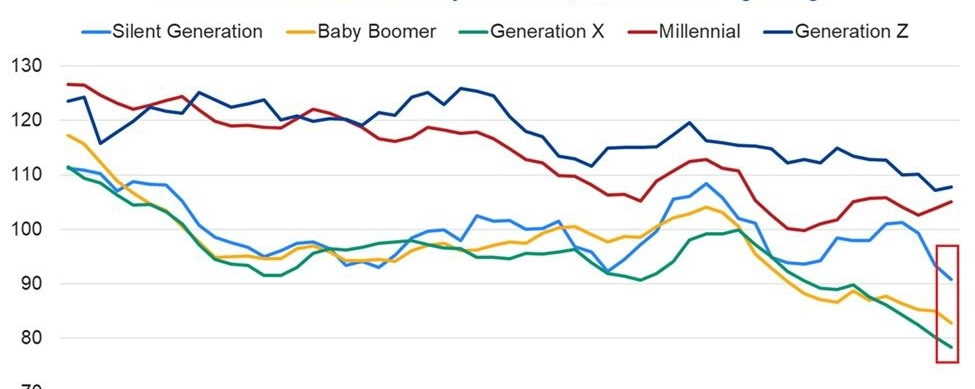
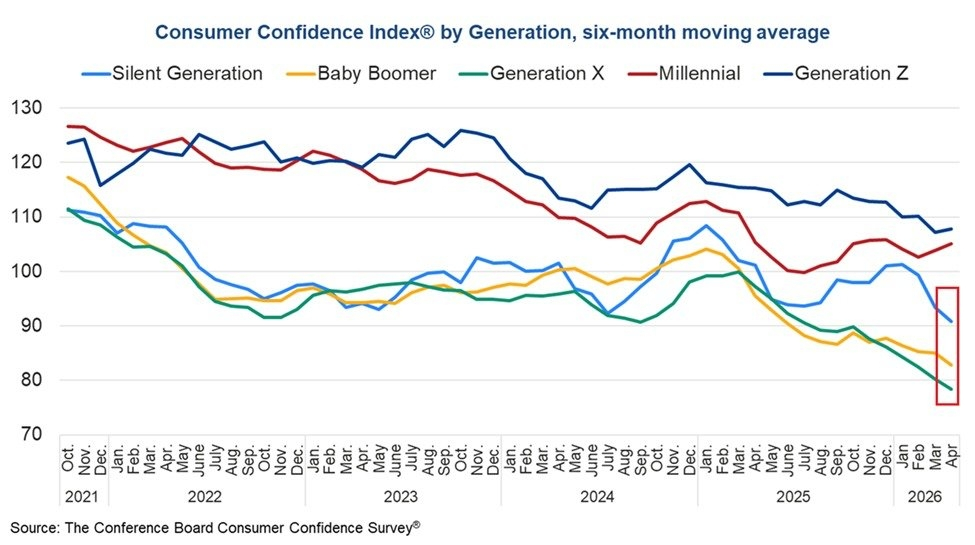
Gen X Hits the Floor: The 6-month average of the Consumer Confidence Index for Generation X has dropped to ~78 points. This represents a severe deterioration, marking the lowest level recorded in at least 4.5 years.
Boomers Turn Bearish: Similarly, the gauge for Baby Boomers has fallen to ~83 points, hitting its lowest point since at least October 2021.
A Sustained Downtrend: This is not a sudden reaction to a single economic data point. Confidence readings for both of these critical age groups have been in a steady, unyielding decline since early 2025.
❍ The Extremes: Silent Generation and Gen Z
The pessimism extends to the oldest and youngest participants in the economy, albeit with slight variations in the data.
Silent Generation Squeezed: The Consumer Confidence Index for the Silent Generation has dropped to ~91 points, matching the broader trend by hitting its weakest level in at least 4.5 years.
Gen Z's Muted Rebound: Generation Z presents a minor anomaly. While their index rose slightly in April to ~110 points, the broader context remains negative. Despite this recent uptick, Gen Z's confidence remains trapped below its historical 2021-2025 range, indicating that younger Americans are still fundamentally uneasy about their economic prospects.
Some Random Thoughts 💭
This generational sweep of declining confidence tells a compelling macroeconomic story. For Gen X and Baby Boomers—groups deeply concerned with retirement accounts, healthcare costs, and preserving accumulated wealth—the compounding effects of sticky inflation and high interest rates over the last few years are clearly taking a psychological toll. The Silent Generation, largely reliant on fixed incomes, is predictably feeling the pinch of diminished purchasing power. Even Gen Z, who might be benefiting from strong nominal wage growth in entry-level roles, realizes that the dream of affordable homeownership and debt-free living is slipping further away. When confidence erodes this systematically across age brackets, it usually acts as a leading indicator for a broader pullback in discretionary consumer spending.