

With holders who’ve been holding since Bitcoin’s early days, it’s more accurate to focus on what’s happening on the active supply side instead, notably through the True Market Mean.
This indicator provides the average price of active BTC, meaning it excludes from the count all coins that haven’t moved in a very long time, since their valuation basis no longer has anything to do with today’s valuations, and since they are partly lost BTC, they end up being illiquid.
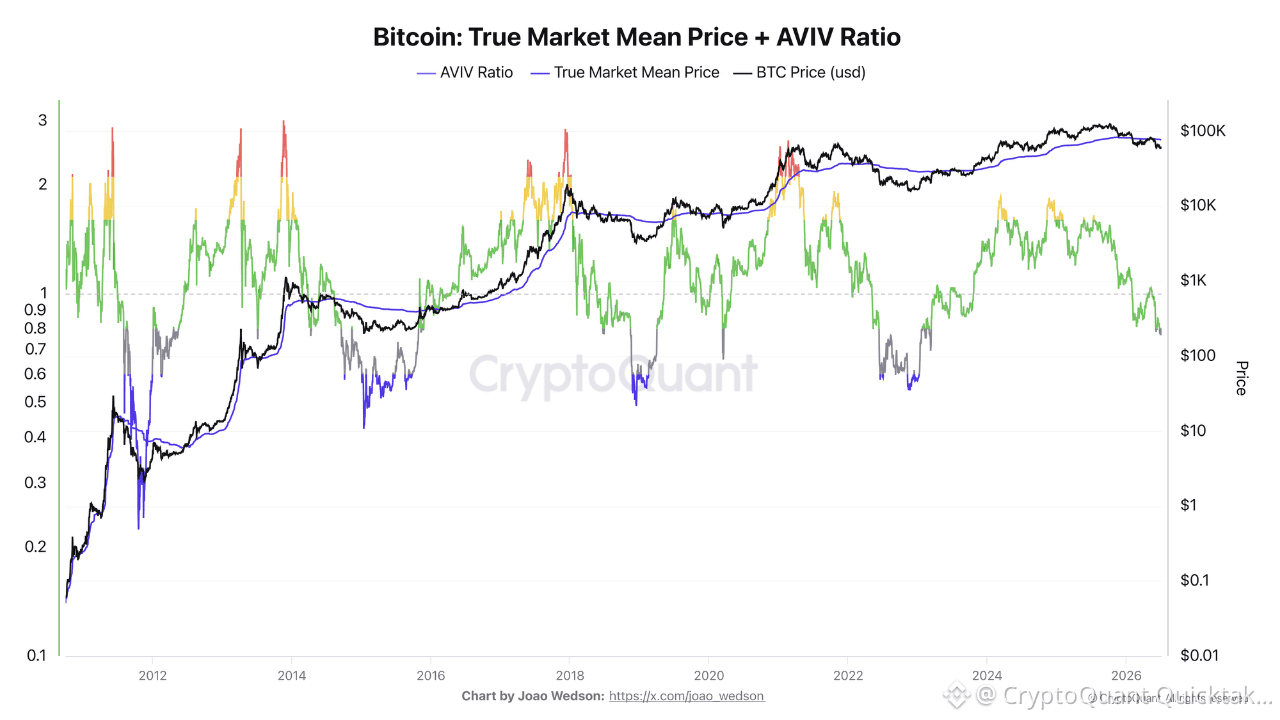
Currently the TMM is estimated at around $76,700 and acts as resistance, as we saw in May when many investors seemed to prefer exiting the market without a loss rather than continuing to hold.
Combined with the AVIV ratio (Active Value to Investor Value), which reflects the current market valuation relative to this cost basis of the active supply (TMM).
It’s currently hovering around 0.8, a devaluation zone meaning this active cohort is on average at a 20% loss.
This is starting to be significant but isn’t yet equivalent to previous bear markets where this ratio reached 0.5-0.6, or losses of around 40%-50%.
I’d be tempted to say we don’t necessarily need to reach such a devaluation for BTC to bounce back, especially given the adoption BTC has seen this cycle.
That said, nothing so far contradicts its cyclicality, even the arrival of institutions and ETFs hasn’t changed anything, no matter how many billions of dollars were injected, BTC still dictates its own rules, and for now we owe it to ourselves to at least stay humble in the face of that.
Written by Darkfost