
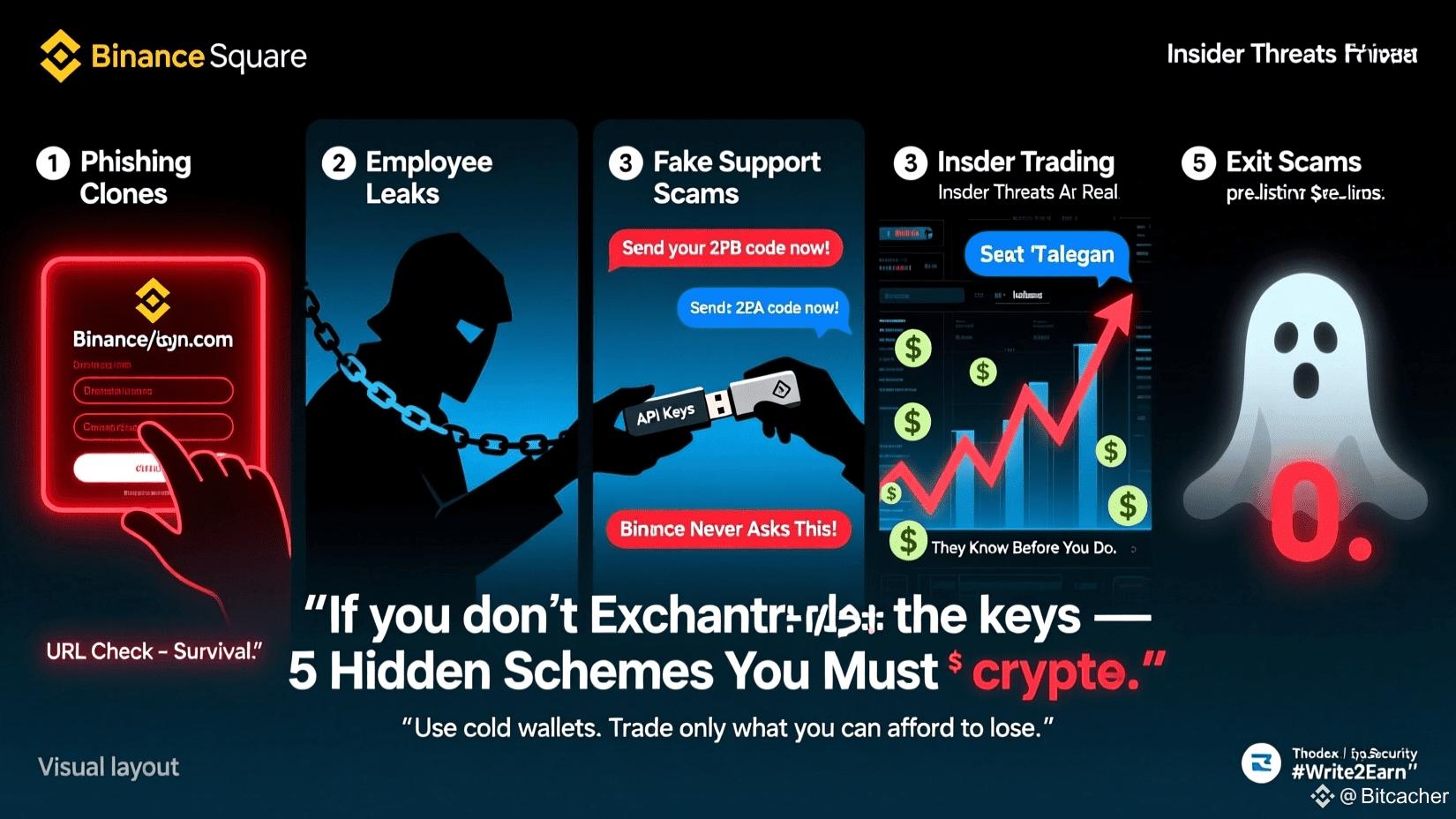
A cryptocurrency exchange is not a bank. Even giants like Binance, Coinbase, or Kraken do not provide guarantees of absolute security. Hackers, insiders, fake support — all of this is reality, not just scare stories. And while you think that 'nothing will happen on a large exchange', someone is already losing funds.
Here are 5 schemes that actually work — and ways not to become their victim.
❌ Scheme 1: Phishing through website and app clones
🔍 How it works:
Fraudsters create an exact copy of the Binance website — for example, binance-login.com. You enter your username and password, thinking everything is fine. A minute later — access to your account is already theirs.
📊 According to Chainalysis, in 2023 more than 30% of all crypto thefts are phishing.
✅ How to protect yourself:
- Check the URL manually
- Enable 2FA via Google Authenticator (not SMS!)
- Never click on links from emails and chats
❌ Scheme 2: Data leak from employees
Yes, it happens. In 2022, a Binance employee leaked client data to hackers. In 2023 — API key leak on KuCoin. This is not a bug — it's a human factor.
🕵️ What can be stolen:
- Email and phone numbers
- Transaction history
- Sometimes — even private keys (if you use Web3 wallets within the exchange)
✅ How to protect yourself:
- Don't keep all funds on the exchange
- Use a separate email
- Change passwords regularly
❌ Scheme 3: Fake 'support' on Telegram and Twitter
You write to Binance support — a 'agent' responds. Asks for API key, 2FA code or 'confirm transaction'. In 2 minutes — the account is empty.
⚠️ Binance never asks for:
- Passwords
- 2FA codes
- Private keys
- API keys with withdrawal rights
✅ Rule:
Any request for such information = 100% scammer.
❌ Scheme 4: Insider trading
Employees of exchanges know in advance which tokens will be listed. They buy them before the announcement and then sell for a profit of 10–100x. This is not hacking, but it is exploitation of trust.
✅ How not to get caught:
- Don't buy tokens 'on hearsay'
- Study projects before listing
- Don't believe promises of 'guaranteed growth'
❌ Scheme 5: Ghost exchanges and exit scams
Some 'exchanges' are just pretty websites. After a few months, they disappear along with your funds. Example: Thodex (2021) — $2 billion vanished, the founder disappeared.
✅ How to check an exchange:
- Is there a license (EU, USA, UAE)?
- How long has it been operating?
- Is there a security audit (CertiK, Hacken)?
- Don't register on little-known platforms without verification
🔒 The main rule:
> If the keys are not with you — the crypto is not yours.
> An exchange is a tool, not a storage.
Keep major assets in cold wallets (Ledger, Trezor). On the exchange — only what you are ready to trade today.
Thefts on exchanges are a daily reality. But 90% of cases can be prevented if you know the schemes and follow basic security hygiene.
👉 Have you encountered scammers? Write in the comments — your experience may save others.
👍 Is the article helpful? Share and like it — let the algorithm show it to those at risk.