
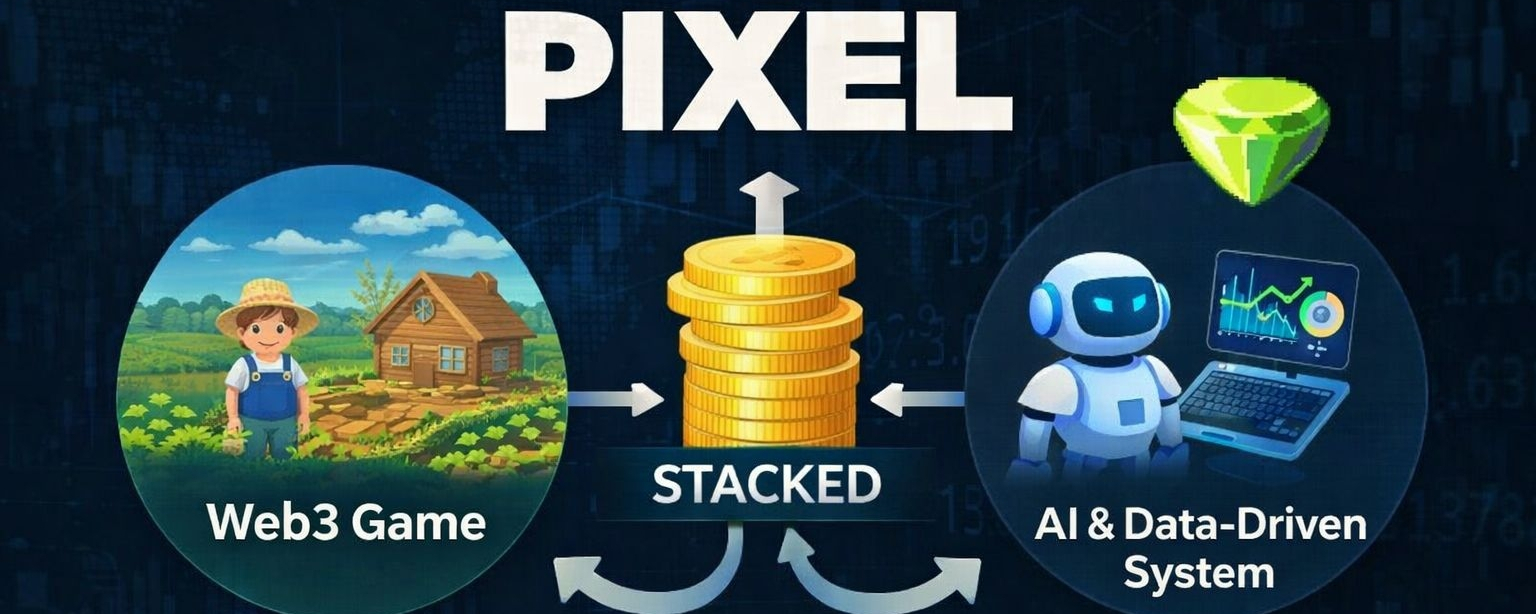

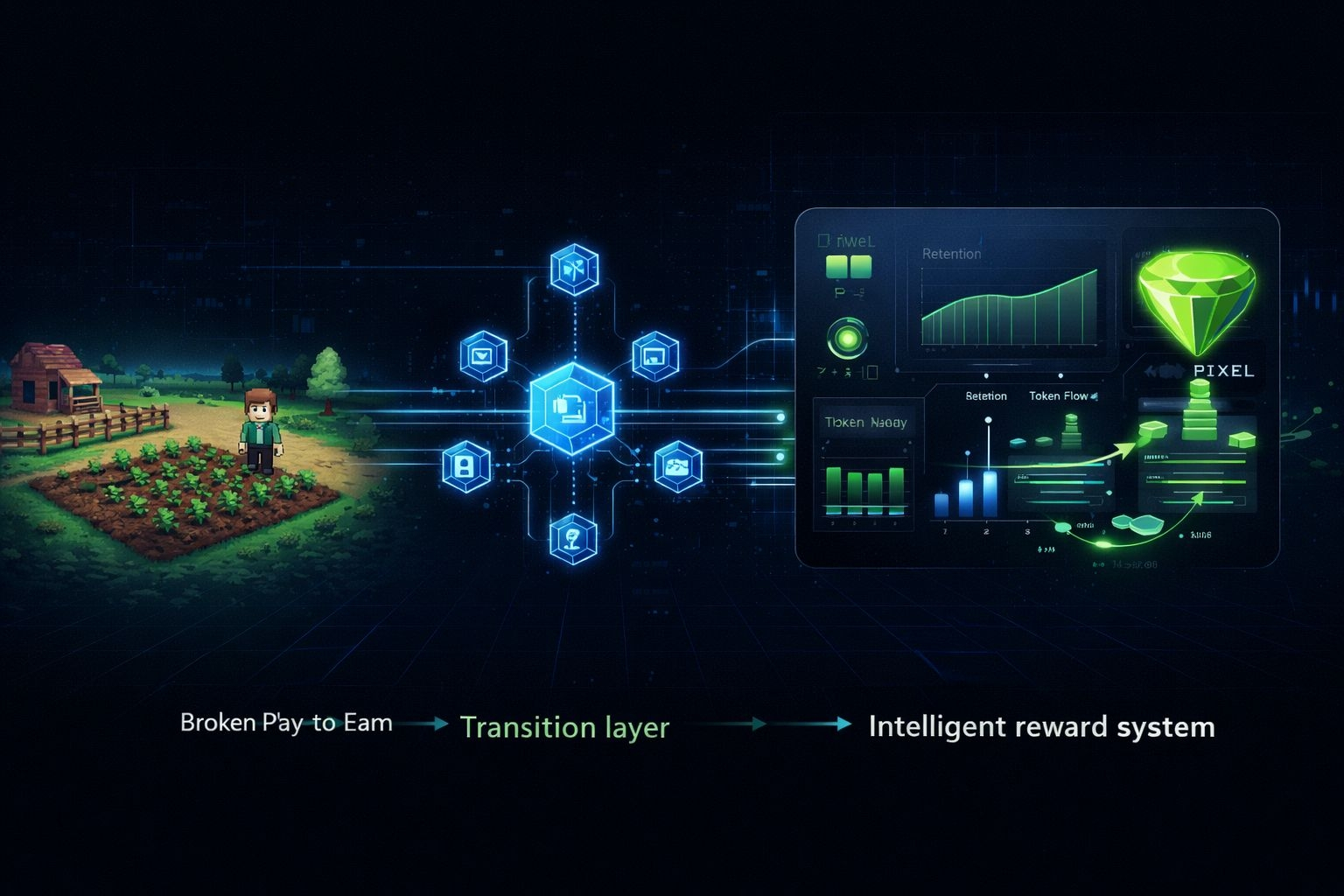
 I used to think Pixels was just another Web3 game… until I understood what they were actually building behind it.
At first glance, it looks simple.
Farming, exploration, a casual open-world experience the kind of thing you’ve seen before in Web3 gaming. And if you’ve been around long enough, you’ve probably also seen how most of these play-to-earn models end.
Initial hype → user growth → token inflation → bots → economy collapse.
That cycle has repeated so many times that I’ve honestly stopped paying attention to most “reward-based” games.
So naturally, I didn’t expect much from Pixels either.
But what changed my perspective wasn’t the game itself.
It was something underneath it.
Stacked.
At first, I didn’t fully understand what it was.
“Rewarded LiveOps engine with an AI game economist” sounds technical… almost like another buzzword-heavy concept. But the more I looked into it, the more it started to feel like this wasn’t just another rewards system.
It’s trying to solve the exact problem that killed most Web3 games.
Not how to give rewards.
But how to give them correctly.
Because the real issue with play-to-earn was never rewards themselves it was how they were distributed. Too much, too fast, to the wrong users… and everything breaks.
Stacked seems to approach this differently.
Instead of blindly rewarding activity, it focuses on:
→ Who should be rewarded
→ When they should be rewarded
→ And whether that reward actually improves retention or revenue
That part is important.
Because most systems don’t measure impact they just distribute incentives and hope for the best.
What made me take it more seriously wasn’t the idea though.
It was the fact that this system is already running in production.
Pixels didn’t just design it they tested it live, under real conditions, with real users.
Millions of players.
Hundreds of millions of rewards processed.
And reportedly contributing to significant revenue.
That’s not something you usually see in crypto.
Most projects are still pitching ideas.
This one already went through the messy part bots, farming, broken incentives and built something that survived it.
Another thing that stood out to me is the AI layer.
Not in the usual “AI narrative” sense.
But in a very practical way.
Studios can actually analyze player behavior and ask questions like:
Why are users leaving early?
Which players are likely to stay longer?
What kind of rewards actually improve retention?
And then act on that… immediately.
That feedback loop insight → action is something most game systems don’t handle well.
Then there’s the bigger shift.
If this works at scale, it changes where value flows.
Right now, game studios spend heavily on ads to acquire users.
Stacked flips that model.
Instead of paying platforms…
That value can go directly to players who actually engage.
That’s a pretty fundamental change in how game economies could work.
And then there’s $PIXEL .
At first, I thought it was just another in-game token.
But it looks like it’s evolving into something broader more like a cross-game reward and loyalty layer inside this system.
Which only really matters if the ecosystem expands.
And that’s still something to watch.
Of course, I’m not blindly convinced.
There are still real questions.
Can this model scale across multiple games?
Will external studios actually adopt it?
And can it maintain balance long-term outside the Pixels ecosystem?
Because we’ve seen systems work in one environment… and struggle when expanded.
Still, this feels different from most Web3 gaming narratives.
Less about hype.
More about fixing a problem that has already broken multiple cycles before.
And that’s probably why it caught my attention.
Not because it’s loud…
But because it’s already been tested where most ideas fail.
For now, I’m just watching how this evolves beyond Pixels itself.
Because if this becomes real infrastructure not just for one game, but across multiple ecosystems then it’s a very different story than just another Web3 title.
Curious if anyone else here has looked deeper into what Pixels is building with Stacked… or if most people are still just seeing it as a game on the surface.