

For a long time, every time a Web3 game started breaking down, the explanation was always the same.
Bots.
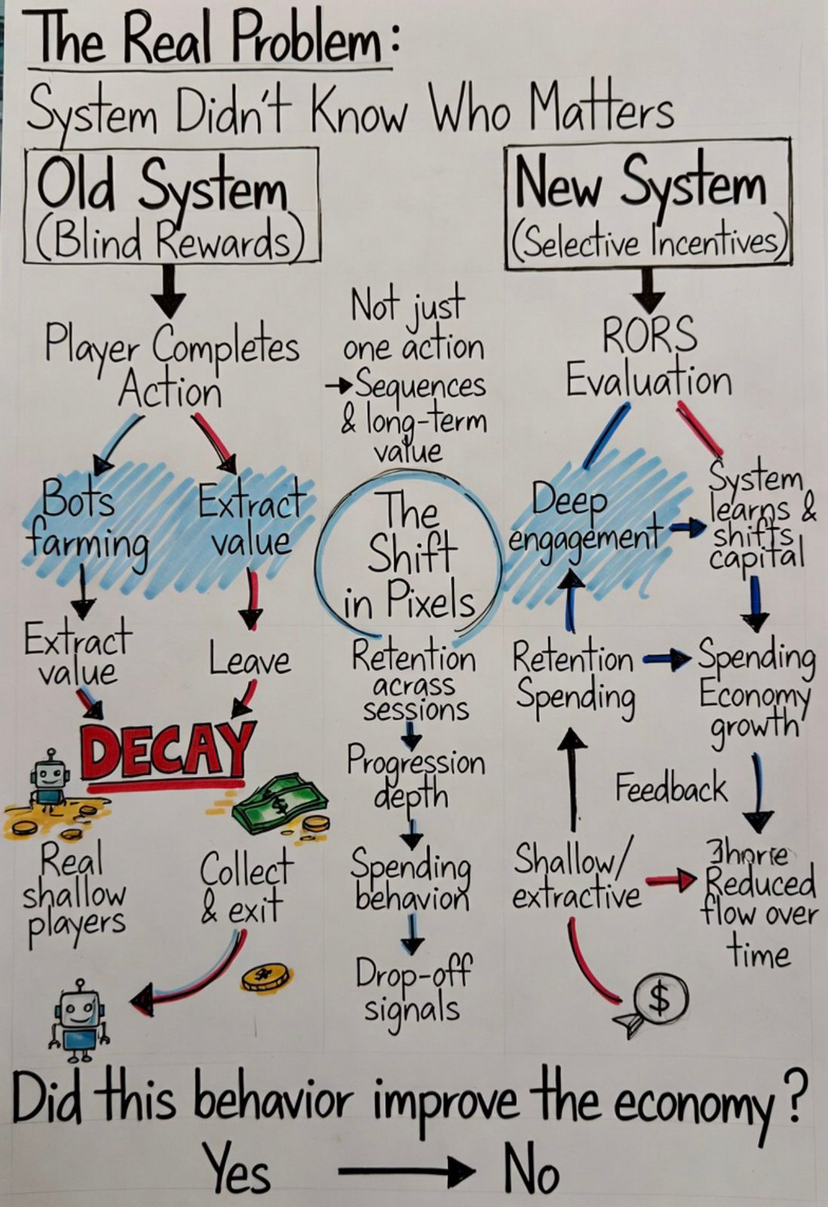
Too many bots farming rewards, extracting value, and leaving nothing behind.
It sounds convincing because bots are visible. You can point to them. You can blame them.
But the more I’ve looked at how these systems behave, the less I think bots were ever the real problem.
They were just the easiest thing to notice.
The deeper issue is less obvious.
Most systems don’t actually know which players matter.
Think about how rewards usually work.
A player completes an action. The system registers it. A reward is distributed.
It feels fair.
But the system isn’t really asking what happens after that.
Does this player stay? Do they spend? Do they contribute to the economy in any meaningful way?
Or do they just pass through, collect, and leave?
Most systems don’t know.
They treat all completed actions the same.
That’s where things start going wrong.
Because once you reward everyone equally, you remove the ability to distinguish between useful behavior and extractive behavior.
And if both are funded the same way, the outcome is already set.
The problem was never that bad actors entered the system. It was that the system kept paying them to stay.
Pixels seems to be rebuilding that exact layer.
Not by focusing on who is a bot and who isn’t.
But by asking a different question.
What kind of behavior is actually worth funding over time?
That’s where the system starts to shift.
Instead of just tracking actions, it starts observing patterns.
Through its data layer, the system looks at what players do across sessions.
Not just one action, but sequences.
Who comes back after day one. Who progresses deeper into the game. Who spends. Who drops off quickly.
I used to think this kind of tracking was just analytics.
But here it’s being used for something else.
It’s feeding decisions.
Because once you can see patterns, you can stop treating every player the same.
This is where RORS becomes important.
It’s not just measuring efficiency.
It’s forcing the system to evaluate whether incentives are actually producing value.
If a group of players keeps receiving rewards but never contributes back through retention or spending, that shows up.
And once it shows up, the system has a reason to adjust.
But seeing and evaluating is still not enough.
The system also needs a way to act.
This is where the structure around staking becomes important.
When $PIXEL is staked into a game, it defines how much incentive flow that game can access.
But that flow is not fixed.
If players attracted through those incentives don’t stay or don’t convert into meaningful activity, the system doesn’t keep pushing the same way.
It doesn’t happen instantly, but over time the system starts favoring what actually works.
Capital shifts toward games and player segments that can turn incentives into real outcomes.
So the system is not just filtering bots.
It’s learning which behavior is actually worth funding.
And that’s a much bigger shift.
Because even real users can behave in ways that weaken the system.
Most game economies don’t collapse because of attackers.
They decay because the system keeps rewarding behavior that doesn’t sustain itself.
Pixels is trying to stop that decay early.
Not by restricting users, but by making incentives conditional on results.
So instead of asking:
Did this player complete the task?
The system starts asking:
Did this behavior lead to something that improves the economy?
That changes how incentives behave.
They are no longer automatic.
They become selective.
And once incentives become selective, the system starts shaping behavior differently.
Players who engage more deeply get reinforced. Shallow participation becomes less attractive over time.
That’s not something most Web3 games were able to do.
They distributed rewards.
They didn’t control where those rewards were most effective.
What makes this more interesting is that this learning doesn’t stay inside one game.
It compounds across the ecosystem.
Each game contributes data. Each game reveals patterns about player behavior. And the system gets better at recognizing what actually works.
So the system starts building something it didn’t have before.
A way to distinguish signal from noise.
And once that distinction becomes clear, a lot of the old problems become less important.
Because the system is no longer blindly funding everything.
I don’t think this is fully solved yet.
But the direction is clear.
Pixels is not just trying to remove bad actors.
It’s trying to build a system that understands which behavior deserves to be amplified in the first place.
And that’s a much harder problem.
Because it requires the system to make decisions continuously, not just enforce rules.
If that works, then the real shift isn’t cleaner gameplay.
It’s a system that knows who actually matters inside it… and acts accordingly.
