
i didn’t notice it through price. The token wasn’t doing anything remarkable, and there was no strong narrative pulling attention. But players were still there, not just logging in, but adjusting, trading, coordinating. It didn’t feel like a system being used. It felt like a system responding. That subtle shift is easy to miss, but once you see it, most GameFi starts to feel static.
Most GameFi economies are built on fixed assumptions. Designers set reward rates, define loops, and hope behavior follows. For a while, it works. Then the system drifts. Incentives get farmed, emissions leak out, and activity stops translating into value. @Pixels approaches this differently. Instead of locking in decisions at launch, it treats the economy as something that needs to be continuously understood and adjusted.
That’s the core idea. #pixel is not just distributing rewards, it’s making decisions about them in real time through a smart reward system. Powered by an AI driven LiveOps layer, the system evaluates player behavior, measures output, and reallocates incentives dynamically. It doesn’t ask “what should rewards be?” It asks “what is actually working right now?” That turns the economy from a static loop into a responsive system.
On the surface, the product still looks familiar. Players gather resources, craft items, trade, and progress through systems like land ownership, guild coordination, and companions. But these are not just engagement features. They are economic inputs. Every action, trading, collaborating, producing, generates data that feeds into the system’s decision making engine.
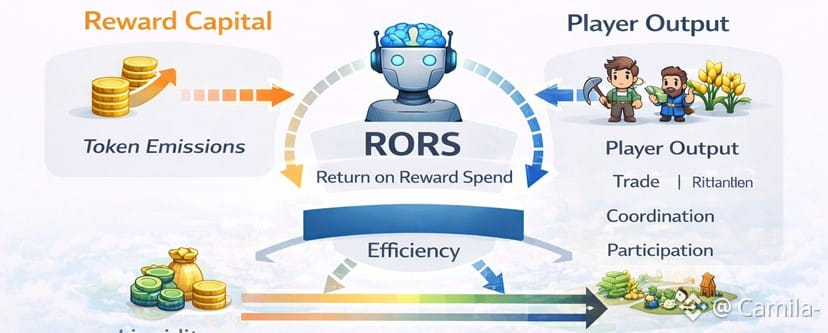
Underneath sits the RORS framework, Return on Reward Spend. Rewards are treated as capital, not giveaways. When tokens are distributed, the system tracks what comes back: liquidity, trade volume, social coordination, and retention. That data feeds back into the system, allowing it to refine allocation and improve efficiency over time. The goal is not to reduce emissions, but to make each token produce measurable return.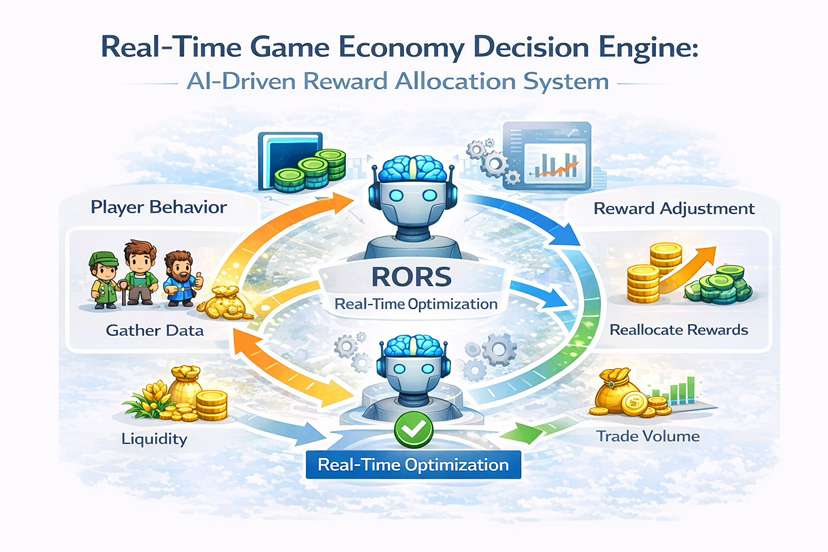
The token still carries familiar pressure. Circulating supply expands, unlocks introduce periodic sell pressure, and the fully diluted valuation sits above current demand. On paper, it resembles a typical GameFi dilution curve. But that view assumes all emissions behave the same. Pixels is betting that targeted emissions are fundamentally different from blind distribution.
The real variable is not just how much supply enters the market, but who receives it. If rewards are increasingly directed toward players who stay longer, contribute more, and reinforce the economy, then sell pressure changes in quality, not just quantity. This doesn’t remove risk, but it reframes it. The key question becomes: can demand, driven by real usage, absorb supply over time?
This is where mechanisms like $vPIXEL matter. By introducing a vote escrowed layer, the system aligns long term participants with reward distribution itself. Holders are no longer passive, they influence where incentives flow. Combined with in game sinks like crafting costs, upgrades, and progression drains, the economy starts to close its loop. Because without sinks, optimization doesn’t matter. Rewards would still leak out faster than value is created.
But none of this works without retention. Most GameFi doesn’t fail because of token design, it fails because users don’t stay. Pixels treats retention as a core variable, not a side effect. Daily loops, social coordination, and progression systems are designed to create habits, not spikes. Because utility only matters if users stay long enough to use it.
Over time, this creates a filtering effect. The system doesn’t try to attract everyone. It learns which players actually contribute to the economy and shifts incentives toward them. Growth becomes less about acquisition and more about refinement. In that sense, the ecosystem itself becomes part of distribution, players, guilds, and creators reinforcing the loop.
The bigger picture is this: Pixels is not just a game, and not just a token. It’s a real time decision system. One that converts incentives into data, data into insight, and insight into better capital allocation. It’s not static design. It’s continuous learning.
That doesn’t guarantee success. If the system fails to correctly identify value creating behavior, rewards can still be misallocated. If players exploit faster than the system adapts, the loop weakens. And if emissions outpace learning, the same old problems return. The difference is that Pixels is structured to respond, not remain fixed.
If you were to map it simply, it’s a loop: reward → action → data → optimization → reward. But the important part isn’t the loop, it’s that the loop learns. And if it learns faster than it leaks, something sustainable starts to form.
The market hasn’t fully priced that yet. It still reacts to unlocks, emissions, and short term activity. But underneath, a different variable is emerging: decision quality. How well can the system allocate rewards? How quickly can it adapt? How accurately can it identify value?
That’s what’s being tested.
If the system learns, value compounds.