


I logged into Pixels after running the same routine for a few days. The setup was stable. I knew how much time each cycle would take and what kind of return to expect. It wasn’t optimal, but it was consistent.
Then the output started dropping.
There was no visible change. I didn’t switch tools, didn’t run out of inputs, and didn’t make an execution mistake. The loop still worked, but it was no longer efficient.
So I moved to a different activity.
That worked for a short period, and then the same thing happened again. The return started fading without any obvious reason.
At that point, it became clear that the issue was not execution. It was positioning.
Most game economies operate on fixed logic. Developers define reward rates and adjust them later if something becomes too profitable or too weak. There is always a lag between player behavior and system response.
Pixels reduces that lag.
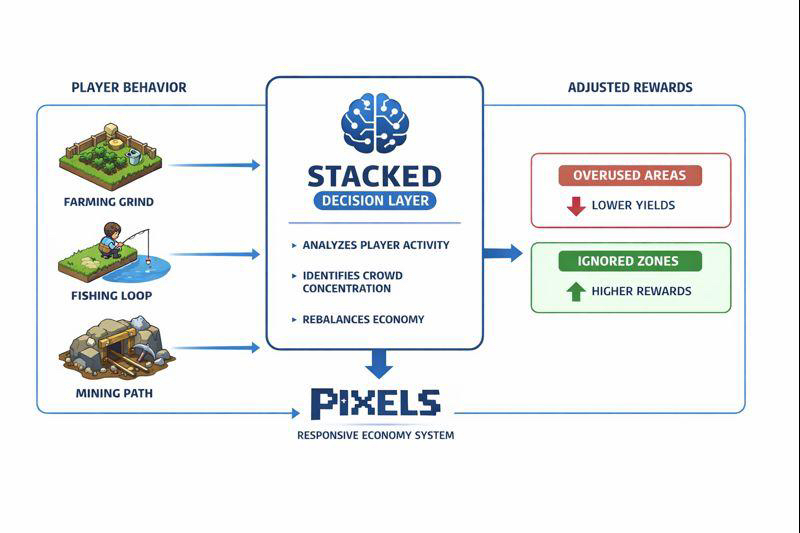
The layer underneath, Stacked, continuously reads how players behave. It tracks where time is being spent, which activities are becoming crowded, and which parts of the system are underused.
Instead of blocking actions or forcing changes, it adjusts how rewards are distributed across those activities.
If too many players concentrate in one loop, the effective return from that loop decreases. If an area is ignored, it becomes relatively more attractive.
No announcement. No patch. The adjustment happens while players are still inside the system.
This creates a different type of environment.
In a fixed system, players optimize once and repeat. In Pixels, optimization has a shorter lifespan because the system keeps adapting to player concentration.
Two players can run the same actions with similar efficiency and still get different results depending on when they entered and how crowded that activity is.
That is not randomness. It is allocation pressure.
The important part is not the reward itself, but how it is routed.
Stacked acts as a decision layer. It routes value based on where players concentrate.
This changes how the economy behaves.
Instead of rewards driving behavior, behavior reshapes rewards. That reduces the ability to exploit a single dominant loop over a long period.
From a player perspective, this shifts the focus.
The question is no longer “what is the best loop?”
The better question becomes “where is value moving right now, and how crowded is it?”
From a system perspective, this is more than balancing.
If this model holds, Pixels is not just managing a game economy. It is building a responsive decision layer that can be reused across games.
That would move Stacked from being a feature inside Pixels to infrastructure for the broader ecosystem.
I didn’t approach it that way at the start.
I was trying to improve a loop.
What changed is that I stopped treating the system as fixed.
Now I treat it as something that reacts to player behavior in real time, and I adjust based on that.
