



Every crypto project talks about growth. Very few are prepared for it.
That is where the real tension begins inside the $PIXEL economy. On one side, there is a fixed supply of 5 billion tokens. On the other, there is the possibility of millions of players entering the ecosystem over time. The question is simple but important. Can a limited supply support expanding demand without breaking the system?
To understand this, you need to look at two numbers most people overlook.
Market cap and fully diluted valuation.
Market cap reflects the current reality. It is based only on tokens that are already in circulation. FDV, on the other hand, assumes all 5 billion tokens are already unlocked and trading in the market.
Right now, there is still a clear gap between the two.
With billions of tokens already circulating but not the full supply, $PIXEL sits in a middle phase. It is no longer in its early scarcity stage, but it is not fully diluted either. That gap is where both opportunity and risk exist.
If you look at the ratio between market cap and FDV, it tells you how much future supply is still waiting to enter the market. In some datasets, this ratio sits close to 0.15, meaning only a small portion of the total valuation is currently realized.
That has two implications.
First, growth potential exists.
If adoption increases and demand rises faster than new tokens unlock, price can still move upward. More players, more transactions, and more in game spending can absorb incoming supply. In that scenario, expansion strengthens the system.
But there is a second side.
Future dilution is real.
As locked tokens are gradually released, they introduce selling pressure. If demand does not keep up, price growth can stall or even reverse. This is the part many investors ignore when they only focus on current market cap.
So the real question is not just about scarcity.
It is about timing.
Pixels is designed with a phased unlock structure. Tokens are not dumped into the market all at once. Instead, they are released gradually across ecosystem rewards, team allocations, and long term incentives.
This creates a moving balance.
Each unlock adds supply, but the game simultaneously tries to increase demand through gameplay. Players spend PIXEL on upgrades, assets, and progression, which pulls tokens back into the ecosystem instead of leaving them idle.
That loop is critical.
If PIXEL only flowed outward as rewards, the system would inflate quickly. But because players are encouraged to use the token inside the game, part of that supply keeps circulating rather than exiting.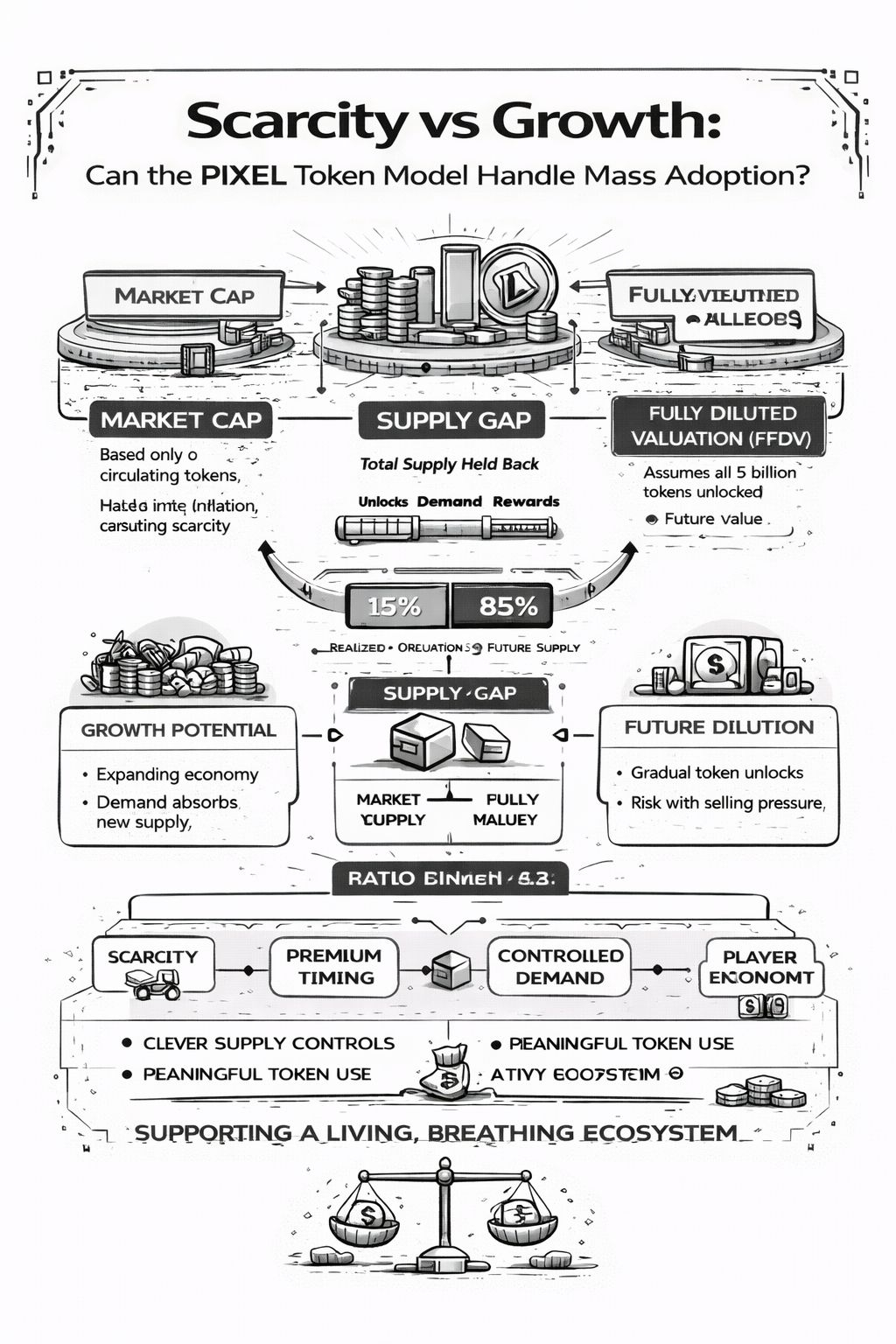
Mass adoption tests this balance.
If millions of players join but only a small percentage actually spend, demand weakens and supply dominates. But if new users actively participate in the economy, spending PIXEL as part of gameplay, demand scales alongside growth.
This is where Pixels has an advantage compared to older models.
It does not rely purely on financial incentives. It leans on gameplay.
Players farm, build, trade, and interact because they enjoy the experience. The token becomes part of that loop, not the only reason to stay. That creates a more natural demand curve, which is essential when supply continues to expand over time.
Still, no model is immune to pressure.
FDV acts as a ceiling that the market constantly evaluates. If the fully diluted valuation looks too high compared to actual usage, the market adjusts expectations. If usage grows into that valuation, the system stabilizes.
So can PIXEL handle mass adoption?
The answer depends less on its fixed supply and more on its ability to create real demand.
Scarcity sets the rules.
Growth tests them.
And the space between market cap and FDV is where the entire story plays out.
If Pixels continues to convert players into active participants rather than passive holders, the model has room to scale. If not, the weight of future supply will always be waiting in the background.
That is the tradeoff built into the system.
And that is what makes it worth watching.