
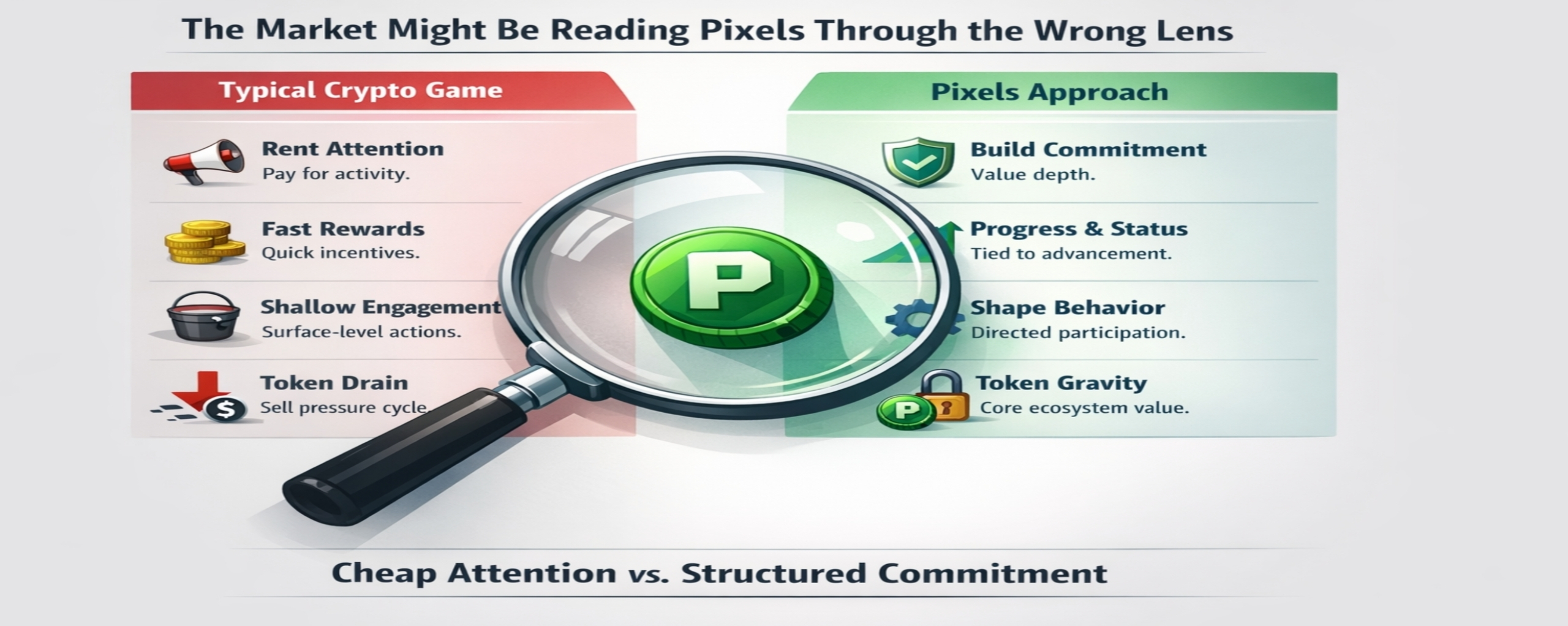
Pixels is the kind of project I would normally dismiss in less than a minute.
I have seen this trade too many times already. A token gets wrapped around a game, the market gets briefly excited, people start throwing around words like community, retention, and digital economy, and then the same cycle plays out again. Rewards turn into sell pressure. Activity becomes noise. Everyone keeps pretending the friction is temporary right until the chart starts exposing what was always underneath.
So yes, I came into Pixels with that bias.
But the reason it keeps holding my attention is because it does not feel like it is only trying to keep the system alive with emissions and hope.
I have watched too many projects confuse movement with strength. A few wallets show up. Some numbers spike for a week. The timeline fills with screenshots. Suddenly people start calling it momentum. Most of the time it is not momentum at all. It is rented attention. Cheap attention. The kind that disappears the second the reward no longer justifies the effort.
That is where most of these ecosystems actually die.
Not in one dramatic collapse.
Just in a slow and ugly loop where incentives get recycled into exits until the whole thing starts looking alive on the surface but hollow underneath.
Pixels feels like it at least understands that problem.
Maybe not perfectly. Maybe not fully. But I can see the shape of the attempt, and that already puts it ahead of a lot of this sector.
What stands out to me is that Pixels does not seem obsessed with rewarding raw activity. It seems more interested in deciding which activity actually deserves to matter. That sounds like a small difference until you spend enough time in crypto and realize almost nobody gets that part right.
Most teams will pay for anything that moves.
They do not care whether the user is adding depth to the economy or just passing through with a bucket in hand. They just want the dashboard to look alive long enough for the story to keep selling.
I am tired of dashboards. I am tired of vanity metrics. I am tired of markets pretending a crowd is the same thing as a foundation.
Pixels, at least from what I can see, seems to be pushing toward something heavier than that.
The token is not just sitting on the edge as a reward chip. It is being pulled closer to the center of the system. Closer to access. Closer to progression. Closer to status. Closer to the parts of an economy that people do not casually walk away from if they believe staying involved still means something.
That does not make it safe.
Not even close.
I am not saying the model is solved. I am saying I can see what it is trying to solve, and that alone makes it more interesting than most projects built on cleaner narratives and weaker foundations.
Because the real challenge was never getting people through the door. Crypto has never struggled with that. Throw enough incentives around and people will show up for almost anything.
The real challenge is figuring out who is actually building the ecosystem and who is simply extracting from it.
That is where the noise begins. That is where the economy gets muddy. That is where projects lose the ability to separate attention from drain.
And once that line gets blurred, the token becomes dead weight.
That is why Pixels feels worth watching to me.
Not because I think it is flawless. Not because I think the market suddenly owes it a premium. But because it seems to be building around commitment instead of motion. Around staying power instead of short-term spikes. Around behavior that compounds instead of behavior that strips value out of the system.
That is a much harder thing to build.
It is slower. Messier. Less exciting to people who want instant scale and easy narratives.
Good.
Most easy narratives in this market are useless anyway.
I also think a lot of people are still reading Pixels too narrowly. They look at it, see a game, and stop there. I do not think that lens is enough anymore.
The more interesting layer is the internal economy being shaped underneath it. A structure where user behavior is not only rewarded, but ranked, directed, and folded back into the system itself. That is where things start to matter.
Not in the usual hype-cycle way.
In the quieter way, where the token becomes harder to dismiss because it is woven into the actual logic of participation.
That is different.
A disposable token gets earned and dumped.
A core token creates gravity.
People do not stay close to it only because they want upside. They stay close because being nearer to the center of the system has value in itself. Those are completely different behaviors, and markets are usually late to recognize that shift because they are too busy forcing everything into old categories.
Still, I am not giving Pixels a free pass.
I want to see whether this structure actually holds when pressure increases. I want to see whether the project can keep user behavior aligned without slipping into the same lazy incentive loop everyone eventually falls back on. I want to see whether the economy gets tighter over time or simply gets better at disguising the same leakage.
That is the part I still do not trust.
Because I have seen too many teams convince themselves they were building durability when they were really just building a more elaborate way to distribute tokens. Crypto is full of projects that confuse layers with depth. Add enough mechanics, enough statuses, enough pathways, enough internal language, and suddenly people start assuming the system must be strong.
Usually it is not.
Usually it is just better dressed.
But that is exactly why Pixels keeps my attention.
Not because it is obviously great. Not because it looks polished. But because the market may still be using an outdated framework on something that is trying to outgrow it.
That does not mean it succeeds.
It just means the old dismissal may not be enough anymore.
And that is where I get interested. Not when something looks clean. Not when a crowd shows up. When I can feel the friction in the design and still sense a serious attempt underneath it.
Pixels feels like that to me.
It feels like a project that understands, at least on some level, that rewarding everyone is easy, but rewarding the right people is hard. Keeping people busy is easy, but making their participation valuable is hard. Creating activity is easy, but building an economy people do not want to leave is hard.
Most projects never make it past the easy part.
They burn out in noise and call it adoption.
Pixels might still fail. I would not be surprised. Honestly, I expect most things in this market to fail until they prove otherwise. Too much time in crypto does that to your brain.
But I cannot look at this one and throw it into the same pile without thinking twice.
There is more intention here than that. More structure. More willingness to wrestle with the ugly question sitting at the center of all of this:
What kind of user behavior actually deserves to scale?
I keep coming back to that.
Because if Pixels gets that part right, then people still treating it like just another gaming token may be looking at the wrong thing entirely.
And if it does not, then it ends up where most of them do. Quietly. Under the weight of its own recycling.
That is what I am watching now.
Not whether Pixels can stay loud.
Whether it can stay meaningful after the noise fades.
