
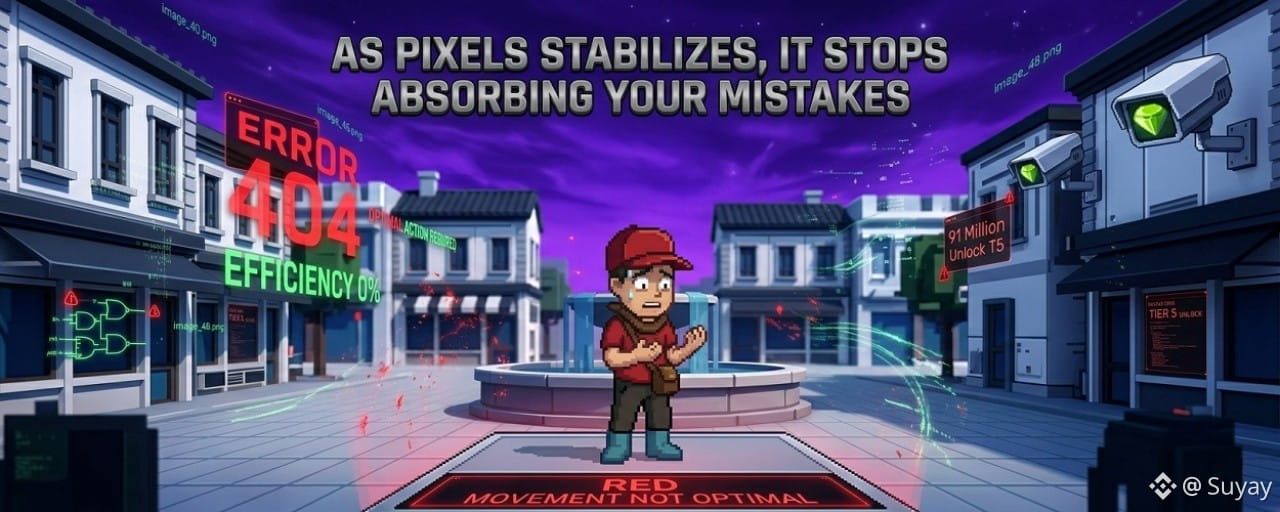

There’s a moment where a system stops feeling early. Not because it becomes bigger or more complex, but because it starts behaving as if it no longer needs to compensate for its own instability. That’s more or less where Pixels feels right now, and I didn’t notice it immediately. It’s not something that shows up clearly in the interface, or even in the market at first glance. It’s something you start to feel when you keep playing the same way… and the results don’t respond the same way anymore.
Over the past few days, most of the visible pressure has already passed. The $PIXEL unlock is behind us, price is stabilizing and even pushing slightly upward again, holding above previous support levels. At the same time, more than 66% of the total supply is already in circulation, which changes the nature of the economy in a quiet but important way. There’s less future dilution to blame, fewer external shocks to point at. From the outside, everything starts to look more mature, more stable, more predictable.
And that should make things easier.
But it doesn’t really feel like that from inside Pixels.
If anything, it feels like the margin for getting things wrong is shrinking.
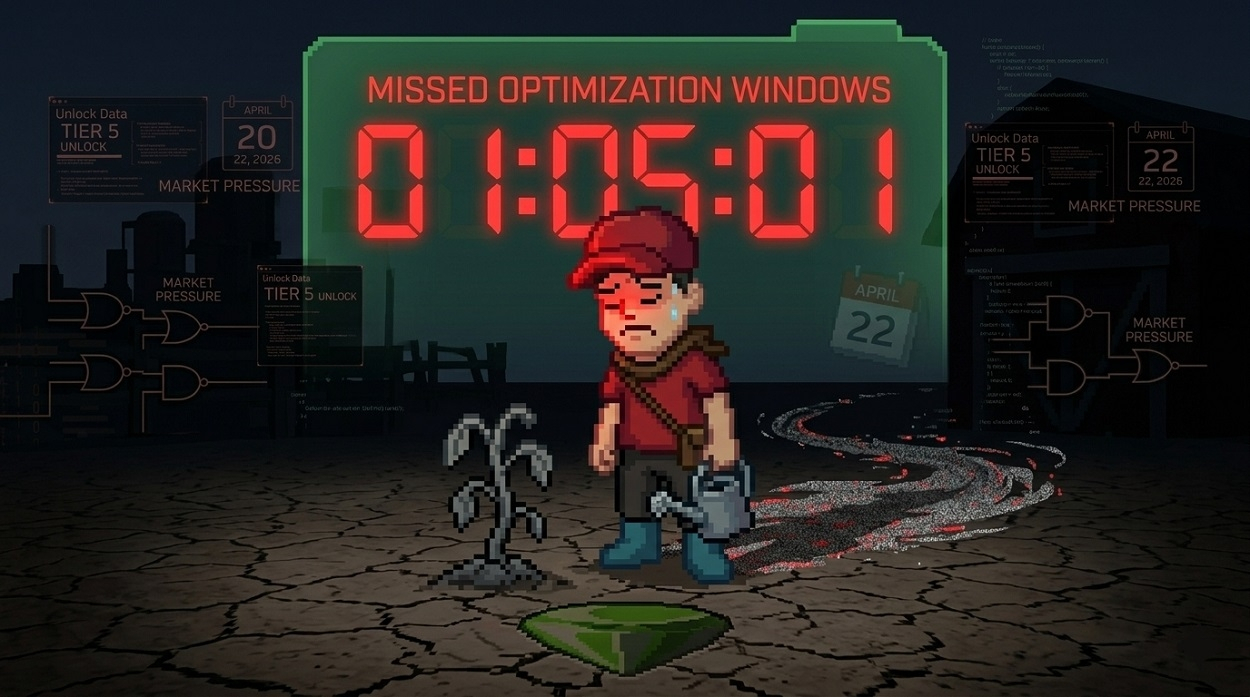
Before, when the system was still expanding, there was a certain tolerance built into how everything worked. You could make inefficient decisions, miss optimization windows, approach loops in a less structured way, and still feel like you were moving forward. Not perfectly, but within a range that felt flexible enough to absorb those inconsistencies.
Now that flexibility feels different.
Not gone, but reduced in a way that’s hard to point at directly.
Stacked keeps refining how it distributes rewards, and as that layer becomes more precise, the difference between slightly efficient and actually optimal starts to matter more than it used to. It’s no longer just about doing the right thing, but about doing it in the way the system currently recognizes as valuable.
And that’s where I start to notice the shift.
Because I’m still doing what looks, on the surface, like the same thing. Same routines, same production chains, same general approach to how I move through the game. But every now and then, something feels slightly off. The outcome doesn’t fully match the effort in the way I expect it to.
Not dramatically.
Just enough to make me pause.
Was that inefficient?
Did I miss a timing window?
Or is Stacked simply interpreting what I did differently now?
That question didn’t carry much weight before.
Now it does.
Because as the environment becomes more stable, there are fewer external explanations available. It’s harder to attribute outcomes to volatility, to market noise, to early-stage imbalance. When everything looks more structured from the outside, the variability you feel inside becomes harder to justify.
And that shifts the responsibility.
It moves from the system… to the player.
At the same time, the ecosystem is expanding. Chapter 3 continues to push more complex production chains, deeper dependencies between resources, and a stronger need for coordination across activities. Stacked is also moving toward a more connected reward structure, where $PIXEL isn’t just tied to one loop, but starts to exist across multiple integrated experiences.
That expansion doesn’t simplify anything.
It increases the number of ways you can be slightly off.
And when the system is loose, that doesn’t matter as much.
When the system matures, it does.
Because precision amplifies small differences.
And small differences, over time, start to separate outcomes more clearly.
Which leads to a thought that I didn’t really have before.
If Pixels keeps becoming more stable, more efficient, more precise in how it interprets behavior… then maybe the real shift isn’t just in the economy itself, but in how little space there is left for playing without fully understanding what you’re doing.
Not in an obvious way.
Not with clear rules.
But in practice.
Because the more the system matures, the less it needs to compensate for inconsistency.
And the less it compensates, the more every small mistake starts to belong entirely to you.
I’m not sure most players notice when that transition happens.
It doesn’t feel like a breaking point.
It feels like continuity.
Same game.
Same loops.
Same actions.
But with a slightly different weight behind them.
And once that weight changes, even if everything looks better from the outside… it becomes harder to tell if you’re actually playing better, or just running out of room to make mistakes without consequences.