


I keep coming back to one uncomfortable thought with Pixels lately: the most important update may not be a new feature, a new chapter, or even a new reward mechanic.
It may be the metric.
Not because metrics are exciting. Usually they are not. Most people tune out the second a project starts talking about internal optimization language. But sometimes a metric tells you what a team is really trying to become. And in Pixels’ case, I think that shift matters more than it looks.
The whitepaper makes this unusually explicit. Pixels says one of its central metrics is RORS, short for Return on Reward Spend. It describes RORS as a simple comparison between rewards distributed and revenue returned to the protocol in fees, and says the goal is to push that figure above 1.0 so that every reward token spent generates net-positive revenue for the ecosystem. The document also says RORS was around 0.8 at the time of writing.

That sounds dry on first read. It is not.
What it really means is that Pixels is trying to stop treating rewards like a growth shortcut and start treating them like an investment that needs to pay for itself. That is a pretty serious change in posture. A lot of GameFi projects distribute tokens first and worry about economic durability later. Pixels is basically saying the opposite: reward spend should be measured the same way a serious company measures customer acquisition efficiency.
And once I looked at it that way, a lot of other updates started making more sense.
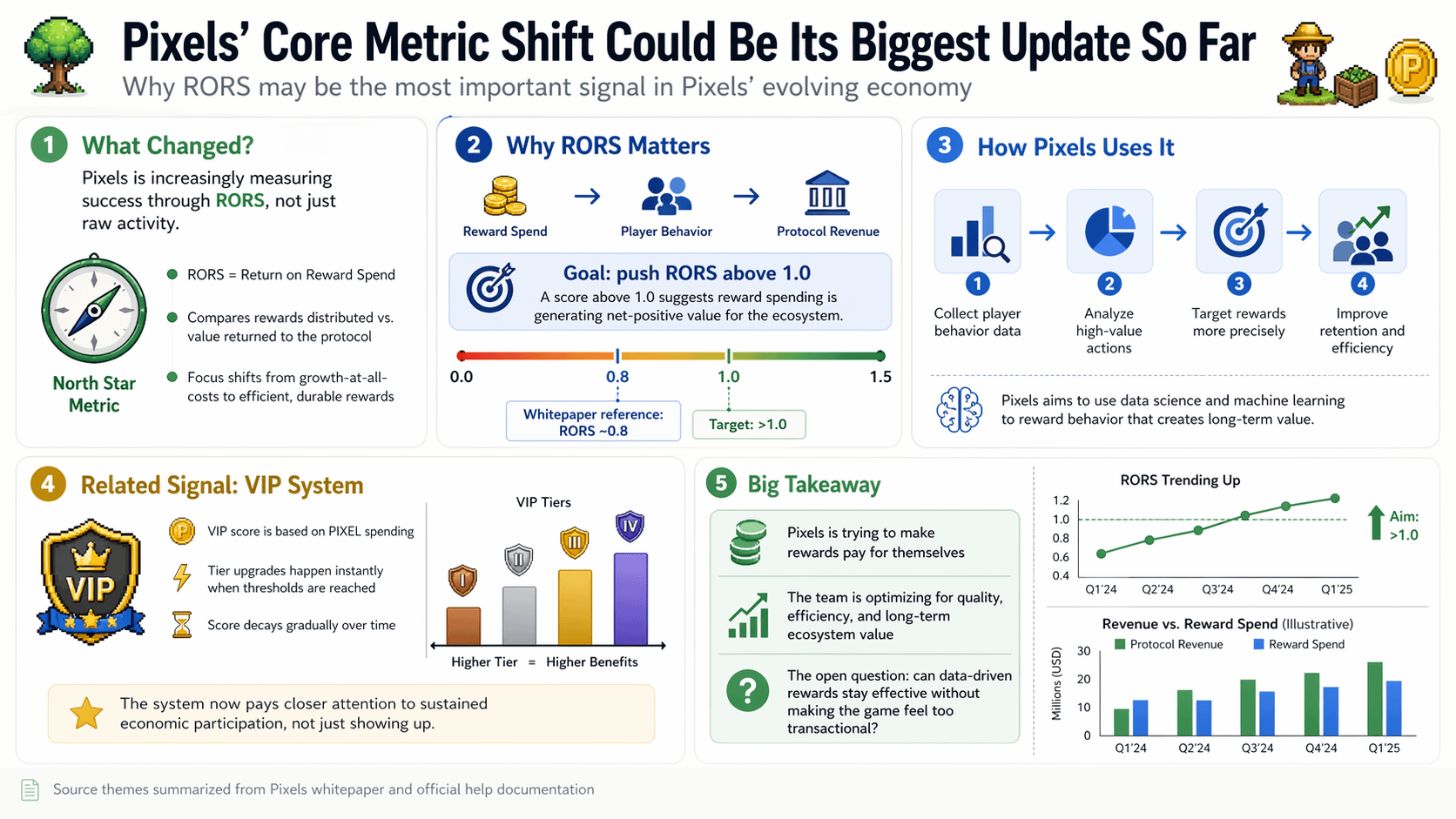
The whitepaper says Pixels wants to use data science and machine learning to identify player actions that genuinely drive long-term value, then direct rewards accordingly. It also describes a publishing flywheel where better games produce richer player data, richer data improves targeting, and better targeting reduces user acquisition costs. That is not the language of a team optimizing for raw activity anymore. It is the language of a team trying to measure quality, efficiency, and retention-adjusted value.
Even the newer VIP system points in the same direction. The official help docs say VIP score is now based on $PIXEL spending, that tier upgrades happen instantly once thresholds are crossed, and that the score decays gradually over time. In plain words, Pixels is not just asking whether a user showed up. It is tracking whether they keep participating in ways that feed the economy.
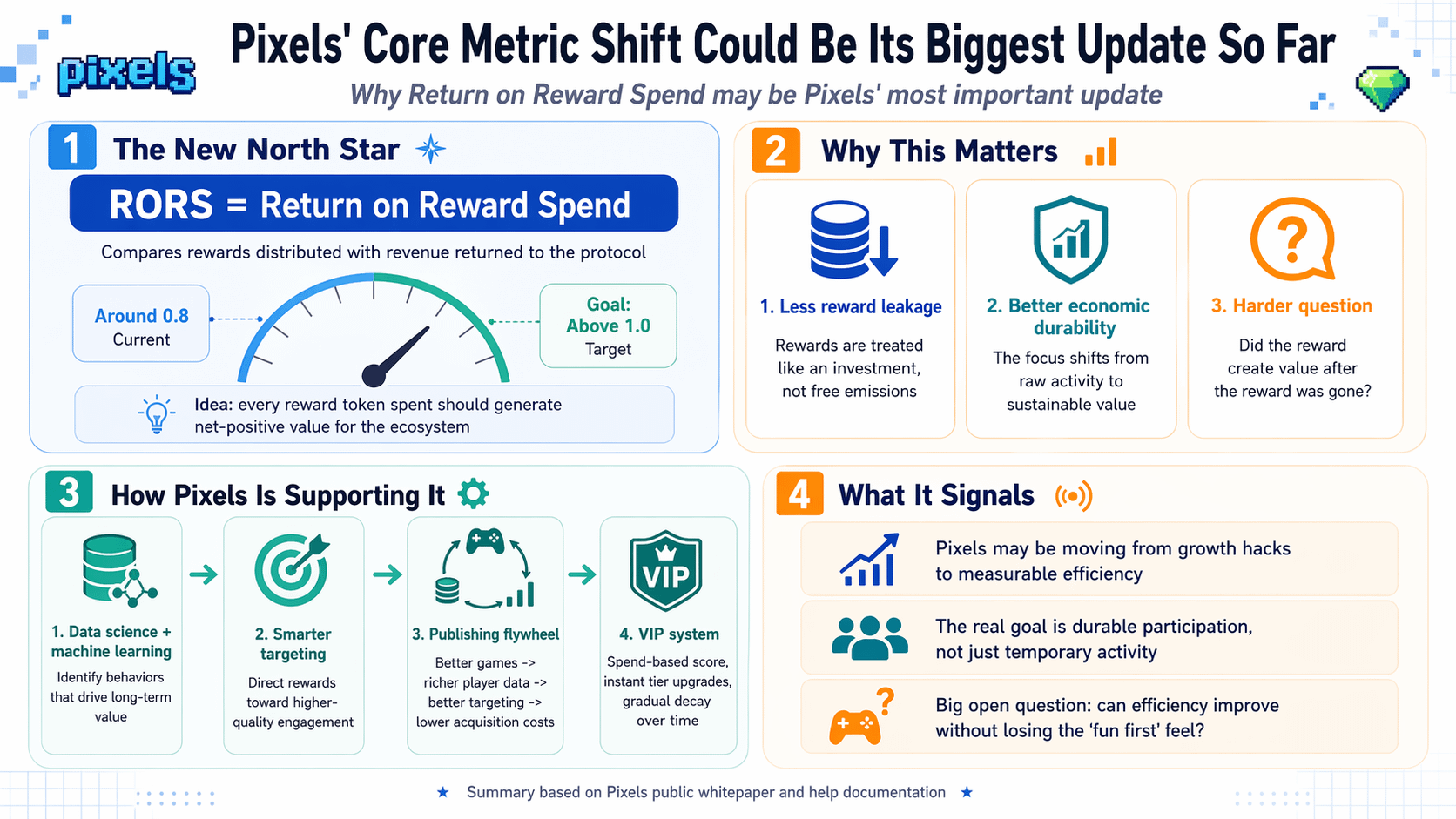
That is why I think this “north star” shift matters.
Because the real update is not just that Pixels has more data now. It is that the team seems more willing to organize the whole ecosystem around a harder question: which player behaviors actually make the system stronger after the reward is gone?
That is the question most crypto games avoid. Daily active users can be inflated. Transaction counts can be gamed. Even retention can look healthier than it really is if emissions are doing too much of the work. But a metric like RORS forces a more uncomfortable standard. Did the reward create durable value, or did it just rent activity for a while?
My only caution is this: once a project starts steering by a metric like this, it can become smarter, but also colder. If everything gets filtered through measurable return, the risk is that systems start favoring only the most obviously monetizable behavior. Games still need room for friction, experimentation, weirdness, and slow attachment. Pixels itself says “fun first,” and I think that line matters more now than before.
Still, if I have to pick the update that matters the most, I would probably pick this one.
Not because players love north star metrics.
Because they quietly reveal what a team is willing to optimize for when the easy growth phase is over.
