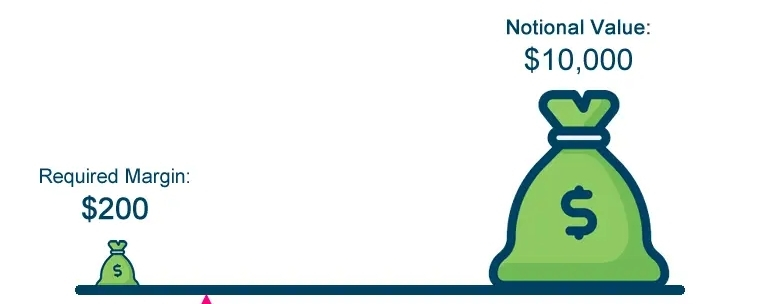
Leverage is a tool that allows you to trade with a larger amount than your actual capital. It's like borrowing from the platform to boost your position.
How does it work?
If you have $100 and use x10 leverage, you can open a position worth $1000. Your gains and losses are calculated on the full $1000, not just the $100.
Practical example:
Without leverage: You buy $BTC$ for $100. It goes up 5% = You made $5.
With x10 leverage: the same $100, if it rises 5% = you made $50.
But if it drops 5% = you lose $50 from your capital, meaning half your account just vanished.
Why does everyone love it?
Amplifying profits: the same small move gives you a larger return.
Capital efficiency: you don't need to lock up a large amount to take a decent position.
Why does everyone fear it?
Amplifying losses: just as profits can multiply, losses can also escalate at the same speed.
Liquidation: if the price moves against you by a certain percentage, the platform forcibly closes your position and takes all your capital. With x20 leverage, a 5% drop wipes out your account.
Funding fees: every 8 hours you pay fees for open positions, and this eats into your profits over time.
3 golden rules if you're using leverage:
Start small: don't use more than x3 to x5 when you're new. x50 and x100 leverage is for pros only.
Stop-loss is mandatory: no stop-loss with leverage = financial slip. Set your loss before you enter.
Don't get greedy: a 2% target at x10 leverage = 20% profit. Don’t wait for 100% because the market will turn against you.
In summary: leverage is a tool, not a trading plan. A pro uses it to reduce the required capital, while a newbie uses it to get greedy and ends up getting liquidated. The difference is risk management.
Educational content only. Trading with high leverage is very risky and you may lose your entire capital. This is not financial advice. DYOR