
You’re optimizing Pixels.
Don’t pretend you’re not.
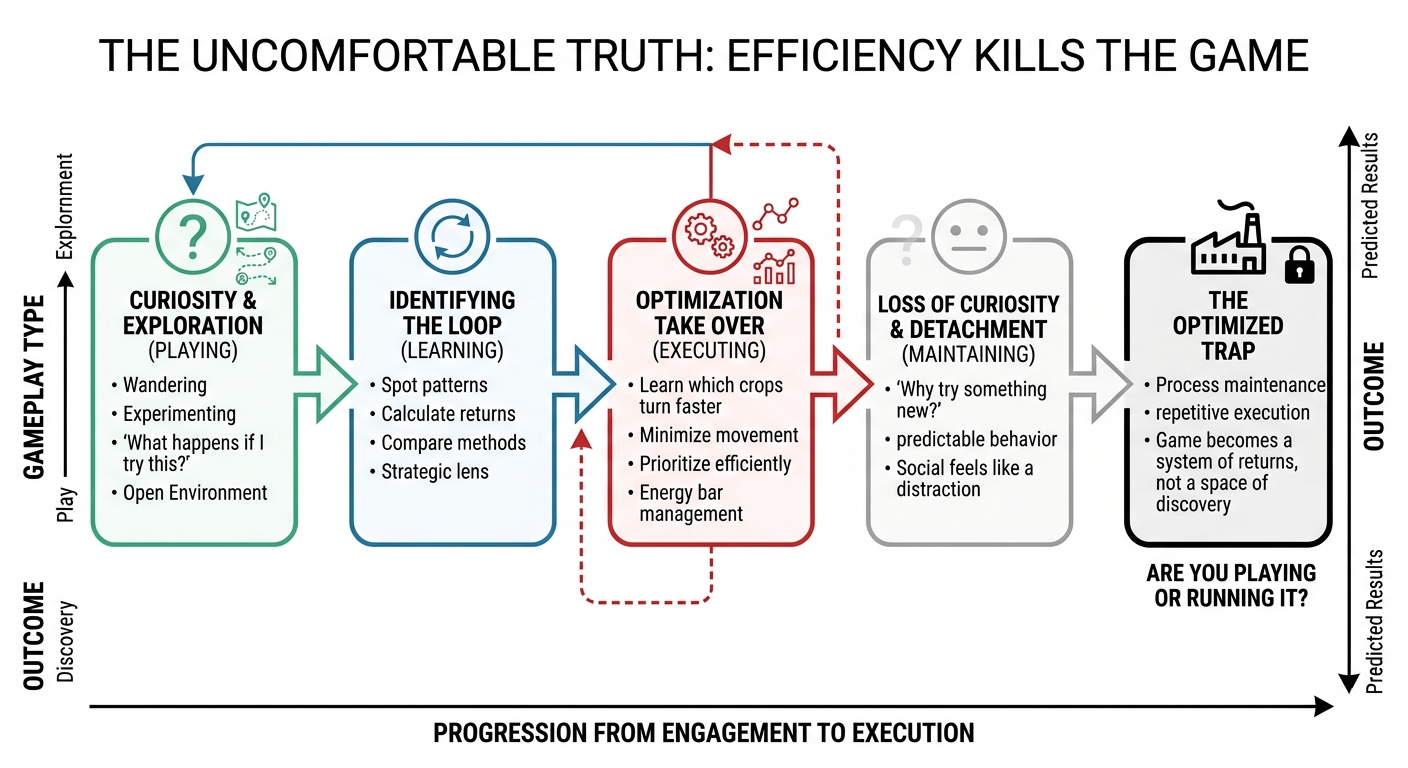
At some point, you stopped wandering and started calculating. You learned which crops turn faster, which routes minimize wasted movement, how to burn your energy bar without leaving idle gaps. You figured out when to log in, what to prioritize, and what to ignore. Maybe you still tell yourself you’re “just playing,” but your decisions say otherwise.
And it feels good.
Cleaner. Smarter. Productive.
You feel in control.
But here’s the part you’re not admitting: the better you get at Pixels, the less it feels like a game.
That’s not a flaw in the design.
That’s the outcome of understanding it too well.
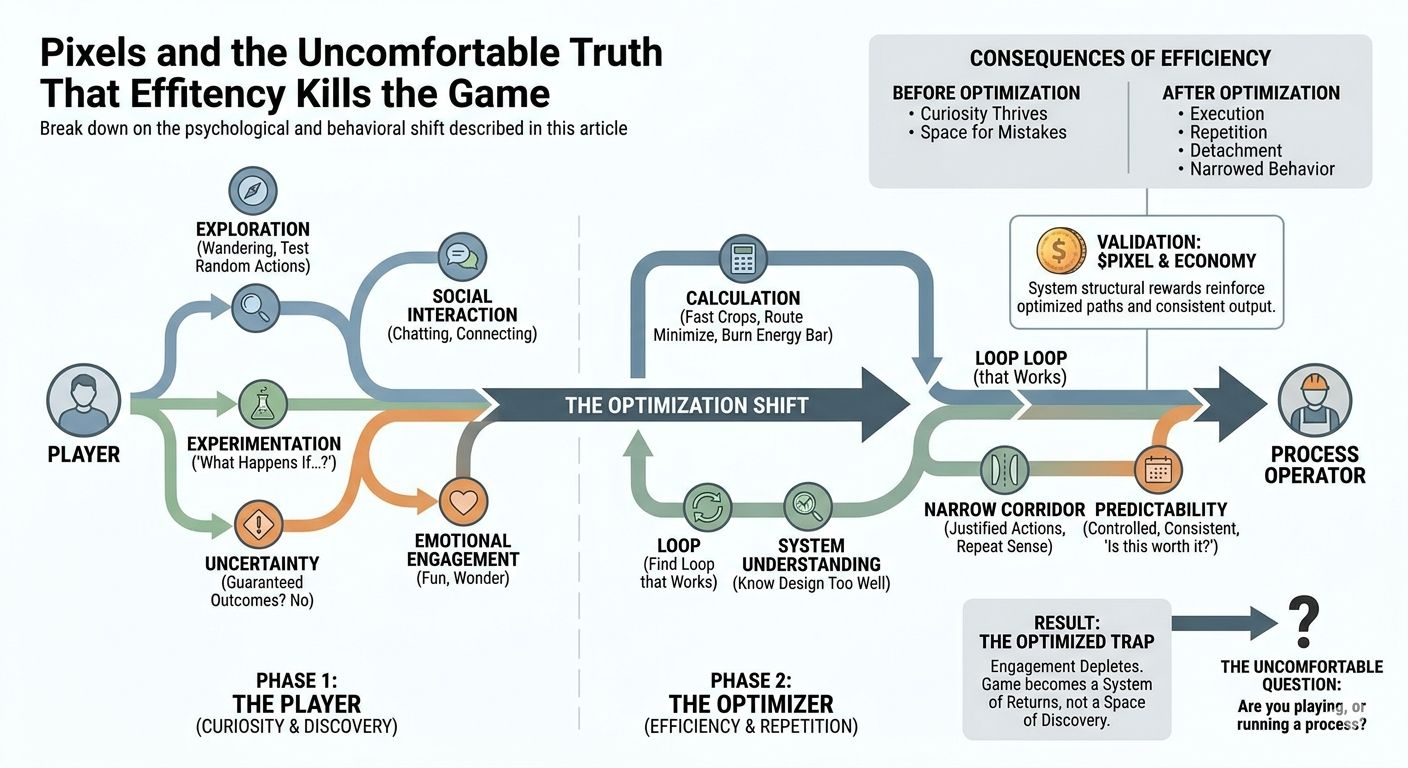
Efficiency compresses experience. The moment you identify a loop that works—really works—everything outside that loop starts to look like a mistake. Exploration becomes inefficient. Experimentation becomes unnecessary risk. Even social interaction starts to feel like a distraction unless it directly improves your output.
You don’t notice it happening.
But your world shrinks.
What started as an open environment—fields, players, choices—turns into a narrow corridor of actions that you repeat because they make sense. You log in, execute, log out. Clean. Predictable. Controlled.
And slowly, something disappears.
Not your progress.
Your curiosity.
That’s the trade.
Because curiosity thrives on uncertainty. It needs space where outcomes aren’t guaranteed, where actions don’t always lead to the best result. Efficiency removes that space. It replaces it with certainty, with known outcomes, with optimized paths that don’t need to be questioned anymore.
You stop asking “what happens if I try this?”
You start asking “why would I try that when this works?”
That shift feels intelligent.
It’s actually limiting.
Look at your own behavior.
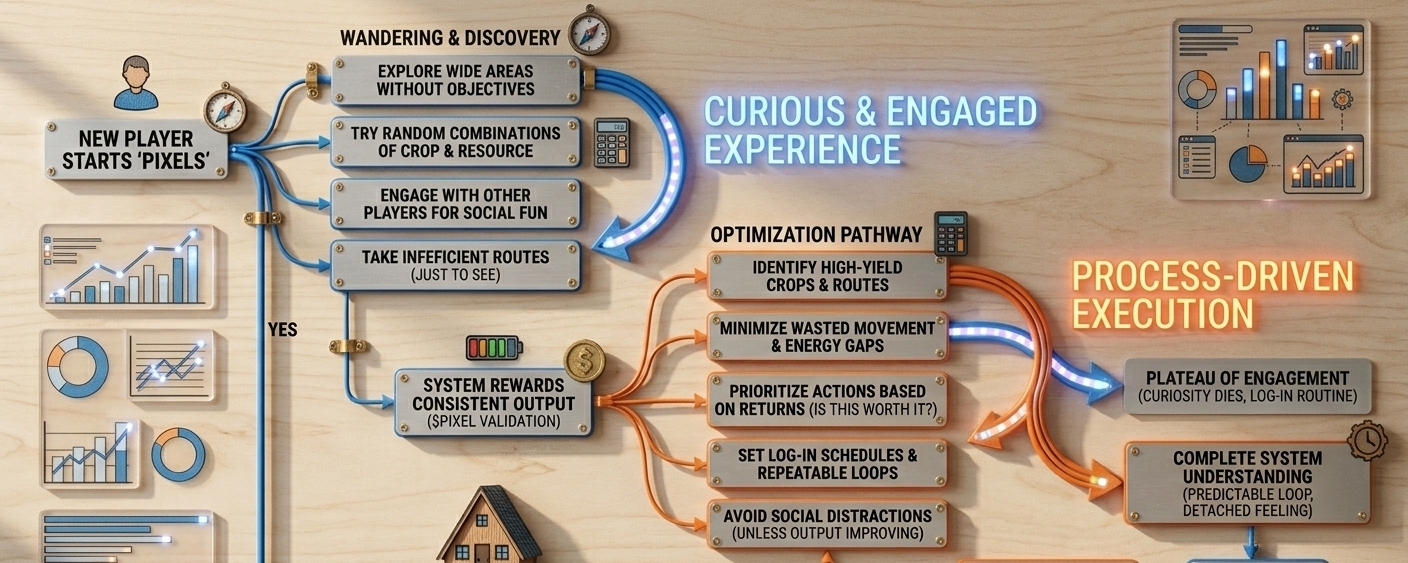
You probably don’t explore areas unless there’s a clear reason. You don’t test random combinations of resources. You don’t take inefficient routes just to see what happens. Every action is justified. Every decision is filtered through one lens:
Is this worth it?
That question kills more gameplay than any mechanic ever could.
Because once everything has to justify itself economically or strategically, nothing gets to exist just for the experience. The game becomes a system of returns, not a space of discovery.
And Pixels quietly encourages this.
Not directly.
But structurally.
The energy system rewards efficient usage. The resource loops reward consistency. The economy reflects predictable behavior. Over time, the system starts favoring players who reduce randomness and increase control.
And then there’s PIXEL.
It doesn’t tell you to optimize—but it validates you when you do.
When your actions start producing consistent output, when your loops become stable, when your time converts cleanly into results—the system responds. Not loudly, not dramatically, but enough to reinforce the pattern.
You start trusting the loop.
And once you trust it, you stop questioning it.
That’s where the real shift happens.
Because now you’re not playing a game anymore.
You’re maintaining a process.
It looks similar on the surface. You’re still farming, crafting, moving through the world. But the intention behind those actions has changed. You’re not engaging—you’re executing.
That difference matters more than most people realize.
Execution is efficient.
But it’s also repetitive.
And repetition, when it’s no longer chosen but required, leads to fatigue.
You’ll start to feel it.
Not as frustration.
As detachment.
You log in because it makes sense, not because you want to. You complete your loop, but you don’t feel anything from it. The satisfaction isn’t emotional—it’s structural. You did what needed to be done.
And that’s the danger.
Because once a game starts feeling like something that needs to be done, it stops being a game.
Pixels doesn’t force you into this state.
You walk into it.
Because optimization works.
Because efficiency is rewarded.
Because narrowing your behavior produces better results.
But better results don’t always produce better experiences.
That’s the contradiction most players ignore.
The system is doing exactly what it was designed to do.
And you are too.
The problem is what happens next.
Because once you’ve optimized your loop, there’s nowhere left to go except deeper into it. You refine it. Tighten it. Remove small inefficiencies. But the core doesn’t change.
It just becomes more precise.
And precision is not the same as engagement.
At some point, you realize you’ve stopped discovering anything new.
You’re just improving what you already know.
That’s when the game plateaus.
Not in content.
In feeling.
And this is where most players quietly drop off.
Not because the game failed.
Because it became predictable.
Pixels isn’t broken when this happens.
It’s complete.
You solved it—for yourself.
The uncomfortable question is whether you’re willing to break your own efficiency to keep the experience alive.
Because the only way to recover curiosity is to step outside the loop you built.
To take actions that don’t make sense.
To explore without justification.
To waste time, in a system that constantly rewards not doing that.
That’s hard.
Because once you understand a system, it’s difficult to ignore that understanding.
But if you don’t…
you’ll keep optimizing.
And the more you optimize, the less you’ll actually feel anything while playing.
So be honest with yourself.
Are you still playing Pixels?
Or are you just running it?