
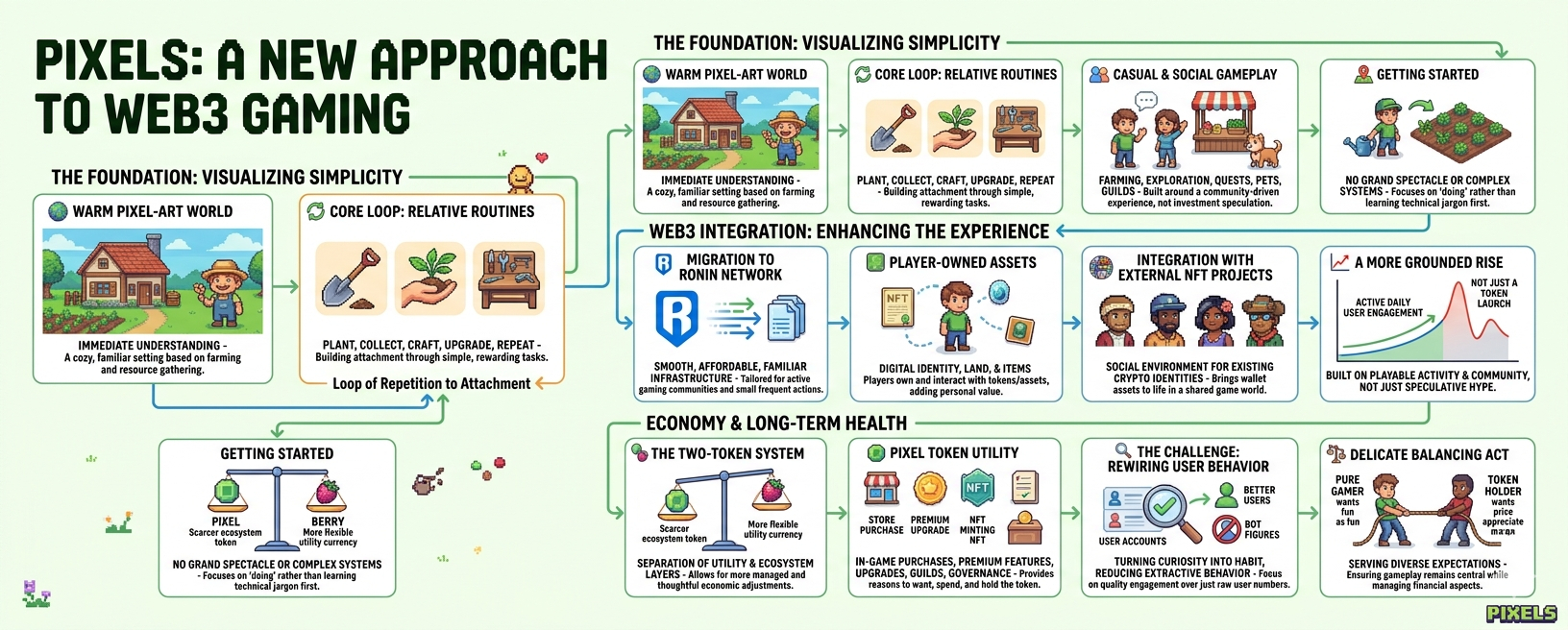

The first thing to understand about Pixels is that it does not behave like the kind of crypto game people usually imagine
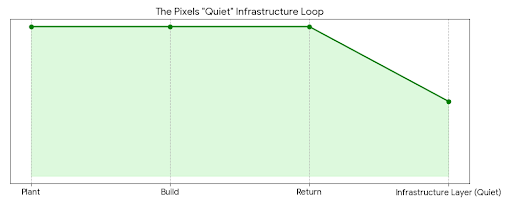
There is no grand science-fiction battlefield demanding a powerful gaming PC. There is no complicated trading terminal greeting players at the door. There is no wall of financial jargon trying to explain why a token matters before the game itself has had a chance to breathe. Pixels begins with something much softer: a farm, a character, a warm pixel-art world, and the familiar satisfaction of planting, collecting, crafting, upgrading, and coming back again
That simplicity is not accidental. It is one of the main reasons Pixels has managed to stand out in a Web3 gaming market crowded with projects that often sound more like investment products than entertainment. At its core, Pixels is a social casual game built around farming, exploration, resource gathering, creation, quests, pets, avatars, and community. The blockchain layer is there, and it matters, but the game’s strongest appeal is not just that players can interact with tokens or digital assets. Its stronger appeal is that it gives people a world they can understand almost immediately
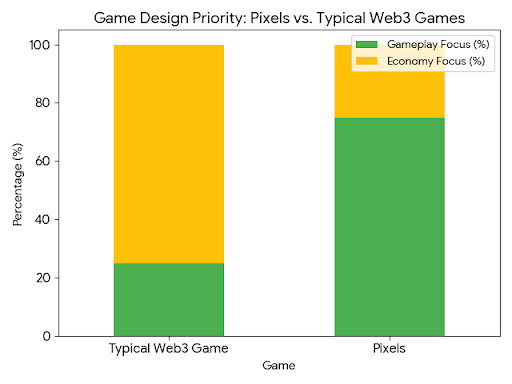
KoA player does not need to be a crypto expert to understand why planting crops, improving land, decorating a space, meeting other players, or completing a quest can feel rewarding. Pixels borrows from a long tradition of comfort-driven games, the kind of games where progress happens slowly and satisfaction comes from routine. Anyone familiar with farming sims, social browser games, or cozy online worlds will recognize the emotional rhythm. You enter a small world. You gather materials. You improve your surroundings. You complete simple tasks. Over time, repetition becomes attachment
That loop is powerful because it does not require spectacle. Farming games are built on small rewards. A crop grows. A skill improves. A rare item appears. A piece of land becomes more personal than it was yesterday. Pixels understands this well. It does not try to overwhelm players immediately with systems, charts, or technical explanations. It gives them something to do first
The game’s world is open-ended enough to feel social, but structured enough to keep players moving. Farming is the foundation, yet the broader experience includes crafting, exploration, quests, land ownership, guild activity, cosmetic identity, pets, events, and community participation. The design does not feel as if it is trying to force every player into the deepest parts of Web3 on day one. Instead, it offers routines. And routines are what live games are made of
A player who logs in every day for a few minutes may eventually become more valuable to a game than someone who arrives during a reward campaign and disappears after claiming whatever is available. That is one of the key challenges Pixels faces: turning curiosity into habit. The game has already shown that it can attract attention. The harder task is convincing people to stay when the excitement settles and the daily experience has to stand on its own
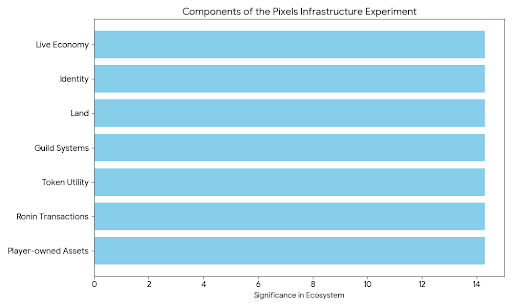 One of the biggest turning points in Pixels’ rise was its move to the Ronin Network. Ronin is best known as the blockchain connected to Axie Infinity, one of the earliest major Web3 gaming success stories. For Pixels, moving to Ronin gave the game access to infrastructure designed with gaming communities in mind. That mattered because a farming game with frequent small actions needs a network that feels smooth, affordable, and familiar to players who are already active in blockchain gaming
Before Ronin, Pixels already had momentum. After the migration, the project became much more visible. Ronin gave it a ready-made audience of Web3 gamers, wallet users, guilds, collectors, and crypto-native communities. Pixels did not have to educate every user from the beginning. Many Ronin users already understood wallets, NFTs, tokens, and digital ownership. That allowed Pixels to focus more on making the game feel active and alive
This is where the project’s growth began to look different from many Web3 games. It was not simply launching a token and hoping people would show up. It already had a playable world. It had daily activity. It had social energy. It had a reason for people to return. That made its rise feel more grounded than the usual cycle of trailers, promises, and speculative excitement
The Ronin move also helped Pixels become part of a larger gaming story. Ronin needed to show that it could support more than one major game economy. Pixels needed a home where blockchain gaming was not treated as an afterthought. The partnership gave both sides something useful. Ronin gained a fast-growing social farming game, while Pixels gained an ecosystem already shaped around player-owned assets and Web3 gaming behavior
At the center of this ecosystem is PIXEL, the game’s native token. Like many gaming tokens, PIXEL is designed to serve several roles. It can be used for in-game purchases, premium features, NFT-related activity, guild systems, upgrades, and future governance. On paper, that may sound straightforward. In practice, token utility is one of the hardest problems in Web3 gaming
A token inside a game has to do more than exist. Players need reasons to want it, reasons to spend it, and reasons not to immediately sell it. If rewards are too generous, the economy can become flooded. If rewards are too limited, players lose interest. If spending options feel weak, the token becomes detached from the game and lives mostly on exchanges. If the game leans too heavily into paid advantages, casual players may feel pushed aside
Pixels is interesting because it appears to understand that tension. Its economy has not been treated as a finished machine. It has been adjusted, debated, and redesigned as the project grows. That is exactly what a live Web3 game has to do. It cannot simply publish a token model and expect the numbers to behave forever. Players adapt. Markets change. Bots appear. Incentives get tested by real behavior
The game has used different forms of in-game value, including BERRY as a more flexible utility currency and PIXEL as the scarcer ecosystem token. This separation gives the developers more room to manage the economy. Everyday gameplay can function through one layer, while PIXEL can be reserved for higher-value systems, premium actions, and deeper participation. It is not a perfect structure, but it is more thoughtful than attaching one speculative token to every action in the game
Success, however, creates its own problems. In Web3 gaming, one of the biggest problems is bots. Any game that allows players to earn value will attract people trying to automate the process. This is not unique to Pixels. It is a structural issue across the whole sector. If a game rewards time and repetition, and those rewards can be converted into money, someone will try to farm them at scale
For a social farming game, this is especially dangerous. Bots can inflate user numbers while weakening the actual community. They can make growth look stronger than it really is. They can drain rewards, distort markets, and make genuine players feel as if the game is being exploited around them. A world that is supposed to feel social can start to feel mechanical if too much activity is driven by extraction rather than interest
That is why Pixels has increasingly focused on the idea of better users, not just more users. Daily active user numbers can be useful, but they can also mislead. A wallet is not always a person. A login is not always loyalty. Activity is not always engagement. The healthier question is not only how many users entered the game, but who is playing because they actually care
That shift matters. A sustainable game economy depends on players who spend, socialize, build, decorate, compete, join guilds, and return because they enjoy the world. A game cannot survive forever by paying people to remain interested. At some point, the interest has to become real. Pixels’ long-term future depends heavily on whether it can keep reducing extractive behavior while still feeling open and welcoming to ordinary players
There is something almost funny about the contrast at the center of Pixels. On the surface, it is a cute farming game. Underneath, it is dealing with some of the most difficult economic design questions in modern gaming. How much should players earn? How much should they spend? What should be free? What should require PIXEL? How should landowners benefit? How should guilds work? How can new players join without feeling late? How can older players be rewarded without turning the economy into a closed club
Traditional games face some of these questions too, especially free-to-play games. But Web3 makes everything sharper because assets and tokens can have external market value. A change in reward rates is not just a balance patch. It can affect player income, token prices, community sentiment, and public perception. That makes Pixels more complicated than it first appears. The farming may be simple, but the system around it is not
This is why Pixels cannot be judged only as a game or only as a crypto project. It is both. Its developers have to think like game designers, economists, community managers, and live-operations strategists at the same time. A normal farming game can adjust crop prices and crafting costs with limited outside consequences. A Web3 farming game has to think about how those changes move through wallets, markets, guilds, landowners, and public discussion
Pixels has also become a gathering place for other Web3 communities. One of its smarter moves has been allowing integrations with outside NFT projects and digital identities. For players who already own crypto assets, Pixels offers a social environment where those assets can feel more alive. Instead of sitting in a wallet or appearing only as a profile picture, a digital identity can become part of a shared game world
This has always been one of the promises of Web3 gaming: your digital identity should not be trapped in one place. A wallet can carry history. An avatar can represent more than a single account. A community can move together across different experiences. In practice, that idea has often been clumsy. Many integrations feel cosmetic, forced, or meaningful only to people already deep inside crypto culture
Pixels makes the idea easier to understand because it places it inside a friendly world. Bringing an NFT identity into a pixel farming game is more approachable than reading a technical explanation of interoperability. It does not fully solve digital identity in gaming, because nobody has done that yet, but it creates a practical version of the idea. It gives communities a place to gather, not just a marketplace where they can trade
The strongest Web3 games are unlikely to win only because of ownership. They will win because people form attachments inside them. Pixels has the ingredients for that. Land gives players a sense of place. Avatars give them identity. Guilds create group goals. Pets and decorations add personality. Events create shared memories. Quests create direction. Even simple farming routines create a reason to return
A game world becomes valuable when players begin to treat it as part of their daily rhythm. That is why the social side of Pixels may prove more important than any single token feature. Tokens can attract attention quickly, but community keeps attention alive. This is also where Pixels has an advantage over more complex blockchain games. It is easy to explain. It is easy to watch. It is easy to imagine someone playing casually. That accessibility gives it a wider potential audience than games built only for crypto veterans
The challenge is that mainstream players are still skeptical of blockchain. Many do not want to think about wallets or tokens when they play. Some associate crypto games with speculation, scams, poor design, or pay-to-win mechanics. Pixels has to make its Web3 systems feel optional, useful, or invisible enough that they do not interrupt the charm of the world. The less the game feels like a lecture about blockchain, the better chance it has of reaching players outside the usual crypto crowd
Pixels also represents a shift in how serious Web3 games are being judged. A few years ago, the industry often rewarded ambitious promises. Projects could attract attention with cinematic trailers, massive metaverse plans, complicated token economies, and roadmaps full of future features. The market was willing to believe before it could play
That period has become much less forgiving. Players now want working games. Investors want evidence of retention. Communities want transparency. Token holders want sustainable demand. Developers need to prove that blockchain improves the experience rather than simply adding a speculative layer to it
Pixels has benefited from this shift because it actually gives people something to do. The game may look simple, but in Web3 that simplicity is a strength. It reduces friction. It makes the product understandable. It gives the project room to grow without asking players to decode an entire financial system at the start. The lesson is clear: the future of Web3 gaming may not look like a futuristic battlefield or a high-budget metaverse. It may look like a small farm
Still, Pixels faces a delicate balancing act. The more visible the PIXEL token becomes, the more financial expectations attach themselves to the game. Some players care about gameplay. Others care about price. Some join for community. Others arrive for rewards. These groups do not always want the same thing
A pure gamer may want fairness, fun, and meaningful progression. A token holder may want scarcity, demand, and price appreciation. A landowner may want stronger land utility. A free player may want fewer barriers. A developer must somehow serve all of them without letting the game lose its identity
This is the danger for any Web3 game with a real token. The market can become louder than the world. Pixels’ best chance is to keep making the game itself more valuable. More content, better progression, richer social systems, stronger customization, and smarter spending options can help shift attention back toward play. If players want PIXEL because it improves their life inside the game, the economy becomes more natural. If they want it only because they expect someone else to buy it later, the project becomes far more fragile
There is also a strong argument that casual and social games are better suited to blockchain than many competitive games. In a farming or social world, digital ownership feels more intuitive. Land, decorations, pets, wearables, resources, and identity items all make sense as ownable assets. Players already understand collecting and customizing. They already value status and self-expression. They already accept that virtual goods can matter emotionally
By contrast, adding tokens to highly competitive games can create immediate concerns around pay-to-win mechanics, balance, cheating, and fairness. Casual worlds have more flexibility. They can build economies around expression, convenience, access, and community rather than pure advantage. Pixels fits that pattern. Its Web3 features feel most natural when they support identity and participation rather than extraction
A player does not need to think like a trader to understand why a rare pet, a piece of land, or a customized avatar might matter. That is where blockchain can become less abstract. Ownership becomes easier to understand when it is attached to something charming, visible, and useful
For all its progress, Pixels is still an unfinished experiment. It needs to prove that it can retain players after the excitement of token launches and reward campaigns fades. It needs to show that its economy can remain healthy across different market cycles. It needs to keep bots under control. It needs to give PIXEL enough meaningful utility without making the game feel overly gated. It needs to keep free players interested while rewarding serious participants
Most importantly, it needs to keep being enjoyable
That sounds simple, but it is the hardest requirement. Web3 games often become so focused on incentives that they forget emotion. People do not fall in love with tokenomics. They fall in love with places, characters, progress, memories, and communities. Pixels has a chance because it begins with those softer things. The farm comes before the market. The world comes before the wallet. The daily routine comes before the economic theory
That order may be the reason it has survived where many louder projects have struggled
Pixels is not important because it has solved Web3 gaming. It has not. No project has. It is important because it is asking the right questions in a playable form. Can a blockchain game feel casual instead of intimidating? Can a token economy support play rather than replace it? Can digital ownership become part of a social world without turning every action into a transaction? Can players care about a Web3 game for reasons beyond earning
Pixels’ answer is still being written, crop by crop, update by update, player by player
What makes the project compelling is not that it promises a revolution. It is that it makes the revolution look ordinary. A person logs in. They tend a farm. They talk to others. They collect something. They spend a little. They return tomorrow
That is how lasting games are built. Not through hype alone, but through habits
For Web3 gaming, Pixels may turn out to be more than another token-backed project. It may become proof that blockchain games do not need to announce themselves with complexity. They can begin quietly, with a field, a character, and a reason to come back
