

As Wall Street's intentions become clearer, a new monetary order blending traditional finance with the crypto market is taking shape. One of the earliest to see this is that Wall Street star fund manager—Cathy Wood.
1. The Shift of Bitcoin's Anchor Point
In 1944, in Bretton Woods, New Hampshire, 44 countries signed an agreement to peg the dollar to gold, creating order for the post-war world. That system collapsed when Nixon closed the gold window in 1971—but it never truly disappeared; it just morphed.
Today, in 2026's Wall Street, a new anchor is quietly being established. But this time, the anchor isn't gold, nor any national currency, but a digital protocol with a capped supply of 21 million coins that will never inflate: Bitcoin.
If you still see Bitcoin as merely a 'speculative asset' today, you might be missing the most important chess game of our era.

2. Cathie Wood's foresight
In 2015, Cathie Wood publicly took a bullish stance on Bitcoin when it was around $250, and was mocked by her peers as a 'tech geek who doesn't understand value.'
At that time, no one thought she was seeing not just the price of Bitcoin, but the outline of a new monetary order.
She defines Bitcoin as a 'rules-based monetary system,' directly paralleling the monetary vacuum that followed the closure of the gold window in 1971. Her core judgment: the debt fragility of fiat systems, combined with the emerging market's thirst for trustworthy currency, is creating demand for a 'trust-minimized' underlying asset.
ARK Big Ideas 2026 report predicts: total crypto market cap could reach $28 trillion by 2030, with Bitcoin accounting for about 70%, implying a price benchmark of around $800,000, with a bullish case of about $1.2 million.
Cathie Wood's insight lies in the fact that she is not analyzing an asset; rather, she is analyzing a systemic replacement. Just like analysts in 1944 couldn't understand the significance of the Bretton Woods Agreement by only focusing on 'gold prices.'
3. The supply-demand structure of the new system
Demand comes frominstitutions, ETFs, corporate treasuries, and potential sovereign nations;
Supply is capped at 21 million plus 5 million permanently lost, with halvings every four years.This isn't just a 'scarcity hype' story; it's the pricing logic of a strategic reserve asset.
A structural explosion on the demand side is happening. Traditional giants like BlackRock and Fidelity are classifying Bitcoin as 'digital gold' for inclusion in their portfolios, with weekly ETF inflows peaking close to $1 billion. The next step is sovereign nations and pension funds—this is the moment when the 'New Bretton Woods' moves from concept to reality.
On the supply side, there is a permanent tightening. The next halving in 2028 will compress daily issuance to just about 225 BTC, combined with over 5 million permanently lost BTC, leading to a continuous reduction in actual circulation. Institutions are no longer 'transients' but 'foundation builders.'
The traditional 4-year cycle is being 'de-cycled' by the ongoing ETF buying frenzy. Fidelity calls 2026 an 'off year' (a year of consolidation), but after the 2028 halving, institutional demand will push prices directly into a new paradigm range.
4. Three future scenarios for BTC prices

Bear case $150,000–$300,000 Probability 20–25%
A macro recession combined with unexpected regulations could slow ETF inflows, and BTC may still be viewed as a 'high beta asset' rather than a core foundation. Construction speeds may slow, leading to a mild revaluation.
Base case $400,000–$800,000 Probability 50%
Wall Street will truly cement BTC as the core foundation of the new system, with ETF inflows continuing at $500 billion to $1 trillion annually, while the 2028 halving creates a super supply-demand gap. Both Standard Chartered and ARK place benchmarks within this range.
Bull case $800,000–$1,500,000+ Probability 25–30%
Value shift is fully realized: sovereign nations and central banks will incorporate BTC into the new Bretton Woods reserves. The trifecta of ETFs, corporations, and nations will drive FOMO post-2028 halving, compounded by supply shocks.
Integrating the most likely pathways:
By the end of 2029, $400,000–$600,000,
By 2031, $600,000–$1,000,000.
This isn't a price prediction; it's an inevitable pricing of systemic reconstruction.
5. Her foresight and our era
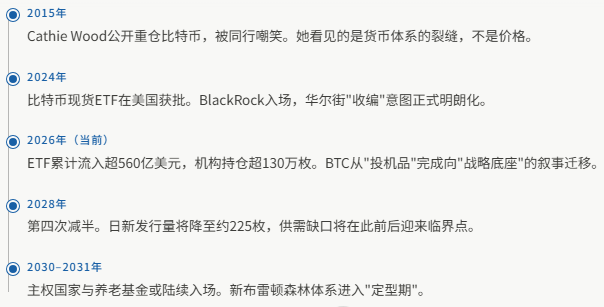
In 2015, Cathie Wood publicly loaded up on Bitcoin and was ridiculed by peers. She saw the cracks in the monetary system, not just the price.
In 2024, the Bitcoin spot ETF will be approved in the U.S. BlackRock enters the arena, and Wall Street's intention to 'recruit' becomes clear.
By 2026 (current year), ETF inflows exceed $56 billion, with institutional holdings over 1.3 million BTC. BTC completes the narrative shift from 'speculative asset' to 'strategic base.'
In 2028, the fourth halving occurs. Daily issuance will drop to around 225 BTC, and the supply-demand gap will reach a critical point around that time.
In 2030-2031, sovereign nations and pension funds will gradually enter the market. The new Bretton Woods system will enter a 'maturation phase.'
Conclusion
The essence of Bretton Woods is to establish a foundation of trust amidst chaos. 1944 was about gold, and 2026 will be about algorithms and consensus. Cathie Wood discerned this logic early, not because she was smarter, but because she has always been asking a bigger question: When the old anchors fail, what will the world choose as the new anchor?
Half a year ago, just transitioning from traditional finance to crypto, I couldn't grasp the inner logic behind Cathie Wood's $1.5 million target for Bitcoin. Like many Chinese crypto KOLs, I thought she was just shooting from the hip...
Times change, and now, after running simulations, I genuinely admire Cathie Wood as a Wall Street fund manager; she's truly impressive!