
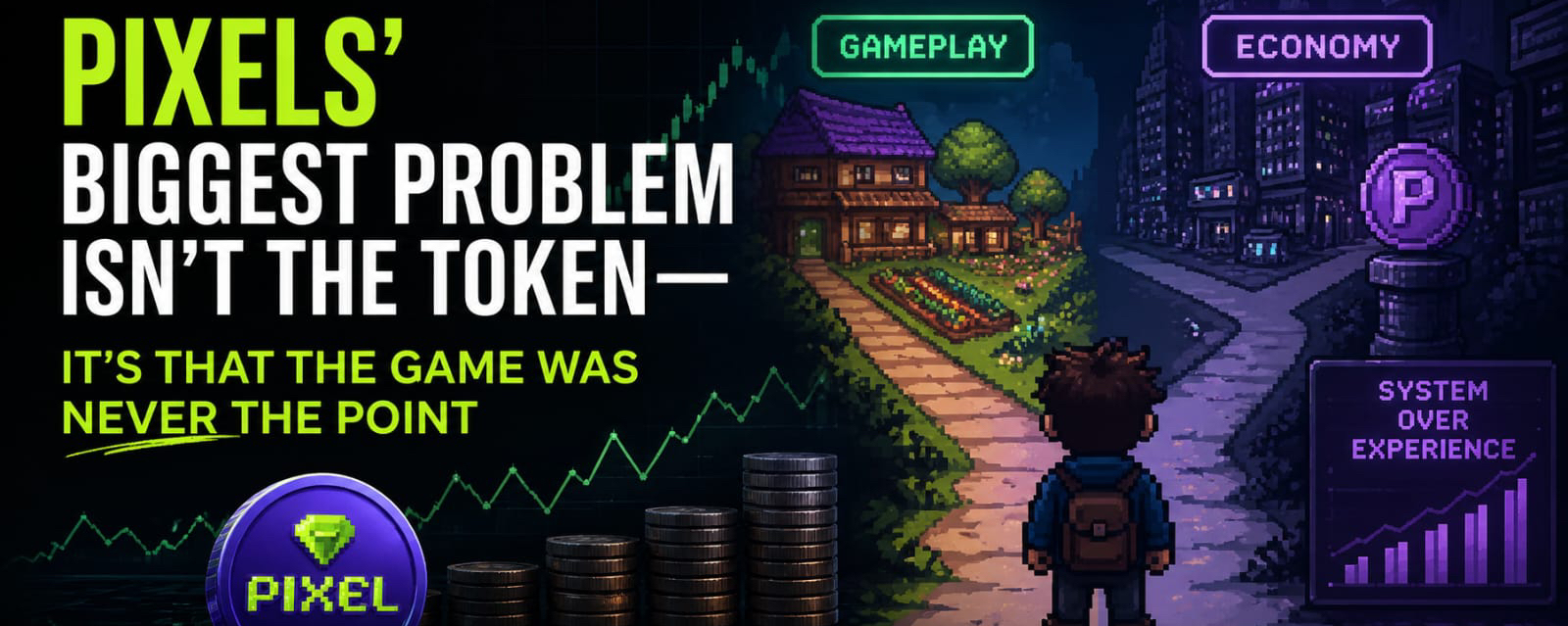
I’ve spent enough time inside Pixels to realize something that most people are still dancing around instead of saying directly: the issue isn’t the token, it’s not inflation, and it’s not even the usual GameFi cycle of hype and collapse. The real problem is more uncomfortable than that. The game itself was never the point. And once you see it, you can’t unsee it.
At first glance, everything looks familiar. You spawn into a pixelated world, you farm, you gather, you craft, you trade. It feels like a nostalgic loop, something inspired by classics but modernized with blockchain ownership layered on top. It feels simple, even relaxing. But that feeling doesn’t last long. Because very quickly, your decisions stop being about gameplay and start being about optimization. Not fun optimization, but economic optimization. You’re not asking “what should I do next?” You’re asking “what gives the best return per action?”
That shift is subtle, but it changes everything.
The more I played, the more I noticed that every meaningful progression path was tied not to creativity or mastery, but to participation in a controlled economic system. The crops you grow, the resources you gather, the actions you take — they’re all inputs into a bigger machine. And that machine isn’t designed to entertain you first. It’s designed to regulate value, manage emissions, and drive spending.
This is where most people get distracted by the token. They look at $PIXEL and say the usual things: inflation, unlocks, price pressure. But focusing only on the token is like blaming the fuel instead of the engine. The token is just a tool. The real design choice is the system it’s plugged into.
And that system is built around one core idea: spending drives sustainability.
On paper, that sounds smart. Traditional play-to-earn models collapsed because they rewarded extraction without enough inflow. Axie Infinity showed exactly how fast an economy can break when rewards outpace demand. So Pixels went the other way. Instead of rewarding players for simply playing, it created a structure where value flows back into the system through premium actions, upgrades, and gated progression.
It’s a correction. But it comes with a cost.
Because when spending becomes the backbone of the economy, gameplay becomes secondary. Not intentionally, maybe. But structurally, it has to.
I started noticing it in small moments. Tasks that felt repetitive weren’t just repetitive — they were intentionally limited in reward unless you upgraded something. Progression wasn’t blocked outright, but it slowed down just enough to push you toward “optional” advantages. And those advantages weren’t cosmetic. They were functional. They affected your efficiency, your output, your ability to compete.
That’s when it clicked for me: this isn’t a game where you play to progress. It’s a system where you engage to optimize.
And that distinction matters more than most people think.
Because in a real game, the core loop is satisfying on its own. Progression enhances the experience, but it isn’t required to justify it. In Pixels, progression often feels like the justification for the loop itself. You’re not farming because farming is fun. You’re farming because it feeds into something bigger — an economy that constantly nudges you to move faster, produce more, and eventually, spend.
There’s also a social layer that reinforces this. Guilds, land ownership, production chains — all of it creates a hierarchy. Not an explicit one, but a functional one. Players with more resources, better tools, and premium access don’t just progress faster. They operate on a different level entirely. They become part of the system’s upper layer, where efficiency compounds and opportunities expand.
Meanwhile, casual players exist in a different reality. They can still play, still progress, still participate. But the gap is always there, quietly widening.
And this is where the “game was never the point” argument becomes hard to ignore.
Because if the primary experience pushes you toward economic participation rather than pure enjoyment, then what you’re really engaging with isn’t a game in the traditional sense. It’s a gamified economy.
That doesn’t make it bad. In fact, it might be exactly what makes it sustainable.
Pixels is one of the few projects actively trying to solve the biggest problem in Web3 gaming: how do you create a system that doesn’t collapse under its own rewards? And to its credit, it’s doing things differently. It uses sinks, controlled emissions, and models like return on reward spend to balance the flow of value. It’s not blindly printing rewards and hoping for the best.
But sustainability alone doesn’t make something engaging.
And that’s the tension at the heart of Pixels.
The more efficient the economy becomes, the more it risks reducing gameplay to a series of optimized actions. The more it rewards spending, the more it risks alienating players who came for the experience, not the system. And the more it leans into economic design, the harder it becomes to maintain the illusion that the game itself is the main attraction.
What makes this even more interesting is how well it works — at least in terms of retention and activity. Millions of players have interacted with the ecosystem, and daily engagement has been strong compared to most Web3 titles. Built on Ronin Network, it benefits from low fees, fast transactions, and an existing gaming audience. It’s accessible, it’s scalable, and it’s constantly evolving.
But high activity doesn’t necessarily mean high satisfaction.
Sometimes it just means the system is effective.
And Pixels is very effective.
It keeps players coming back. It gives them goals. It creates loops that feel meaningful. But underneath all of that, there’s a question that keeps getting louder the longer you stay in it: if you remove the economic incentives, what’s left?
Would people still log in every day?
Would they still grind the same loops?
Would they still care about optimizing their output?
For most players, I don’t think the answer is clear. And that uncertainty is the real signal.
Because great games don’t rely on external incentives to justify themselves. They stand on their own. The economy enhances them, not defines them.
In Pixels, it often feels like the opposite.
The economy isn’t supporting the game. The game is supporting the economy.
And once you start seeing it that way, everything else starts to make more sense. The design choices, the progression systems, the emphasis on premium features, the careful balancing of rewards — it’s all aligned around maintaining a functioning system, not just delivering a fun experience.
That doesn’t mean Pixels is failing. If anything, it might be one of the most honest experiments in the space right now.
It’s showing us what happens when you prioritize sustainability over pure gameplay. When you design a world where value flows are controlled, where spending is incentivized, and where progression is tightly linked to participation in an economic loop.
The real question isn’t whether that model works.
It’s whether players actually want it once the novelty fades.
Because if the game was never the point, then eventually, players will start asking what is.