

Let’s be real for a second: Web3 gaming has been trying to sell the same shiny dream for years, and most of us have watched it crack in real time.
Play a game. Earn tokens. Own your stuff. Maybe cash out. Maybe change your life.
It sounds great in a pitch deck. It sounds even better when markets are green, Discord is screaming, and everyone is pretending they discovered the future before everyone else. But inside an actual game? It can get weird fast.
Because the moment money walks into the room, fun starts acting differently.
A crop is not just a crop anymore. It is yield. A quest is not a quest. It is a route. A rare item is not a cool little thing you earned after playing too late on a Tuesday night. It is something to price, list, flip, or stress over. Suddenly, the warm little world of pixelated farming and late-night chats gets dragged into the cold glow of wallets, tokens, and market charts.
That is the trap Pixels has to avoid.
Pixels has charm. That matters more than crypto people sometimes admit. It is not trying to look like a sci-fi war machine or a spreadsheet with character skins. It is a social farming game with crops, resources, land, tasks, avatars, and that soft pixel-world feeling that makes you think, “Okay, I’ll just check in for five minutes.”
Five minutes becomes twenty.
That is how games win.
Not by shouting. Not by promising everyone a payday. Not by dressing up a token economy as a personality. Games win when people quietly build habits around them. When a player opens the game because their farm needs attention. Because someone might be online. Because there is one more upgrade to finish. Because their little corner of the world feels unfinished without them.
That sounds small. It is not.
Small is where retention lives.
Pixels sits in a tricky place because it is both cozy and crypto. It wants the warmth of a casual farming world, but it also carries all the baggage of Web3 gaming: tokens, ownership, speculation, reward loops, marketplace thinking, and that familiar gold rush fever that turns normal players into part-time economists.
I have seen this movie before, and it usually ends in a crash if the game forgets what it is supposed to be.
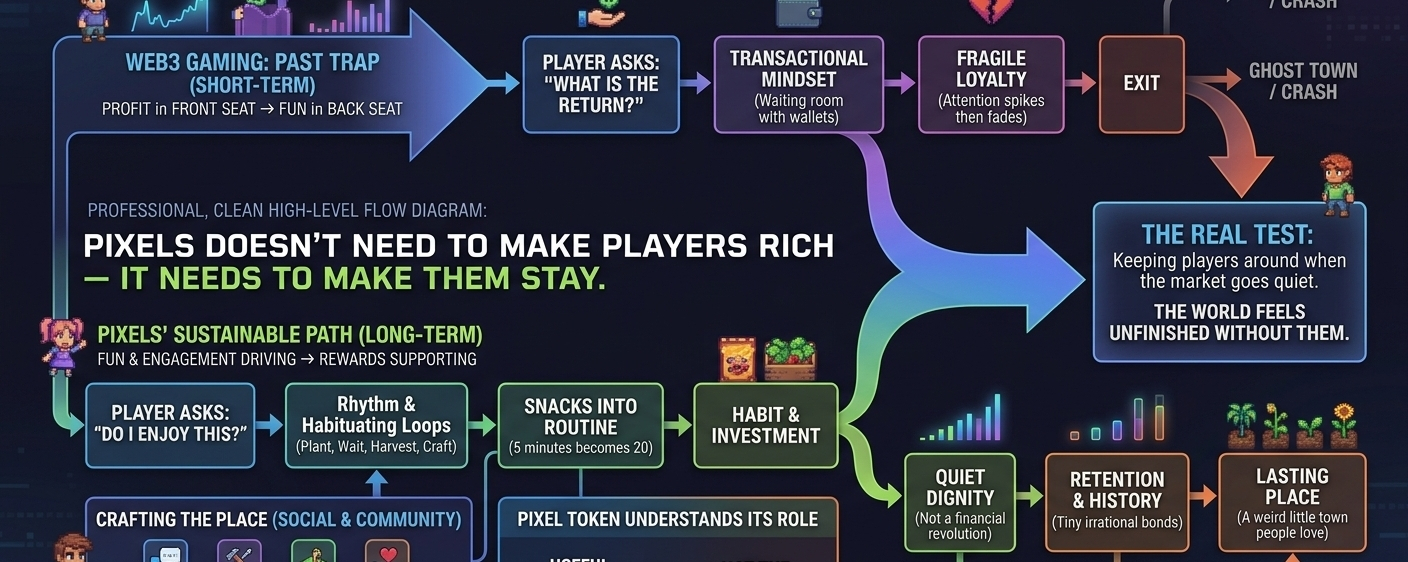
The mistake Web3 games keep making is not that they let players own things. Ownership can be interesting. It can make digital items feel less disposable. It can give players a stronger connection to what they earn and build. The mistake is putting profit in the front seat and asking fun to ride in the back.
Once that happens, the game starts rotting from the inside.
Players stop asking, “Do I enjoy this?” and start asking, “What is the return?” That question is poison if it becomes the main reason people log in. It makes every update feel like a policy decision. Every balance change becomes personal. Every reward adjustment starts a small fire. If the token goes down, the mood goes down with it. If another game offers better earning, people drift away like they were never really there.
That is not a community. That is a waiting room with wallets.
Pixels cannot survive long-term by becoming another place where people arrive, extract, and leave. It needs something stickier than rewards. Something more human.
And honestly, it already has the shape of that.
A farming game does not need to punch you in the face with excitement. It is built on rhythm. Plant. Wait. Harvest. Craft. Upgrade. Decorate. Wander around. Talk to someone. Get distracted. Come back later. There is a softness to that loop when it is done well. It gives the player a sense of return, almost like checking a small garden outside your house.
That is why casual games can be dangerous in the best way. They sneak into your routine.
You do not always remember the exact day a game became part of your life. It just happens. You start logging in after dinner. You check progress before bed. You recognize names. You learn the map without thinking. You get annoyed when something changes because, somewhere along the way, the game stopped being “content” and became a place.
Pixels needs to become a place.
Not a faucet. Not a dashboard. Not a cute wrapper around token farming.
A place.
That means the farm has to feel like more than a production machine. Land should feel personal. Items should carry memory. Customization should have taste. Social spaces should feel alive when there is no major campaign running. Players should have reasons to hang around even after the obvious tasks are done.
That is hard, by the way. Much harder than launching a token and watching attention spike for a while.
Anyone can create noise when money is involved. Keeping people around after the noise fades is the real craft.
The danger is that Pixels could accidentally train its own players to care about the wrong thing. If the best way to play is also the most boring way to play, many players will choose boredom. Of course they will. People optimize. They always have. Give players a reward path, and someone will grind it until there is nothing left but dust and resentment.
In a normal game, that can already be a problem.
In a Web3 game, it becomes toxic because the grind has a price tag attached.
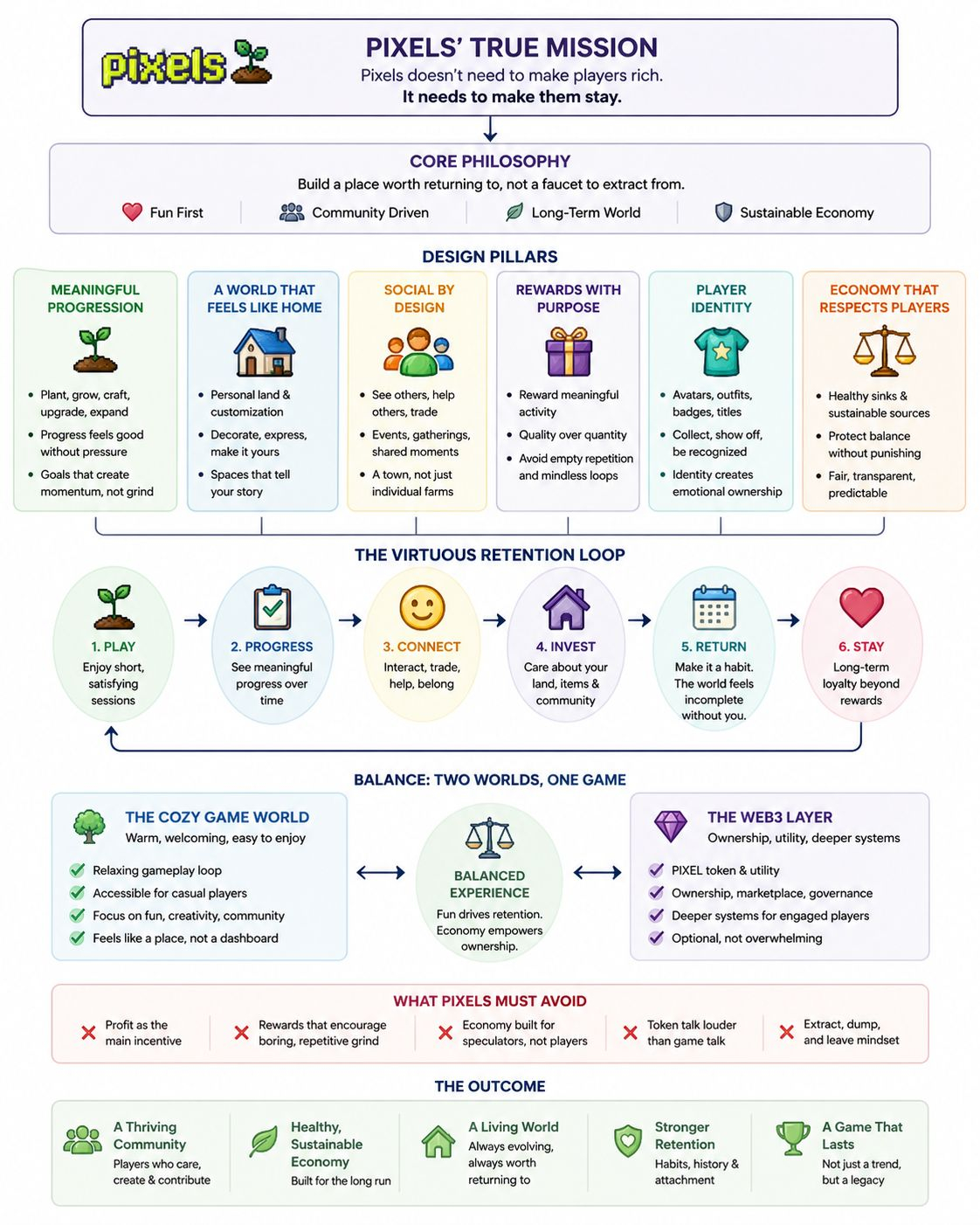
So Pixels has to be careful about what it rewards. Empty repetition should not become the highest form of participation. The player who makes the world feel alive should matter. The player who builds useful spaces should matter. The player who helps newcomers, hosts social moments, collects for identity, decorates with care, or simply shows up every day without treating the game like a slot machine — those players are the ones who make a world feel inhabited.
The spreadsheet player will always exist. Fine. Let them have depth. Let them optimize. Let them chase margins.
But do not build the whole soul of the game around them.
Because then the world gets cold.
And Pixels, at its best, should not feel cold. It should feel like a strange little town where people farm, trade, decorate, joke around, compare progress, and occasionally care too much about a digital object that looks ridiculous to outsiders. That is gaming. That is how attachment forms. Not through perfect systems, but through tiny irrational bonds.
A player does not stay because every mechanic is balanced beautifully. They stay because they have history there.
Maybe they remember when their land looked terrible. Maybe they remember the first item they actually wanted. Maybe they met someone who made the game less lonely. Maybe they just like the sound of finishing a task after a long day.
You cannot put all of that into a token model.
Crypto can support it. It cannot replace it.
PIXEL, the token, should understand its role. It can be useful. It can power premium items, upgrades, cosmetics, special features, governance, and deeper economic play. It can give committed players something extra to care about. But the token should not become the main character.
The moment PIXEL becomes louder than Pixels, the game has a problem.
You have probably seen this happen. A project launches with an actual idea, then slowly every conversation turns into price, supply, unlocks, emissions, listings, rewards, and whether the next update is “bullish.” The world disappears. The people disappear. The game becomes a lobby for speculation.
That is a recipe for a ghost town.
Pixels needs players talking about what they built. What they found. Who they met. What they are saving for. Which area feels alive. Which event was fun. Which mechanic needs work. Token talk will always be there because this is Web3. Fine. But it cannot be the only music playing.
The healthiest version of Pixels is one where a casual player can enjoy the game without feeling like they need a finance degree, while a deeper Web3 player still has meaningful systems to explore. That balance is not glamorous. It is not the kind of thing that gets easy hype. But it is exactly what separates a real game from a temporary reward farm.
Ronin makes this more interesting, and also more loaded.
Pixels being on Ronin gives it access to an audience that already understands blockchain gaming. That is useful. It lowers friction. It brings players who know wallets, assets, marketplaces, and the strange emotional weather of crypto communities.
But Ronin also carries history. You cannot talk about Ronin without the shadow of Axie Infinity somewhere nearby. Axie proved Web3 games could attract enormous attention. It also showed what happens when earning expectations grow bigger than the game itself. Once a game becomes income first and entertainment second, every crack in the economy feels like betrayal.
Pixels has the chance to learn from that without becoming trapped by it.
It does not need to reject earning. That would be fake. Rewards are part of the appeal. Ownership is part of the pitch. Some players will always come because they smell opportunity. That is not wrong.
But Pixels should not build its future around gold rush fever.
Gold rush towns do not age well.
They boom, they empty, and then somebody writes a nostalgic thread about what could have been.
The better path is slower. Less sexy. More durable.
Make the world worth returning to. Make daily play feel good without turning it into homework. Give long-term players goals that do not all depend on token output. Let social play matter. Let creativity matter. Let identity matter. Build sinks that make sense. Protect the economy without punishing ordinary players. Make new users feel welcomed instead of hunted.
And please, keep the language of the game warmer than the language of the wallet.
Because that contrast is the whole story here. Web3 talks in wallets, tokens, emissions, staking, liquidity, governance. Games talk in places, habits, friends, memories, jokes, mistakes, favorite outfits, ugly farms, lucky drops, and staying up too late because one more task somehow became six more tasks.
Pixels has to live in both worlds, but it should know which one keeps people around.
People do not fall in love with infrastructure.
They fall in love with the little mess of being somewhere.
That is why the “make players rich” dream is so thin. It sounds powerful, but it creates fragile loyalty. If the money is the reason people arrive, money can also become the reason they leave. A richer reward somewhere else, a weaker token chart, one ugly market week — suddenly the crowd moves on.
But if players feel rooted, the math changes.
They may complain. Gamers always complain. They may leave for a while. They may come back months later and act like they never left. That is normal. That is healthy. A real game community has moods. It has arguments. It has inside jokes. It has people who care enough to be annoying.
Pixels should want that kind of annoying.
It should want players who are invested in the world, not just the withdrawal path. Players who notice when social areas feel empty. Players who ask for better tools. Players who decorate badly but proudly. Players who bring friends in and say, “Just try it, it’s weirdly relaxing.”
That sentence is worth more than a thousand hype posts.
There is also a quiet dignity in not trying to be everything. Pixels does not need to become the biggest financial revolution in gaming. It does not need to save Web3. It does not need to prove that every digital cabbage should be an asset class.
It just needs to be good enough, warm enough, and deep enough that people keep coming back.
That sounds modest until you realize how many Web3 games never get there.
Most of them chase the entrance. The launch. The mint. The listing. The campaign. The spike. Pixels needs to obsess over the return. The second week. The third month. The boring Tuesday when nothing major is happening and a player still logs in because their little world feels unfinished.
That is the real test.
Not whether Pixels can attract a crowd when rewards are loud.
Whether it can keep a town alive when the market goes quiet.
