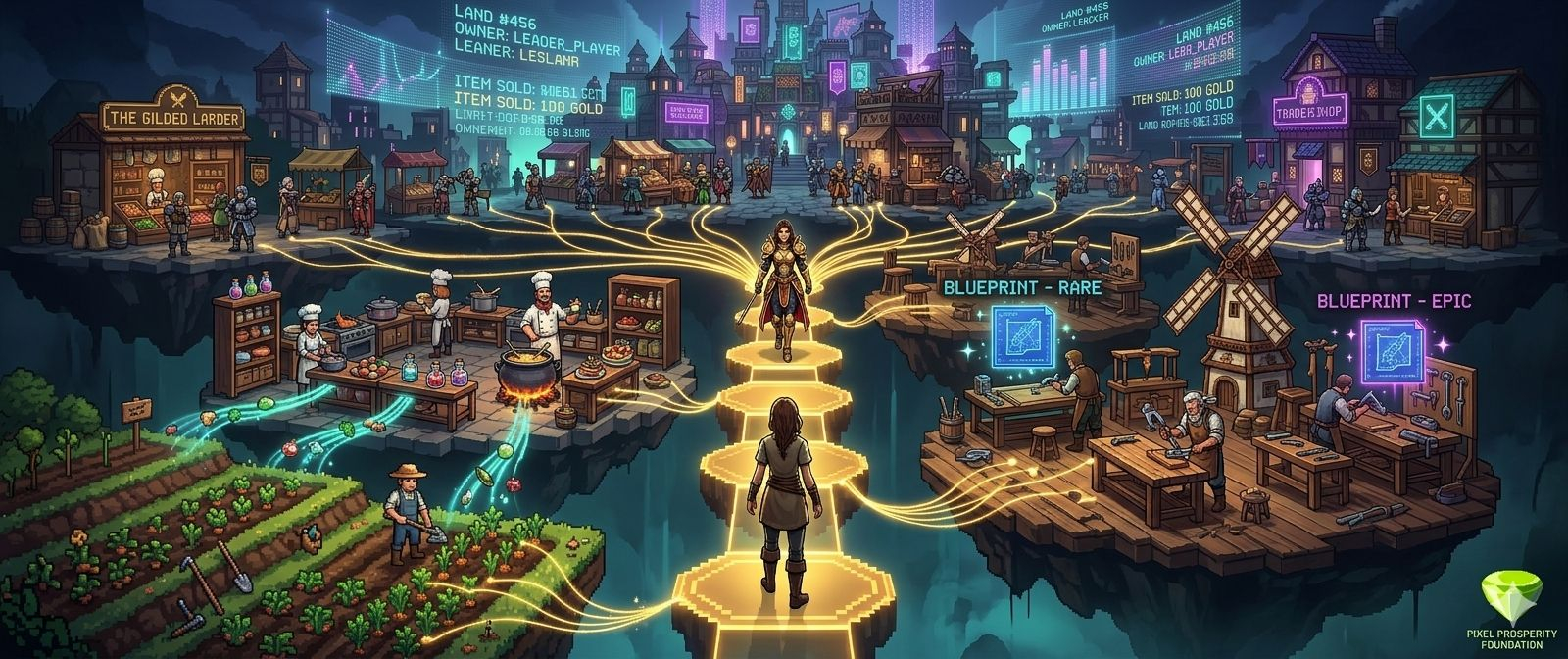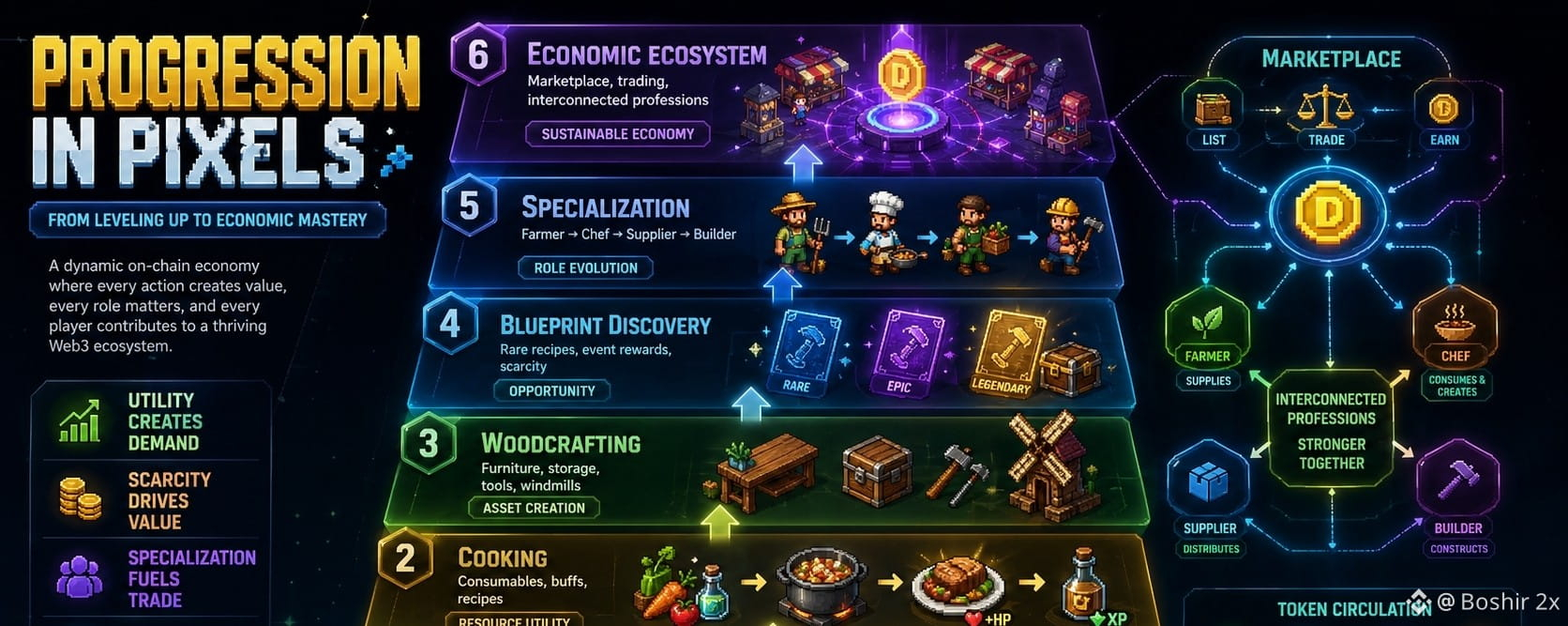
At first glance, progression in Pixels looks pretty familiar.
Level up, unlock new mechanics, access better resources.
Standard game design.
But the more I looked into it, the more it felt like Pixels is using progression for something bigger than simple player retention.
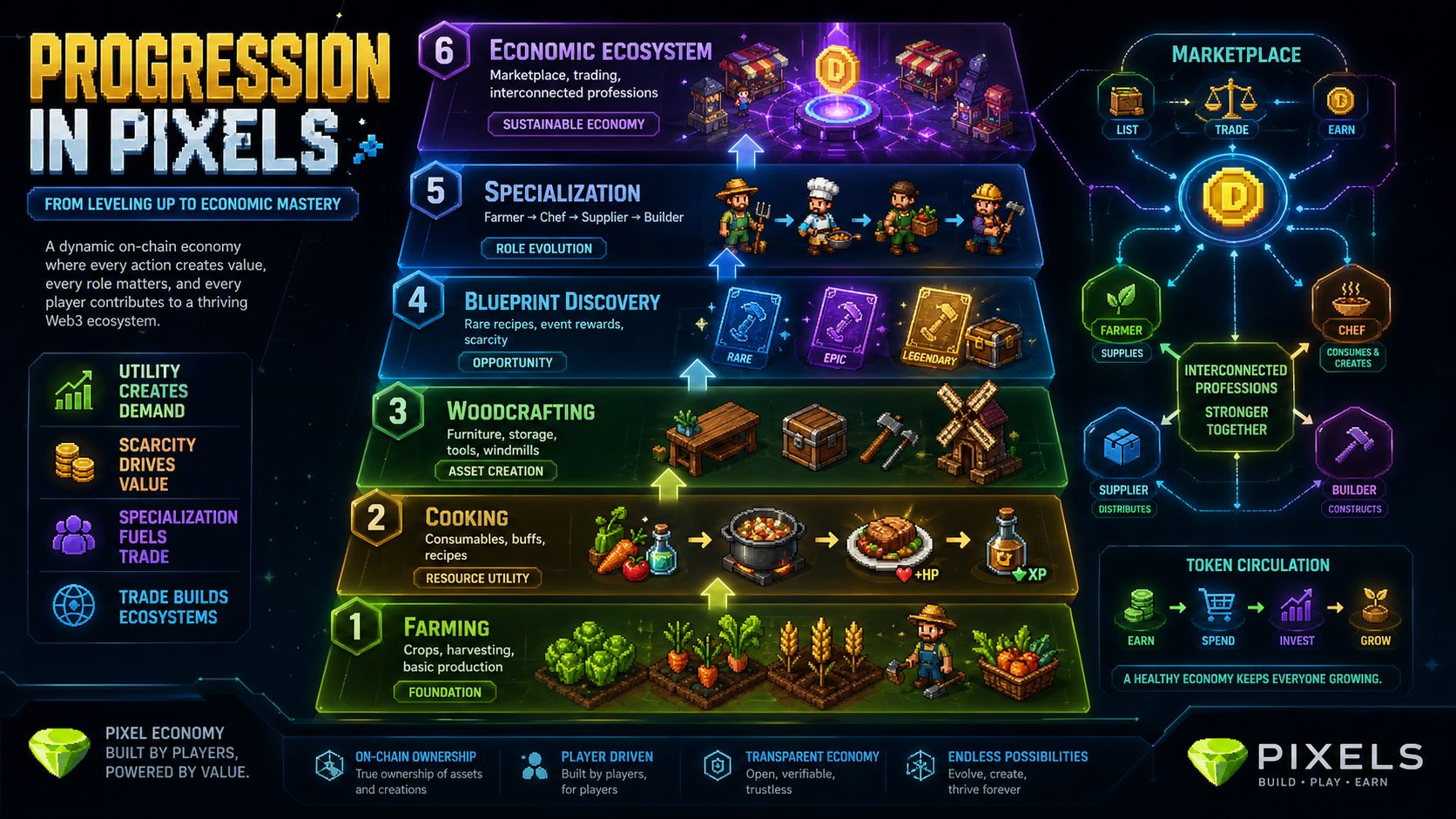
It's building layers.
Every stage of progression opens up entirely new parts of the economy.
Not just stronger tools or faster farming—but entirely new industries.
And that's where things get interesting.
Take Cooking, for example.
On the surface, it's just another skill.
But it's actually much more than that.
Cooking introduces consumables, buffs, and recipe discovery.
That means resources gain new utility.
It creates demand for ingredients that might otherwise be overlooked.
A simple crop can suddenly become part of a larger production chain.
That's how real economies start to form.
Then there's Crafting.
Or more specifically, Woodcrafting.
This is where progression begins to intersect with ownership.
Players aren't just producing consumables anymore.
They're creating assets.
Furniture, storage, tools, windmills—even housing upgrades.
Some items are decorative.
Others have direct utility.
That distinction matters.
Because utility creates long-term demand.
And long-term demand creates sustainable markets.
But the part I find most compelling is the blueprint and recipe system.
Not everything is immediately available.
Players must progress, participate in events, or simply get lucky.
That scarcity changes behavior.
It encourages exploration.
It rewards commitment.
And it gives certain discoveries real economic value.
A rare blueprint isn't just content.
It's opportunity.
This design also helps Pixels avoid a common GameFi problem.
In many blockchain games, progression often feels shallow.
Numbers go up, but gameplay stays largely the same.
Pixels seems to be aiming for the opposite.
As players advance, their role inside the ecosystem evolves.
A farmer can become a chef.
A chef can become a supplier.
A crafter can become a builder.
And each transition opens new strategic choices.
That's important.
Because meaningful progression isn't just about power.
It's about possibility.
The more options players unlock, the deeper the game becomes.
And deeper games usually create stronger communities.
They also create stronger economies.
Because specialization naturally leads to trade.
Trade leads to markets.
Markets lead to ecosystems.
In that sense, Pixels isn't simply designing progression.
It's designing economic complexity.
Of course, balance will always matter.
Too much complexity can overwhelm new players.
Too little can make veterans lose interest.
Finding that middle ground is difficult.
But the framework looks promising.
Pixels understands that progression should do more than keep players busy.
It should make them feel increasingly important.
More capable.
More connected.
More invested.
And in a game built around ownership and economy...
that might be the most valuable upgrade of all.