
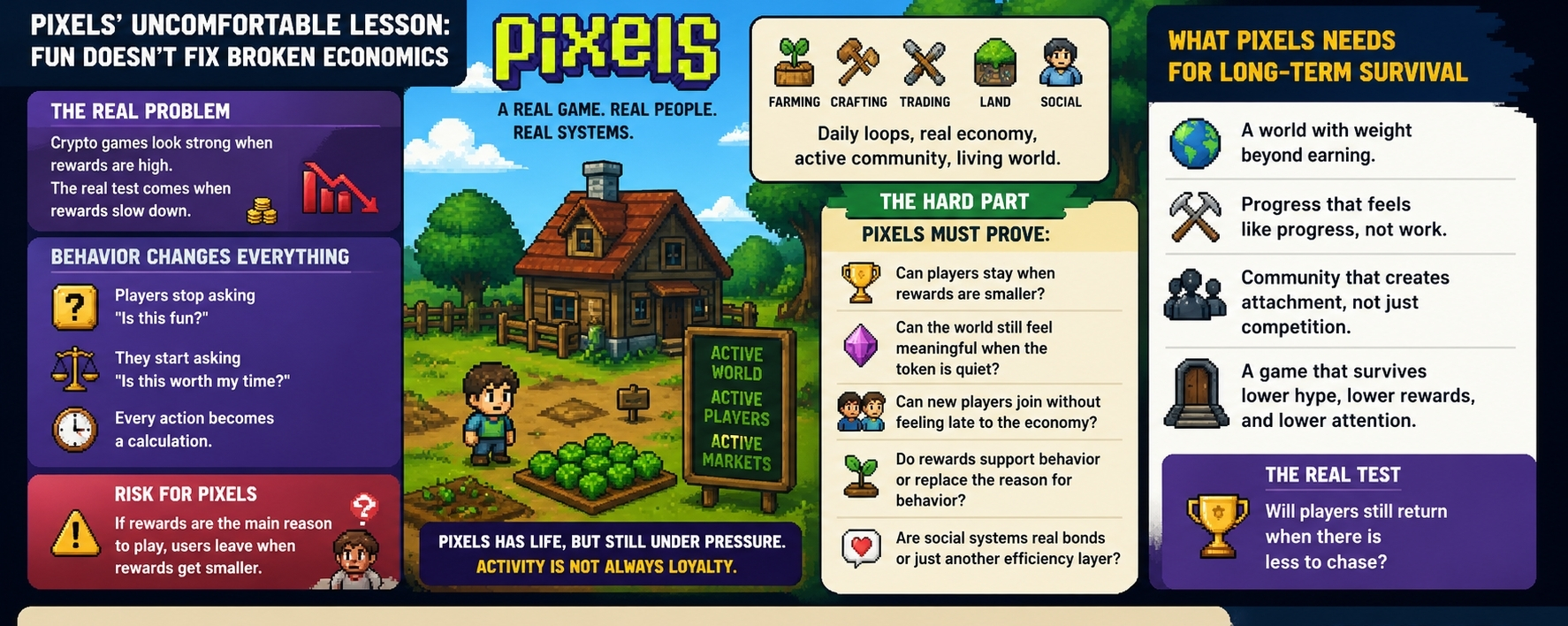

I’ve noticed Pixels keeps bringing me back to the same question: can a crypto game stay alive because people genuinely care about playing, or does it still depend too much on rewards to keep attention moving? That question matters because Pixels is not an empty project.
It has a real world, real loops, real players, and a daily rhythm that many Web3 games never manage to build. People farm, craft, trade, manage land, follow updates, and return because there is always something happening. But that does not automatically mean the economics are safe. This is where Pixels becomes interesting to me.
It feels more honest than a lot of crypto games because it shows the tension clearly. The game can be active and still be under pressure. The community can be busy and still be uncertain. The economy can move every day and still need stronger reasons for people to stay long term. That is the hard part. In Pixels, every action carries two meanings. On one side, it is gameplay. You collect, build, wait, trade, and progress.
On the other side, it is tied to value. Players start asking whether the time they spend inside the game is actually worth it. That changes the way people behave. A normal task can become a calculation. A daily habit can become a strategy. A reward can become the main reason someone logs in. Once that happens, the game is no longer only fighting for attention. It is also fighting against disappointment. That is why I’m careful with Pixels. I think the project has more substance than many Web3 games. It does not feel like a random token with a game attached to it. There is structure here. There is player behavior to study. There are systems that make people come back. But the real test is not whether Pixels can create activity. The real test is whether Pixels can keep meaning when the rewards are smaller, the token is quieter, and the market is no longer giving free excitement. That is when every crypto game starts showing what it really is. Pixels has to prove that its world matters beyond earning. Land needs to feel useful beyond price. Crafting needs to feel like progress, not just a step toward extraction.
Social systems need to become real reasons to stay, not just another way to optimize. New players need to feel like they are entering a living game, not arriving late to someone else’s economy. That matters. A lot of Web3 games fail because they train users to care about rewards first. At the start, everything looks strong. Players are active. Numbers rise. Communities talk nonstop. But when rewards slow down, the same users suddenly realize they never built a real attachment to the game. Pixels is trying to avoid that trap, but it is not free from it. The project still has to balance fun, earning, ownership, land, markets, and player expectations inside one system. That balance is difficult because every group wants something different. Some players want fun. Some want profit. Some want status. Some want long-term value. Some are only there while the math works. That is where I keep looking. If Pixels can turn daily activity into real attachment, it has a chance to become something stronger than another reward cycle. But if most behavior still depends on earning, then the project remains fragile no matter how polished the game feels. I do not think Pixels should be judged only by hype, price, or short-term activity. Those signals can be misleading.
A busy game can still be weak underneath. A quiet period can still be healthy if the right users remain. The deeper question is whether players stay when there is less to chase. That is the real test. Pixels is important because it forces the Web3 gaming space to face an uncomfortable truth. Fun matters, but fun cannot carry broken economics forever. If incentives are weak, users eventually feel it. If rewards become the main reason to play, the game slowly turns into work.
That is why Pixels still feels like a project worth watching carefully. Not because everything is solved. Because nothing is fully proven yet. Pixels is still standing in the middle of the hardest question in crypto gaming: can it become a lasting world, or is it only a better version of the same old reward loop?