
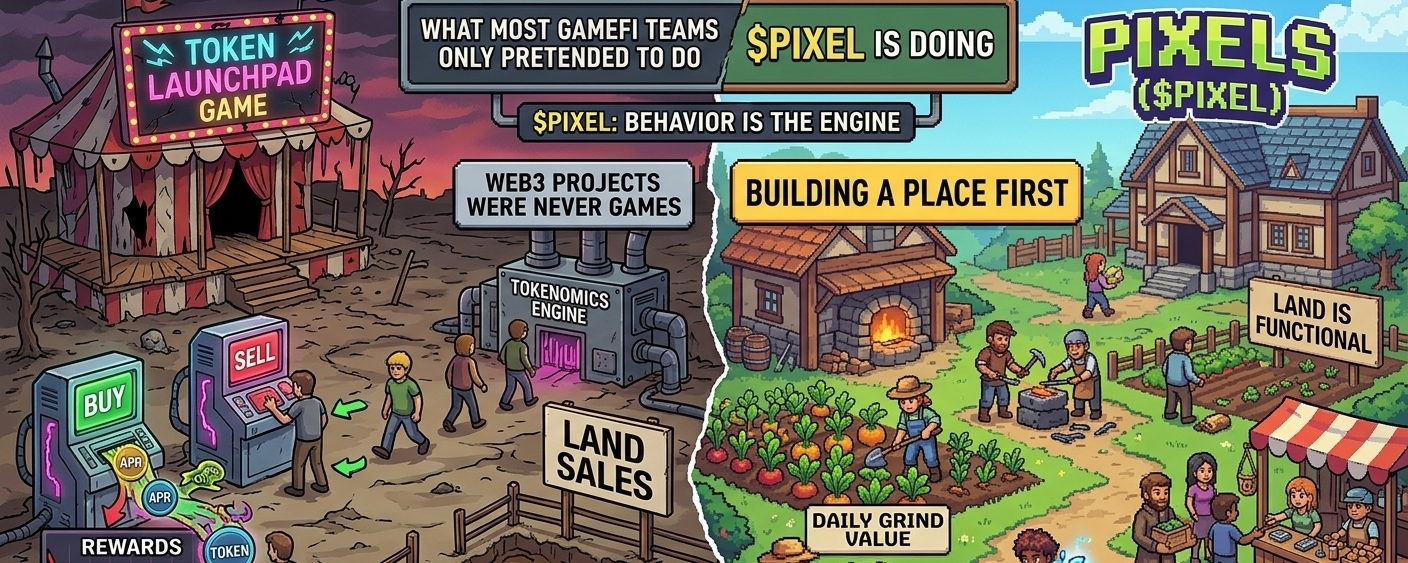
Let’s be honest. Most GameFi projects were never games.
They were token launchpads wearing cartoon skins. Click a few buttons, earn emissions, dump rewards, repeat until the chart bled out. We’ve seen this movie before, and the ending was always the same: users vanished the second APR stopped looking ridiculous.
$PIXEL feels different because it started in the only place that actually matters—behavior.
Not hype. Not tokenomics slides. Behavior.
People log in when a loop feels good. That’s it. They come back when progress feels tangible, when small actions stack into something bigger, when the world gives them a reason to care tomorrow. Pixels understood that early, which is why farming, crafting, gathering, trading, upgrading land, and social coordination weren’t side features bolted onto a token plan—they were the engine.
That distinction sounds subtle on paper.
It isn’t.
A lot of Web3 teams built economies first, then panicked when nobody wanted to live inside them. Pixels did the harder thing: build a place first, then layer value on top of it.
The token structure matters here too. And this is where many people miss the point.
Older GameFi titles loved the “one token does everything” model. Rewards token. Governance token. Utility token. Pressure valve. All in one. Which usually meant farmers were dumping the same asset investors were buying. A slow-motion train wreck disguised as innovation.
$PIXEL doesn’t lean into that trap the same way.
Daily grind value and broader premium ecosystem value are separated more intelligently. That reduces the reflexive bleed where every active user becomes an automatic seller. Cleaner incentives. Less chaos. Still not magic—but far better design than the 2021 copy-paste era.
And then there’s land.
Let’s really be honest here: most Web3 land sales were expensive digital dust-collectors. Fancy maps full of empty promises. Owners sitting on parcels nobody visited, waiting for a future that never arrived.
Pixels made land more functional.
