
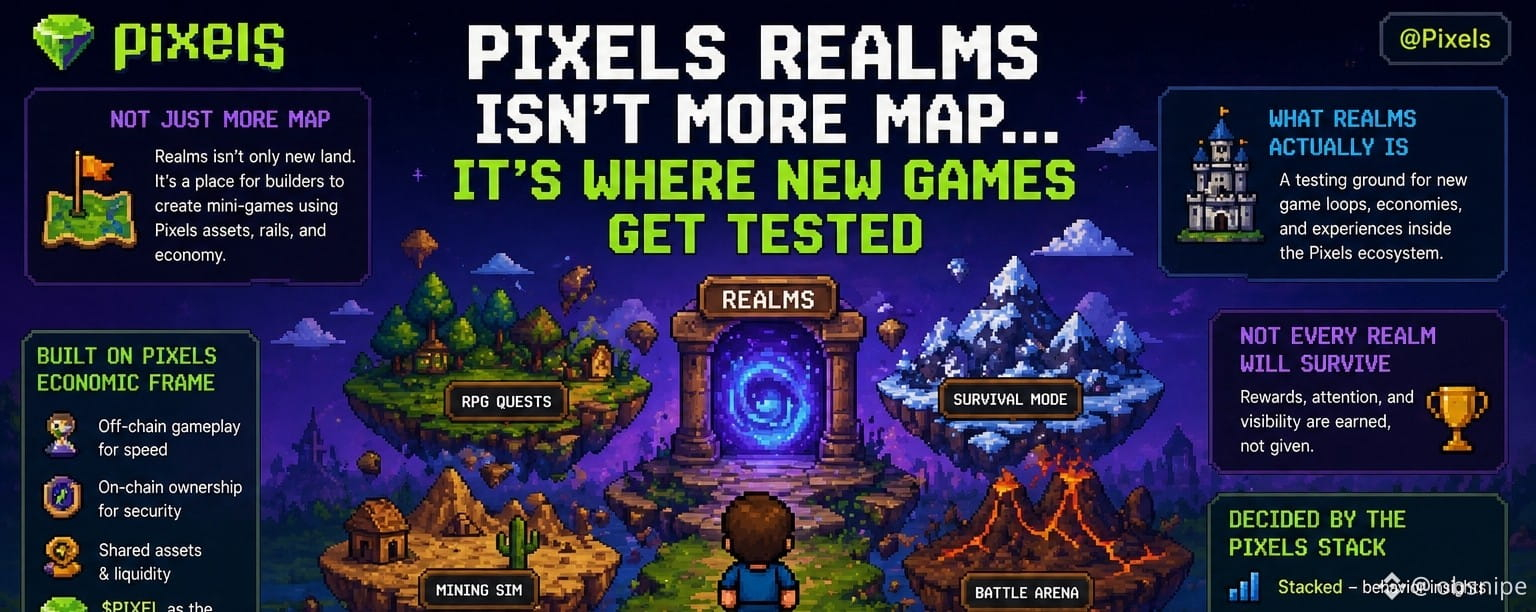
At first glance, Realms looks like a simple extension of Pixels. More space, more areas, more things to do. That’s the natural assumption, especially in a game already designed to expand horizontally.
But that framing doesn’t hold for long.
The deeper you look, the less Realms feels like map expansion and the more it feels like a shift in how Pixels defines a “game” within its ecosystem. This isn’t just about adding content. It’s about allowing new experiences to plug into an existing economic and behavioral framework.
If Realms were only new land, the value would be straightforward. More content for players. But if it becomes a layer where builders can create mini-games using existing assets, shared liquidity, and the same reward infrastructure, then Pixels is no longer just expanding. It is becoming a platform.
That distinction matters.
Pixels already operates on a hybrid structure. Fast interactions happen off-chain. Movement, farming, crafting, and daily loops feel seamless because they are not constrained by constant on-chain settlement. Meanwhile, ownership, assets, and value extraction sit on-chain, where they carry weight.
Realms appears to extend this structure.
Not by duplicating it, but by letting other game loops exist within it.
This introduces a new dynamic. Instead of building isolated games with separate economies, developers may begin building inside a shared system where behavior, rewards, and token utility are already defined. That reduces friction for creation, but increases pressure on sustainability.
Because not everything can be supported equally.
Every new Realm introduces new activity. Every activity competes for attention. Every attention path eventually connects to rewards. Without control, this leads to inflation, extraction, and noise.
That is where systems like Stacked and RORS become critical. They do not just distribute rewards. They decide which behaviors are worth incentivizing. In a Realms-driven environment, that role becomes even more important.
Realms does not remove the core challenge of GameFi. It inherits it.
Which experiences retain players
Which loops justify reward allocation
Which systems generate value instead of draining it
This is no longer just game design. It is economic routing.
From the outside, Realms may look like a collection of mini-games. From the inside, it behaves more like a filtering layer where only certain experiences become economically visible. Others may exist, but without reward support, liquidity, or player attention, they remain inactive.
That shifts control in a subtle way.
The developer builds the experience, but the system determines whether it survives.
And that is where the real transformation happens.
If Realms succeeds, Pixels evolves beyond a single farming loop into a network of interconnected game experiences, all tied together by $PIXEL, shared infrastructure, and controlled reward distribution.
If it fails, it becomes what most expansions become. More content, temporary attention, and eventual inactivity.
So the real question is not what Realms adds.
It is what Realms allows to become sustainable.
Because in a system like Pixels, survival is not about existence. It is about alignment with the economy.
@Pixels s $PIXEL #PIXEL/USDT el