I used to believe that an open game economy meant simple ownership.
You enter the world, invest your time, build progress, and whatever you produce belongs to you in a meaningful economic sense. That assumption felt especially natural in Pixels. Its casual farming loops, social design, and open-world structure create the impression of freedom. The system appears accessible. Effort feels self-directed. Economic opportunity seems embedded directly into participation.
At first, that looks like player sovereignty.
But over time, I’ve started to question whether openness at the activity layer necessarily means openness at the value layer.
Because in systems like Pixels, participating is not always the same as finalizing value.
That distinction feels increasingly important.
The more I observe Web3 ecosystems, the more I think the real architecture often lies beneath visible gameplay loops. Farming, crafting, exploration, and social coordination may generate constant activity, but activity alone does not automatically become persistent economic value. Instead, there seems to be an underlying settlement structure that determines when player effort is fully recognized, converted, or economically validated.
This is where $PIXEL begins to feel less like a conventional reward token and more like infrastructural logic.
Rather than simply distributing incentives, it may play a deeper role in regulating when in-game productivity becomes economically meaningful.
That subtle difference reshapes the system entirely.
On the surface, Pixels presents a familiar progression model: engage more, produce more, earn more.
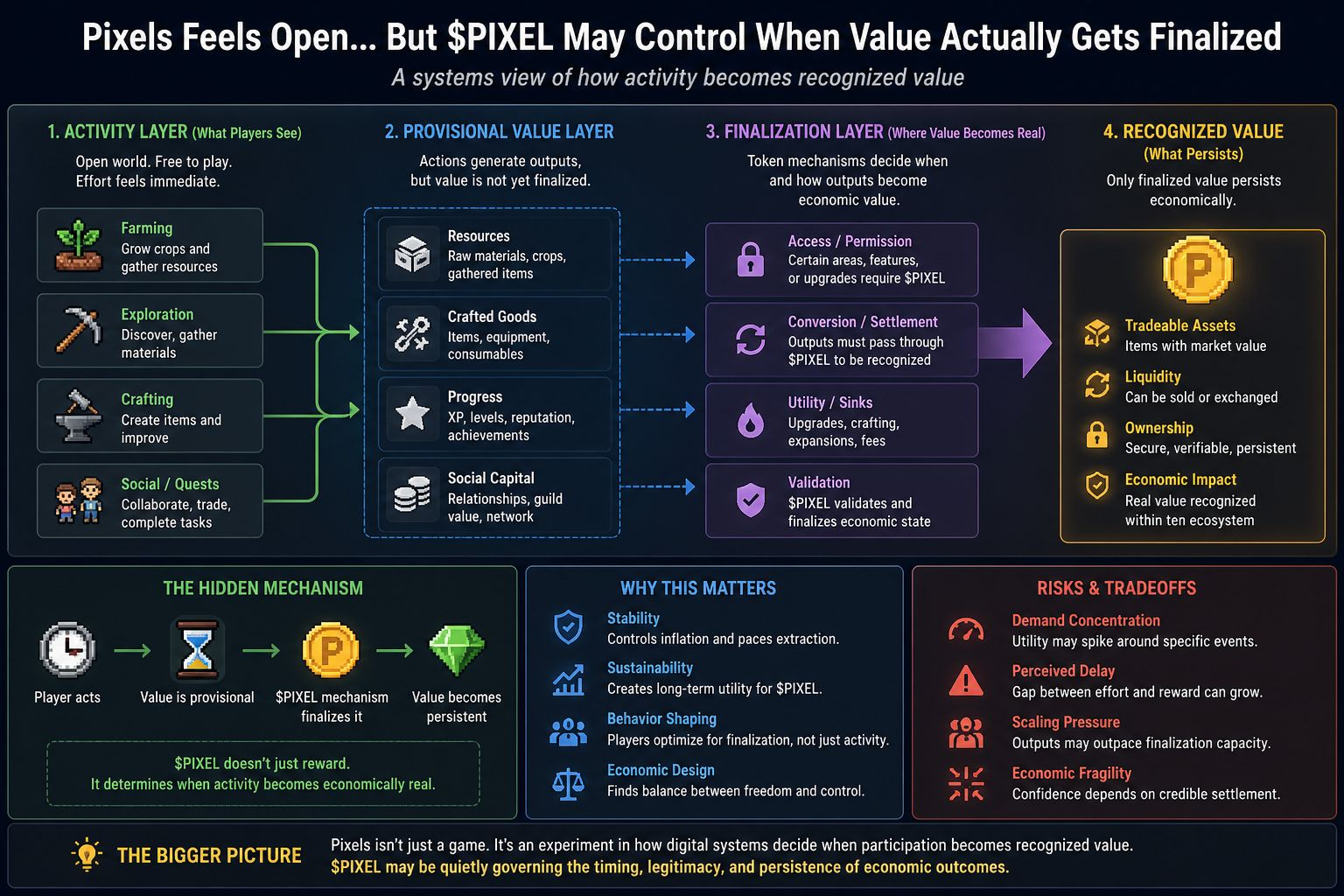
But beneath that simplicity, the system may function more like a staged economic framework where player actions first create provisional value, and only later pass through tokenized mechanisms that transform those actions into finalized economic outcomes.
In other words, gameplay may generate output, but token structures may govern recognition.
This feels less like straightforward game design and more like financial settlement architecture.
Traditional financial systems often separate transaction activity from final settlement. Trades occur constantly, but true ownership or liquidity is defined by deeper infrastructural layers. Pixels may be introducing a similar dynamic into digital labor ecosystems, where visible effort is immediate, but economic persistence depends on controlled pathways.
If so, this creates a more sophisticated system than many players initially realize.
Players are not simply earning.
They may be operating within an economy where timing, conversion, and validation are central.
That structural design has important consequences.
Once players begin recognizing where value is actually finalized, behavior naturally shifts. Exploration, creativity, and casual progression often become secondary to optimization. The focus moves toward understanding token sinks, conversion pathways, resource pacing, and economic bottlenecks.
The game remains social on the surface.
But beneath it, participants increasingly behave like system navigators.
This introduces both strength and fragility.
On one hand, delayed economic recognition can protect ecosystem stability. By pacing value extraction and controlling inflation, the system may avoid the rapid economic collapse that has damaged many earlier play-to-earn models.
On the other hand, settlement-heavy systems depend on sustained confidence.
If players begin to feel that their activity produces only temporary or weakly recognized value, motivation can erode. A gap emerges between visible effort and perceived economic reward.
That psychological tension matters.
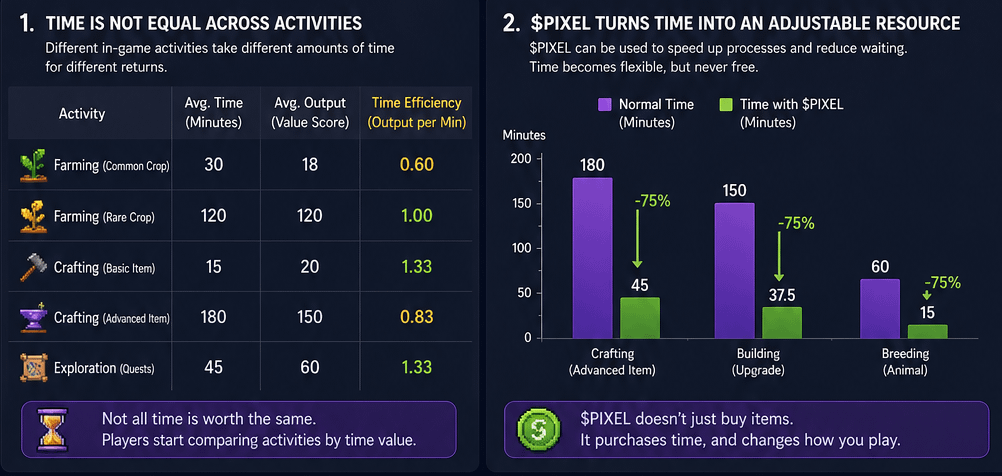
Because healthy economies do not rely solely on participation volume. They rely on credible belief that participation consistently leads to meaningful value.
This is where long-term balance becomes difficult.
I wonder whether Pixels can maintain continuous demand for $PIXEL rough ongoing utility, or whether demand may concentrate around specific conversion events, upgrades, or progression checkpoints.
If token demand is burst-driven rather than structurally constant, the ecosystem could face cyclical pressure. Periods of strong economic engagement may be followed by weaker phases where player activity remains high, but settlement demand softens.
That imbalance can become dangerous at scale.
As more users generate provisional outputs, the system must ensure that pathways to durable value recognition expand proportionally. Otherwise, economic productivity risks outpacing economic persistence.
In practical terms, players may continue working while feeling that meaningful value realization becomes increasingly delayed, competitive, or restricted.
That is not merely a gameplay issue.
It is a systems design challenge.
Pixels therefore feels increasingly significant not because it offers tokenized farming, but because it may be exploring a larger question:
How should digital economies decide when participation becomes economically real?
That question extends beyond gaming.
It touches infrastructure, market design, and the broader future of tokenized labor systems.
From this perspective, PIXEL may function less as a simple currency and more as a mechanism of economic authorization a system that quietly governs when effort transitions from temporary in-game productivity into recognized, persistent value.
That role is powerful.
It shapes incentives, defines behavioral patterns, and ultimately determines whether the ecosystem feels sustainable or extractive.
Pixels still presents itself as an open, player-driven world.
And in many ways, it is.
But openness may primarily describe how players interact with the system—not how value itself is finalized.
Beneath the relaxed farming loops and social accessibility, PIXEL may be serving a more foundational purpose: structuring the timing, legitimacy, and persistence of economic outcomes.
That transforms Pixels from a casual Web3 game into something more complex.
Not simply a digital world where players earn, but a system that quietly determines when player activity truly becomes recognized value.