
I keep coming back to this question and I can't fully settle it.
I started playing the way most people do. Farming loop, craft, repeat. Familiar enough. But somewhere between Chapter 2 and what eventually became Chapter 3, the experience shifted quietly. Not with a dramatic announcement. More like the floor under the game changed and I only noticed it after I'd already adjusted my footing.
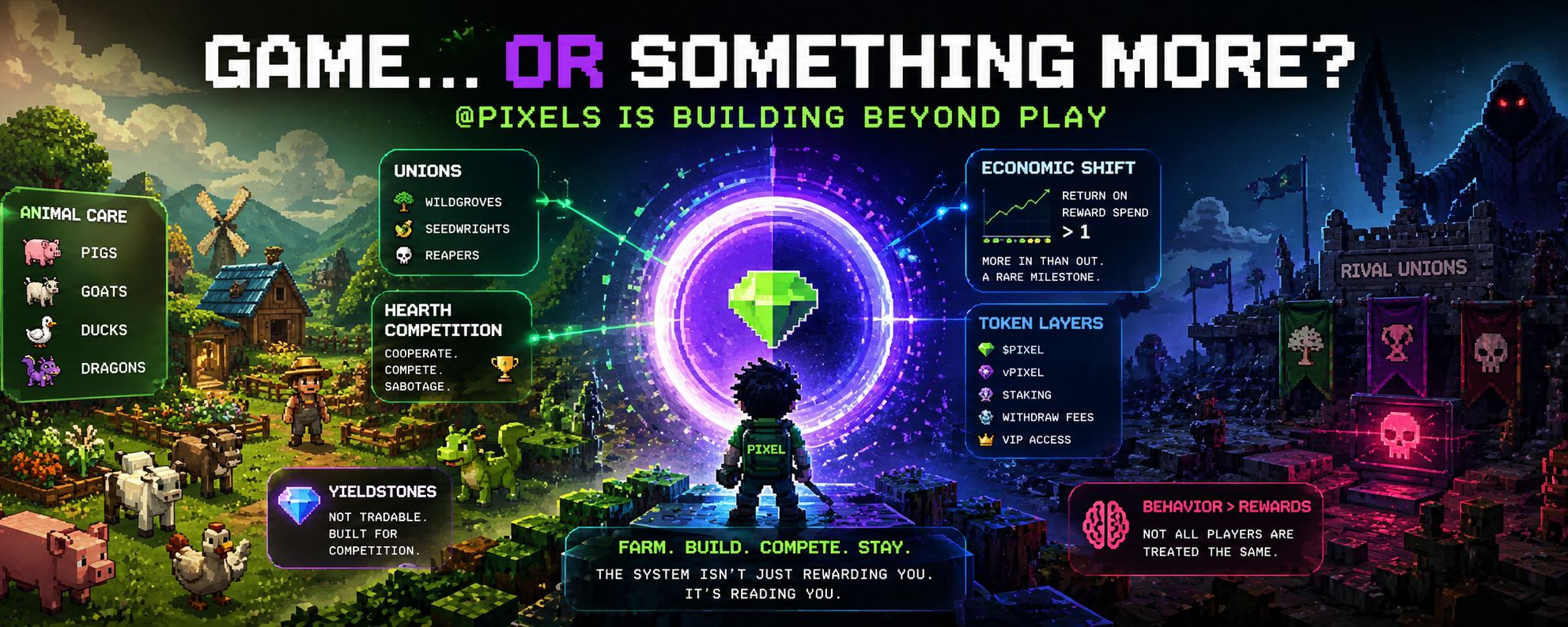
Chapter 3 wasn't just new content. It introduced Unions Wildgroves, Seedwrights, Reapers. Three factions. And at first it sounds like a guild system with a new name. But the mechanics underneath are different. You're not just teaming up. You're depositing resources into a shared Hearth, competing with rival Unions, and even sabotaging others. There's a real tension in there. Cooperative on the surface but quietly adversarial underneath. And Yieldstones the core resource in that loop can't be traded. They only exist inside the competition. That's a specific design decision. It forces value to stay contained, prevents the usual extraction shortcut.
But what really caught my attention wasn't the Union system itself. It was what the team said about it. They're now tracking something called "return on reward spend", whether in-game spending outpaces token distribution. That metric crossed above one. For the first time, the game was pulling in more than it was giving out. Even briefly, that's not a small thing. Most Web3 games never get there.
Then there's the Animal Care update. Pigs, goats, ducks, dragons added alongside the existing animals. Feed schedules tied to specific crafted items. Offspring mechanics tied to long-term land management. Cooldown timers on certain dependencies. None of this is casual anymore. It's layered resource management dressed as farming. The systems are building on each other in ways that take time to feel.
And sitting above all of this is the token structure. $PIXEL , vPIXEL, staking, withdrawal fees, VIP gating. It sounds complicated because it is complicated. But the underlying logic is simple, the system is trying to separate players who want to extract from players who want to stay. The choice between paying withdrawal fees on PIXEL or using vPIXEL fee-free inside the ecosystem isn't just a preference. It's revealing which type of participant you are. The system is reading you while you think you're just deciding.
That's the part I find hard to look away from.
Most games optimize for engagement. More time spent, more actions taken. But here it feels like the optimization is pointed somewhere different. It's trying to understand what valuable behavior actually looks like and then quietly rewarding that pattern more than others. Not randomly. Not equally. Based on how you move through the system.
Is that a game still? Or something else?
The farming is still there. The cozy loop. The pixel art and seasonal events. But underneath, there's an economic architecture that most players are probably interacting with without fully seeing it. And maybe that's intentional. Systems don't need users to understand them. They just need users to behave slightly differently because of them.
What I find myself wondering now is where the boundary actually is. Between playing and participating. Between earning and being measured. Because the more layers that get added Unions, staking, behavior-based rewards, multi-game token flows the more it feels like @Pixels is building something that a single word doesn't fully cover.
Not a game. Not a protocol. Not a community. Somewhere in between all three.
And we're all just inside it, figuring it out in real time.
NFA ~ DYOR 🚀
