
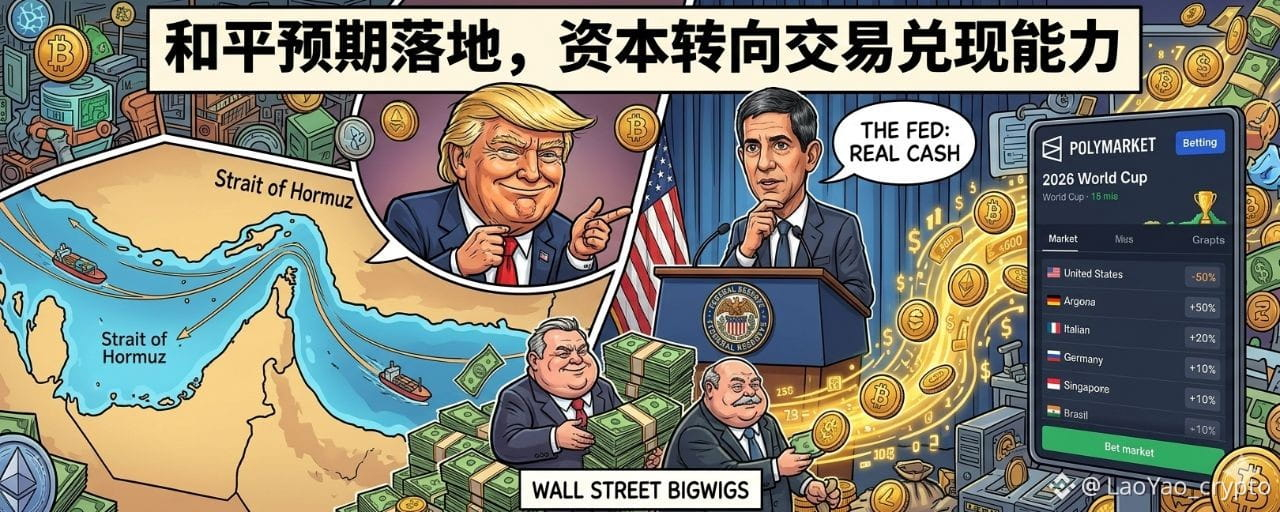
In recent months, global capital has been trading on peace expectations.
However, in the past 24 hours, the market has entered a new phase - can the trade on peace expectations be fulfilled?
After the signing of the US-Iran memorandum, intense negotiations about the final deal are underway; the Strait of Hormuz has reopened but could be shut down again at any moment;
Yen is hitting decades-low levels, and even with the BoJ's rate hikes, the capital flow can't be reversed;
The crypto market is overall quiet with shrinking volume,
The prediction market is booming due to the World Cup hype.
From geopolitical issues to monetary systems, from energy capital to on-chain funds, a common logic is emerging -
👉 The market no longer pays for hope but begins to price in realization ability.
🧱 Geopolitical chessboard: Middle East situation is turbulent
① Trump raises the "Hormuz protection fee"
While vacationing at Camp David, US President Trump suddenly proposed new conditions: the current agreement ensures free navigation through the Strait of Hormuz for the next 60 days, but if a final comprehensive agreement is not reached by then, the US will consider imposing transit fees on passing vessels as compensation for maintaining regional security costs.
This means that signing a memorandum between the US and Iran is not the end but the starting point for the next round of negotiations.
② Swiss technical negotiations officially begin
On June 21, US Vice President Vance, negotiator Whittaker, and Kushner held comprehensive technical negotiations with the Iranian delegation and mediators from Qatar and Pakistan in Switzerland.
What determines market direction is no longer whether an agreement is signed, but whether it can be executed.
③ Risks on the Middle East front still exist
Iran announces the closure of the Strait of Hormuz again but simultaneously resumes oil loading at Kharg Island; Israel continues to strike Hezbollah targets in Lebanon.
Surface peace has emerged, but underlying risks have not disappeared.
🧘 Psychological insights:
Agreements solve formal issues, while realization solves trust issues.
What the market really cares about has never been the signing itself, but whether anyone is willing to perform after the signing.
💹 Capital mapping: monetary policy and energy chain restructuring
① The yen continues to fall, approaching a 40-year historical low
USD/JPY oscillates in the 161.2—161.8 range, touching 161.80 on June 19, the weakest level since December 1986. The yen has depreciated about 1.5% this month, with a cumulative drop of over 10% in the past 12 months, and the BIS real effective exchange rate has hit a historical low since the floating exchange rate system began in 1973.
Despite the unprecedented situation of Japan's central bank governor Ueda being hospitalized and the special circumstance of being chaired by Deputy Governor Amamiya, the bank resolutely raised rates to 1.0% (31-year high, with the Nikkei index subsequently breaking through 71,000 points historically), the strong hawkish stance of new Fed Chairman Kevin Walsh still makes it hard for the dollar's underlying strength to be shaken.
② Energy giants quietly retreat, traditional oil and gas returns
After more than three months of blockade in the Gulf has eased, multinational oil and gas giants like Shell and Norway's Equinor have drastically cut long-term investments in clean energy—under short-term profit pressure, "high certainty" traditional oil and gas have once again become a safe haven for capital.
🧘 Psychological insights:
The Bank of Japan raises rates to the highest in 31 years, yet still can't stop the yen's decline.
The market proves again: capital obeys real returns, not policy intentions.
💸 Web3 Overview: Low-volume consolidation and prediction market frenzy
After a week of wild fluctuations, the crypto market has entered a phase of low-level oscillation and low-volume consolidation, with bullish confidence being weak.
BTC: Slight rebound, narrow oscillation between 63K—65K, with ETF funds continuously flowing out.
ETH: Following BTC's recovery, the ETH/BTC ratio remains low, lacking independent momentum.
① World Cup ignites the decentralized prediction market
As of mid-June, Polymarket's cumulative trading volume has officially surpassed $2.8 billion. This World Cup has seen extreme scenarios like "last 15 minutes goals" (nearly 29% of goals occurred after the 75th minute), with many live traders using crypto wallets for real-time odds hedging and on-chain betting, pushing the prediction market to new heights.
The Chinese-speaking community is naturally internalizing: the chill in mainstream tokens is forcing capital to find an exit, with various platforms' "free guessing + trading volume for rewards" World Cup activities quickly going viral, becoming a new tool for community engagement.
🧘 Psychological insights:
When mainstream coins lose their trend, capital starts to look for new casinos.
The explosion of the prediction market is not due to the World Cup.
But because the market lacks a certain direction.
🧘 Conclusion:
In the past few months, the market has been trading on peaceful expectations.
Falling oil prices, rising stock markets, and rebounding risk assets are essentially pricing in optimism about the future.
The current market has entered the second phase: trading realization
· Will Hormuz remain open?
· Will the final US-Iran agreement be signed?
· Can the global energy supply chain return to normal?
· Can the Fed's rate cut path be realized?
These questions will determine the next round of capital flow.
Expectations create trends, realization determines direction!
In an era of liquidity contraction and returning uncertainty:
Many see the expectations, but few understand the realization.
And the real factors determining the income gap often lie between these two.
📌 LaoYao(@LaoYao_crypto )
Using psychological insights as a blade, cutting through the depths of power in the crypto space.