
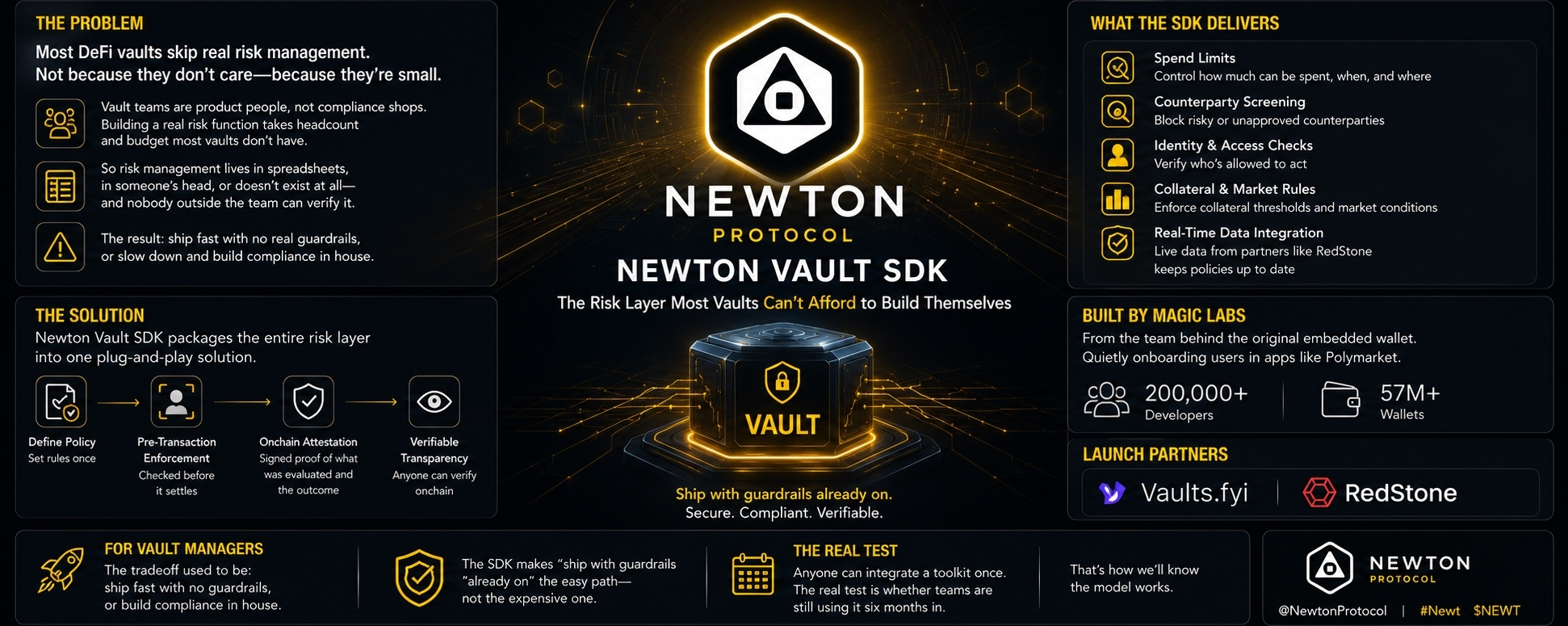
I was thinking about why so many DeFi vault teams skip real risk management, and it’s not because they don’t care. It’s because they’re small.
Most teams building a vault are product people. They want to ship, get deposits in, run the strategy well. They are not compliance shops. Standing up a real risk function, the kind a bank would have, takes headcount and budget most vaults just don’t have. So that layer either doesn’t exist, or it exists somewhere informal, in someone’s head or a spreadsheet, where nobody outside the team can actually check it.
That’s the gap the Newton Vault SDK is aimed at. Instead of a team building spend limits, counterparty screening, identity checks, and collateral rules from scratch (or skipping them), the SDK packages all of it into one layer the vault plugs into. Policy gets enforced before a transaction settles, not reviewed after the fact once something’s already gone wrong.
What made me pay more attention than usual is who’s behind it. @NewtonProtocol ’s core team comes out of Magic Labs, the people behind the original embedded wallet, the thing quietly onboarding users into apps like Polymarket without most of those users ever knowing Magic was there. That’s not nothing. Magic’s network is reportedly over 200,000 developers and 57 million wallets already. Most infra protocols spend years trying to build that kind of reach from zero.
The launch partners tell you something too. Vaults.fyi and RedStone are already wired in, feeding live market data into policies instead of static rules that go stale in a week. That’s a sign this wasn’t built to sit on a shelf waiting for adoption. It shipped with real integrations already attached.
For a vault manager, the tradeoff used to be ship fast with no real guardrails, or slow down and build compliance in house. The SDK is trying to make ship with guardrails already on the easy path instead of the expensive one.
The part I can’t answer yet is adoption depth. Anyone can integrate a toolkit once. The real test is whether teams are still leaning on it six months in, after the initial setup wears off. Only that second thing actually proves the model works.