

For years, blockchain technology has been measured by one simple promise: trust the code.
If a transaction follows the protocol, carries a valid digital signature and meets the network's rules, it is executed automatically. This predictable behavior is one of blockchain's greatest strengths. It removes the need for human approval and allows anyone to participate under the same rules.
But as blockchain moves beyond simple payments, a more important question begins to emerge.
Should every technically valid transaction always be executed?
At first, the answer seems obvious. A blockchain should remain neutral. It should not judge intentions or make subjective decisions. Its role is to verify facts, not opinions.
That design has served the industry well.
However, today's blockchain ecosystem looks very different from the one created more than a decade ago.
Institutional investors are entering the market.
Tokenized real-world assets are growing.
AI agents are beginning to perform financial actions.
Autonomous applications are becoming more common.
These changes introduce a new challenge.
Many future transactions will be technically correct while still creating unnecessary risk.
A valid signature only proves that a wallet approved a transaction.
It does not explain why the transaction exists.
It does not determine whether it follows internal policies.
It does not evaluate compliance requirements.
It does not measure financial risk.
Most importantly, it cannot understand intent.
This difference between verification and intent may become one of the defining challenges of the next generation of blockchain infrastructure.
For many years, the industry focused on answering one question:
"Who authorized this transaction?"
The next generation may need to answer a different one:
"Should this transaction happen at all?"
That single shift changes how we think about blockchain security.
Instead of only protecting private keys, future systems may also need to protect decision-making itself.
The conversation is no longer only about faster transactions or lower fees.
It is increasingly about building systems that can combine decentralization with responsible execution.
Understanding this shift is essential because it changes the purpose of blockchain itself.
The future may not belong only to networks that execute transactions efficiently.
It may belong to networks that understand when execution should wait.
To understand this challenge, we first need to separate two ideas that are often treated as if they are the same.
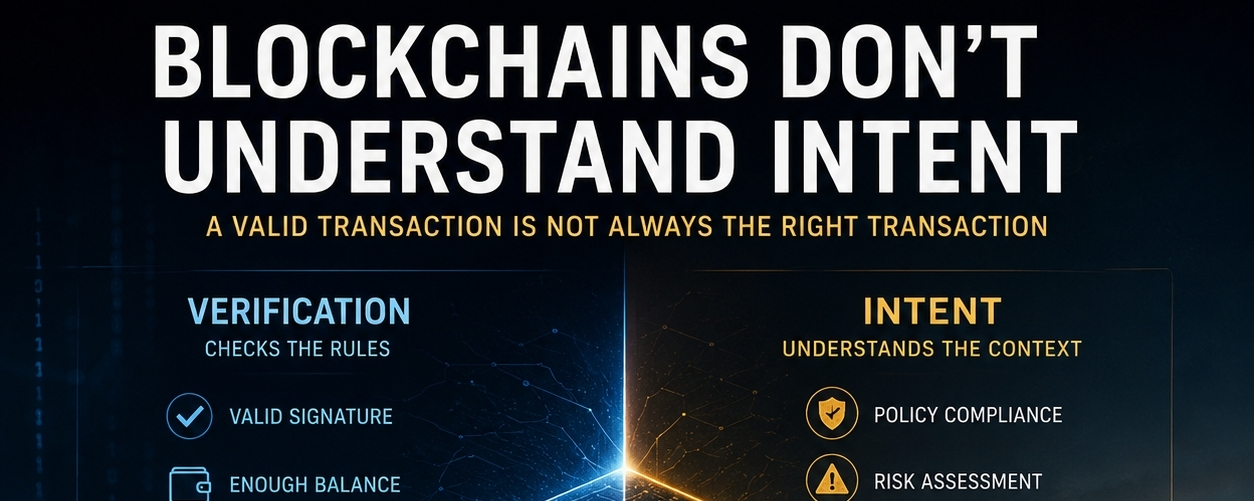
Verification and intent are not equal.
Verification answers a technical question.
Intent answers a judgment question.
When a blockchain verifies a transaction, it checks whether the sender owns the assets, whether the digital signature is valid, and whether the transaction follows the protocol's rules.
If every condition is satisfied, the transaction moves forward.
The blockchain has done exactly what it was designed to do.
It does not ask whether sending the funds is a mistake.
It does not ask whether the wallet has been compromised.
It does not ask whether the transaction violates an organization's internal policy.
It only verifies facts.
This design was intentional.
Bitcoin was created to remove trusted intermediaries, not to replace human judgment with machine judgment.
The protocol was built to remain neutral.
Every participant follows the same rules, regardless of identity or purpose.
That neutrality became one of blockchain's greatest strengths.
It made censorship difficult.
It reduced dependence on central authorities.
It allowed transactions to be processed consistently across a global network.
However, neutrality also has limitations.
A blockchain cannot distinguish between a legitimate payment and a payment made under fraud.
It cannot recognize whether an AI agent is acting within approved limits.
It cannot determine whether a transaction should require additional approval before execution.
From the blockchain's perspective, both transactions may appear identical.
The protocol only sees valid instructions.
It does not understand context.
This is where the idea of intent becomes important.
Intent asks questions that exist outside the protocol itself.
Why is this transaction happening?
Does it match predefined business rules?
Is it consistent with compliance requirements?
Does it introduce unnecessary operational risk?
Could this action create damage even if every technical rule has been followed?
Traditional financial systems already consider these questions every day.
Banks do not rely only on account ownership.
Payment networks do not approve transactions based only on identity.
Multiple policy checks often take place before money moves.
Blockchain introduced a powerful model based on cryptographic verification.
The next stage of blockchain infrastructure may require combining that model with intelligent decision-making before execution.
That does not mean replacing decentralization.
It means recognizing that technical validity alone may not always be enough for increasingly complex financial systems.
If verification alone is no longer enough, what comes next?
The answer is not to remove blockchain's core principles.
The answer is to build an additional decision layer before execution.
Think about how an airport works.
A valid passport proves who you are.
It does not automatically allow you to board every flight.
Before boarding, several checks take place.
Security screening.
Travel documents.
Destination requirements.
Risk assessment.
Only after those checks is boarding approved.
The passport confirms identity.
The security process confirms permission.
The same principle may become important in blockchain.
A valid digital signature proves ownership.
It does not always prove that executing the transaction is the best decision.
This is where authorization becomes different from authentication.
Authentication asks:
"Who are you?"
Authorization asks:
"What are you allowed to do?"
That difference becomes increasingly important as blockchain applications become more advanced.
Imagine an AI agent managing a company's treasury.
The wallet signature is valid.
The AI has permission to initiate payments.
But what happens if the payment exceeds company policy?
What if the destination wallet appears on a sanctions list?
What if the transaction amount is far above normal behavior?
The blockchain itself cannot answer these questions.
It simply executes valid instructions.
An authorization layer attempts to answer them before execution.
Instead of changing blockchain rules, it adds another stage of evaluation.
Policies.
Risk limits.
Compliance requirements.
Business rules.
Identity conditions.
These checks happen before the transaction reaches the blockchain.
If every condition is satisfied, execution continues.
If not, the transaction can be rejected or paused for review.
This approach does not suggest that every blockchain should become permissioned.
Instead, it recognizes that different applications require different levels of control.
A public payment between individuals may require very little oversight.
An institutional treasury moving hundreds of millions of dollars may require much more.
One model cannot solve every problem.
Different environments create different security requirements.
This is why authorization is becoming an important topic across Web3.
The conversation is slowly moving away from a single question:
"Can this transaction be executed?"
Toward a more important one:
"Should this transaction be executed under these conditions?"
That small change in perspective may become one of the biggest shifts in blockchain infrastructure over the next decade.
Like every major innovation, authorization is not a perfect solution.
It introduces new opportunities, but it also creates new responsibilities.
Every policy must be designed carefully.
Rules that are too strict may block legitimate transactions.
Rules that are too loose may fail to prevent harmful activity.
Finding the right balance becomes just as important as the technology itself.
Another challenge is governance.
If policies decide which transactions are allowed, who creates those policies?
Who updates them?
Who is responsible when conditions change?
These questions cannot be ignored.
Good technology alone cannot solve governance problems.
They require transparency, accountability and clear decision-making.
There is also an important philosophical debate.
One of blockchain's greatest strengths has always been neutrality.
The network follows mathematical rules without considering personal opinions.
Some people argue that introducing authorization moves blockchain closer to traditional financial systems.
Others believe programmable policies are necessary if blockchain is expected to support institutions, governments and AI-powered financial systems.
Both perspectives deserve serious consideration.
This is not a choice between decentralization and compliance.
It is a discussion about how both can exist together without weakening the principles that made blockchain valuable in the first place.
Perhaps the future is not about replacing permissionless systems.
Perhaps it is about giving different applications the ability to choose the level of authorization they require.
An individual sending funds to a friend may need almost no additional checks.
A multinational company managing billions of dollars may need far more protection before a transaction is executed.
Different risks require different safeguards.
The blockchain industry has always evolved by solving yesterday's biggest problem.
First, it solved digital ownership.
Then it solved decentralized execution.
The next challenge may be responsible execution.
That shift does not change what blockchains are.
It expands what they can safely support.
The strongest blockchain networks of the future may not be the ones that execute every valid transaction the fastest.
They may be the ones that know when execution should pause, when additional verification is required, and when protecting users is more valuable than processing another block.
This changes the conversation entirely.
The future of blockchain may not be defined only by speed, scalability or lower costs.
It may be defined by better judgment.
That is the difference between verifying a transaction and understanding its intent.
◈ UA INSIGHTS Insight
A blockchain can verify ownership with mathematics.
Understanding intent requires rules, context and responsible decision-making.
That may become the next layer of trust in Web3.
The evolution of blockchain has never been about replacing the previous generation.
It has always been about solving the limitations that became visible as adoption increased.
Bitcoin solved the problem of digital ownership.
Ethereum expanded blockchain into programmable applications.
The next stage may focus on something different.
Not faster execution.
Not bigger block sizes.
Not lower transaction fees.
Better decision-making before execution.
As blockchain becomes part of global finance, artificial intelligence and real-world asset tokenization, the value of every transaction will increase.
With greater value comes greater responsibility.
A system that can only verify signatures may not be enough for the next generation of financial infrastructure.
That does not mean every blockchain should become permissioned.
It does not mean decentralization has failed.
It means the industry is beginning to recognize that verification and judgment are two different challenges.
One confirms ownership.
The other protects outcomes.
Whether authorization layers become a common standard remains uncertain.
Different blockchain ecosystems will likely choose different approaches depending on their goals, users and security requirements.
However, one trend is becoming increasingly clear.
The conversation is no longer only about making transactions possible.
It is about making the right transactions possible.
That shift represents a change in perspective rather than a change in technology.
History shows that financial systems earn trust not only because they process transactions efficiently, but because they reduce avoidable mistakes before money moves.
Blockchain may now be entering the same stage of maturity.
The future may belong to networks that combine openness with responsibility, automation with policy, and decentralization with thoughtful safeguards.
The next era of Web3 may not be defined by how quickly transactions are executed.
It may be defined by how confidently users know those transactions should happen.
## Final Conclusion
For years, blockchain has answered one important question:
"Is this transaction valid?"
The next generation may need to answer another:
"Is this transaction appropriate?"
The difference between those two questions could shape the future of blockchain infrastructure.
Technology alone creates capability.
Responsible decision-making creates trust.
And in the long run, trust is what transforms technology into infrastructure.
## UA INSIGHTS Question
If blockchains can verify ownership but cannot understand intent, should the next generation of Web3 add an authorization layer before every high-value transaction?
◈ UA INSIGHTS
Research First.
Noise Never.
@NewtonProtocol $NEWT #newt #NEWT