
The biggest problem in crypto might not be speed. It might be permission.
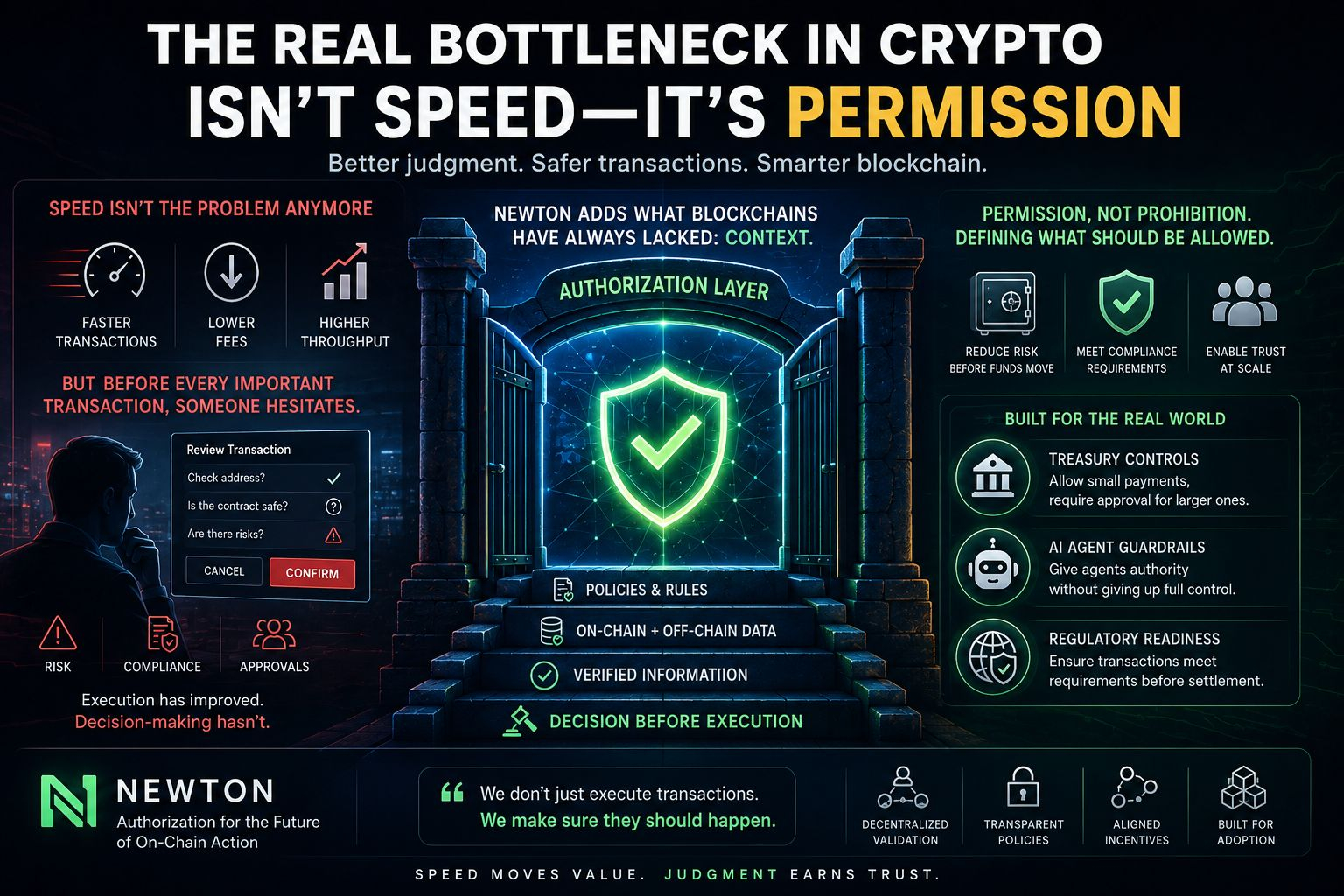
When I first looked at Newton, I noticed something that kept repeating across almost every blockchain conversation. People celebrate faster transactions, lower fees, and higher throughput, yet before almost every important transaction someone still pauses. They read the wallet prompt twice. They check the address again. They wonder if a smart contract is safe. Institutions go even further, adding legal reviews, compliance teams, and internal approvals before a single transaction moves. That hesitation says something important. Execution has improved. Decision-making hasn't.
Newton starts from that uncomfortable observation rather than trying to build another chain that claims to be faster than the last one. It asks a quieter question: what if blockchains aren't missing speed anymore? What if they're missing a dependable way to decide whether a transaction should happen at all?
At first glance, users may never notice what Newton is actually doing. They still open a wallet. They still sign transactions. Assets still move across chains. Nothing looks dramatically different on the surface. That restraint is interesting because many crypto projects compete by changing the visible experience, while Newton spends most of its attention underneath it.
Beneath every transaction sits a simple but important layer of logic. Before value moves, Newton allows predefined policies to evaluate that action. Think of it less like adding another checkpoint and more like adding judgment. Instead of asking only whether a transaction is technically valid, the system can also ask whether it satisfies rules that were defined beforehand.
That difference sounds small until you compare it with how money already works outside crypto.
A bank transfer doesn't move simply because someone clicked a button. Risk systems evaluate it. Fraud engines score it. Spending limits apply. Regulatory requirements matter. Businesses have approval chains....Multiple quiet systems participate before money reaches the other side.
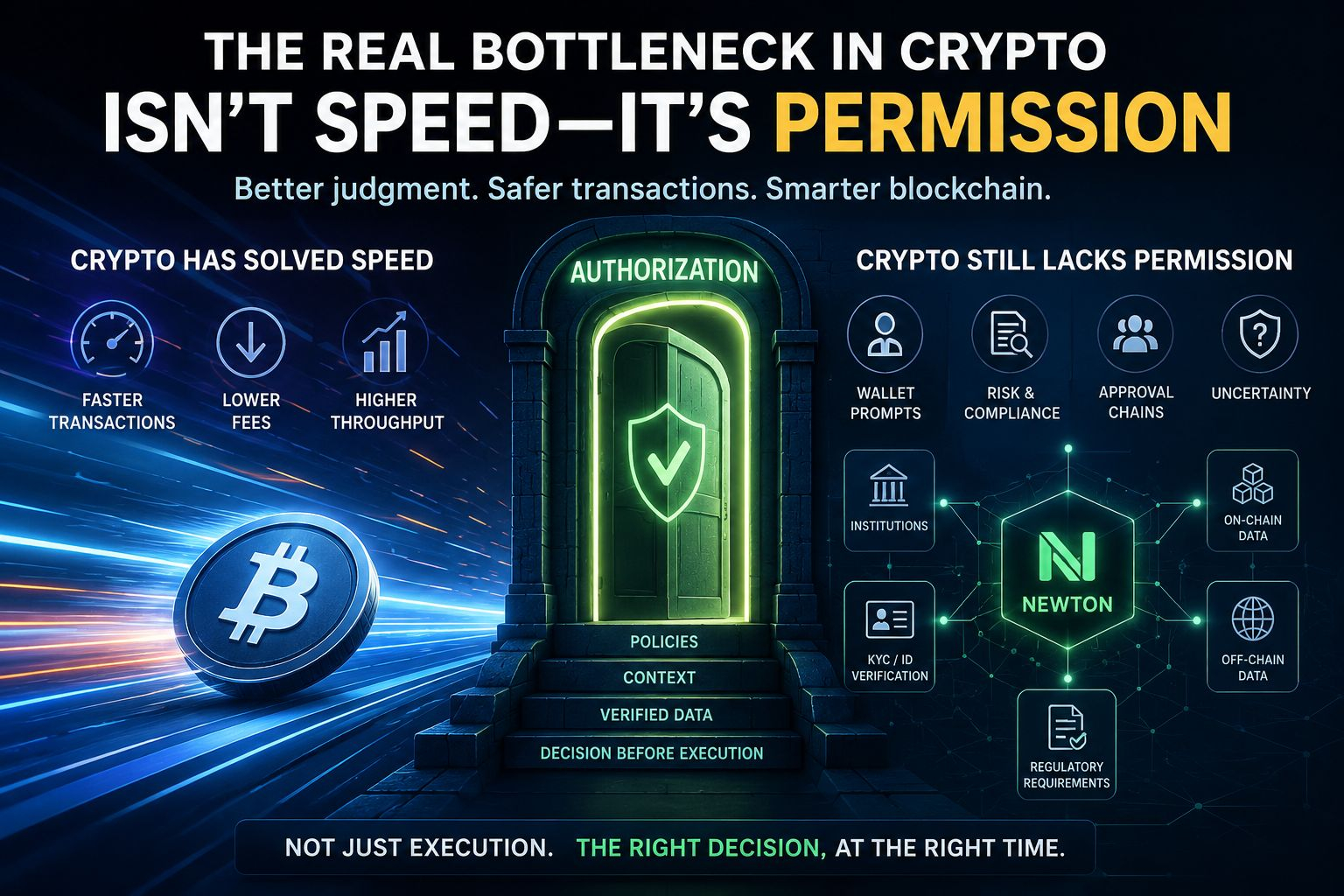
Blockchain removed many intermediaries, which made transactions more direct. It also removed many of those decision layers. The result is greater freedom, but also greater responsibility. Every wallet holder becomes responsible for making perfect decisions, every single time.
Newton attempts to rebuild decision-making without rebuilding centralized control.
That distinction matters because policies aren't necessarily about restriction. They can define permissions instead of prohibitions.
A treasury wallet could allow payments below a certain amount while requiring additional approval above it....
An AI agent could receive authority to rebalance a portfolio without gaining unlimited control over every asset. A stablecoin issuer could ensure transactions satisfy regulatory requirements before settlement instead of correcting problems afterward...
Surface level, users simply see transactions succeed or fail.
Underneath, a programmable policy engine evaluates conditions that may involve both blockchain data and verified information beyond the chain itself...
. If those conditions match predefined rules, execution continues. If not, execution stops before assets move.
Understanding that helps explain why Newton keeps talking about authorization instead of automation.
Crypto has spent years making execution automatic. Smart contracts execute exactly as written. That precision is powerful, but it also creates rigidity. Code cannot interpret intent. It follows instructions regardless of whether circumstances have changed.
Authorization introduces another layer..
. Instead of assuming every valid transaction deserves execution, it asks whether this specific action matches the context surrounding it.
That sounds almost ordinary, yet ordinary systems often become foundational precisely because people stop noticing them.
Another detail that stood out to me is Newton's interest in connecting on-chain actions with verified off-chain information. ..
That phrase can sound technical, so it's easier to imagine a practical example.
Suppose an institution wants to purchase tokenized real-world assets. The blockchain can verify ownership and settlement, but it cannot independently know whether a participant completed identity verification or whether regulatory requirements have changed. Those answers exist elsewhere.
Newton creates a structured way for trusted information to influence blockchain decisions without asking the blockchain itself to understand the outside world directly.
That doesn't eliminate trust questions. It simply moves them into clearly defined places where assumptions become visible instead of hidden.
Early signs across crypto suggest this kind of architecture is becoming more important because blockchain adoption is expanding beyond individuals experimenting with decentralized finance. Institutions operate differently. Companies answer to regulators. Funds answer to investors. Governments answer to legal frameworks.
Whether people like regulation or not almost becomes a separate conversation. The practical reality is that larger pools of capital rarely operate without rules.
Newton seems to recognize that reality instead of treating it as an obstacle. It treats regulation more like infrastructure than ideology.
That creates another interesting effect.
For years, many crypto discussions framed decentralization and compliance as opposing forces. Newton quietly suggests they may simply belong in different layers. Decentralization protects execution from centralized control. Policies define acceptable behavior before execution begins. Those ideas can coexist if designed carefully.
Of course, this approach carries risks.
Policies become powerful once they influence transactions. Who writes them? Who updates them? How transparent are they? Can users verify what rules exist before signing?
Those questions remain important because authorization systems become trusted only when their own governance earns that trust. Good infrastructure cannot rely on invisible assumptions.
The project's use of decentralized validation aims to reduce dependence on a single authority, but architecture alone cannot guarantee good outcomes.... ...
Governance, incentives, and adoption all matter just as much as technical design...
The NEWT token also makes more sense when viewed through this lens.
Many people immediately ask what a token's price might do. I think that question misses the more interesting part.
Inside Newton, the token functions as infrastructure. It helps coordinate participation, align incentives among network participants, and support the authorization layer itself. In other words, it behaves more like plumbing than a product. Good plumbing rarely becomes the center of attention. Its value comes from making everything above it function predictably.
Whether that design succeeds depends less on speculation and more on whether developers, institutions, and applications actually build around it.
That remains to be seen.
Still, what struck me is that Newton isn't trying to convince people that crypto needs another race for faster execution. It is quietly asking whether better judgment creates more value than another small improvement in transaction speed.
That question reaches beyond one protocol.
Artificial intelligence is beginning to make decisions. Stablecoins are connecting traditional finance with blockchain settlement. Real-world assets continue moving onto public networks. Each trend increases the importance of deciding not just how transactions execute, but whether they should execute under specific conditions.
The conversation slowly shifts from moving value to governing value.
If that shift continues, projects that specialize in authorization may become as important as projects that specialize in execution. Not because they replace blockchains, but because they give blockchains something they have historically lacked: context.
The more I studied Newton, the less it looked like another blockchain project competing for attention, and the more it looked like an attempt to solve a quieter problem hiding underneath every transaction. Speed captures headlines. Judgment earns trust.
#newt #Newt @NewtonProtocol $NEWT

