

At the heart of the Dusk Network lies a powerful suite of cryptographic technologies designed to deliver institution-grade privacy, security, and regulated finance support in a decentralized blockchain environment. Unlike many blockchains that focus purely on public transparency, Dusk uses advanced mathematics and privacy techniques to enable confidential transactions, private smart contracts, and compliance-ready asset management — all without sacrificing trust or verifiability.
Cryptography isn’t an add-on for Dusk — it’s the foundation. Every major function of the protocol, from transaction privacy to smart contract execution and identity handling, is built on a curated set of cryptographic primitives and proof systems that have been rigorously researched and implemented by the Dusk team.
Core Cryptographic Building Blocks
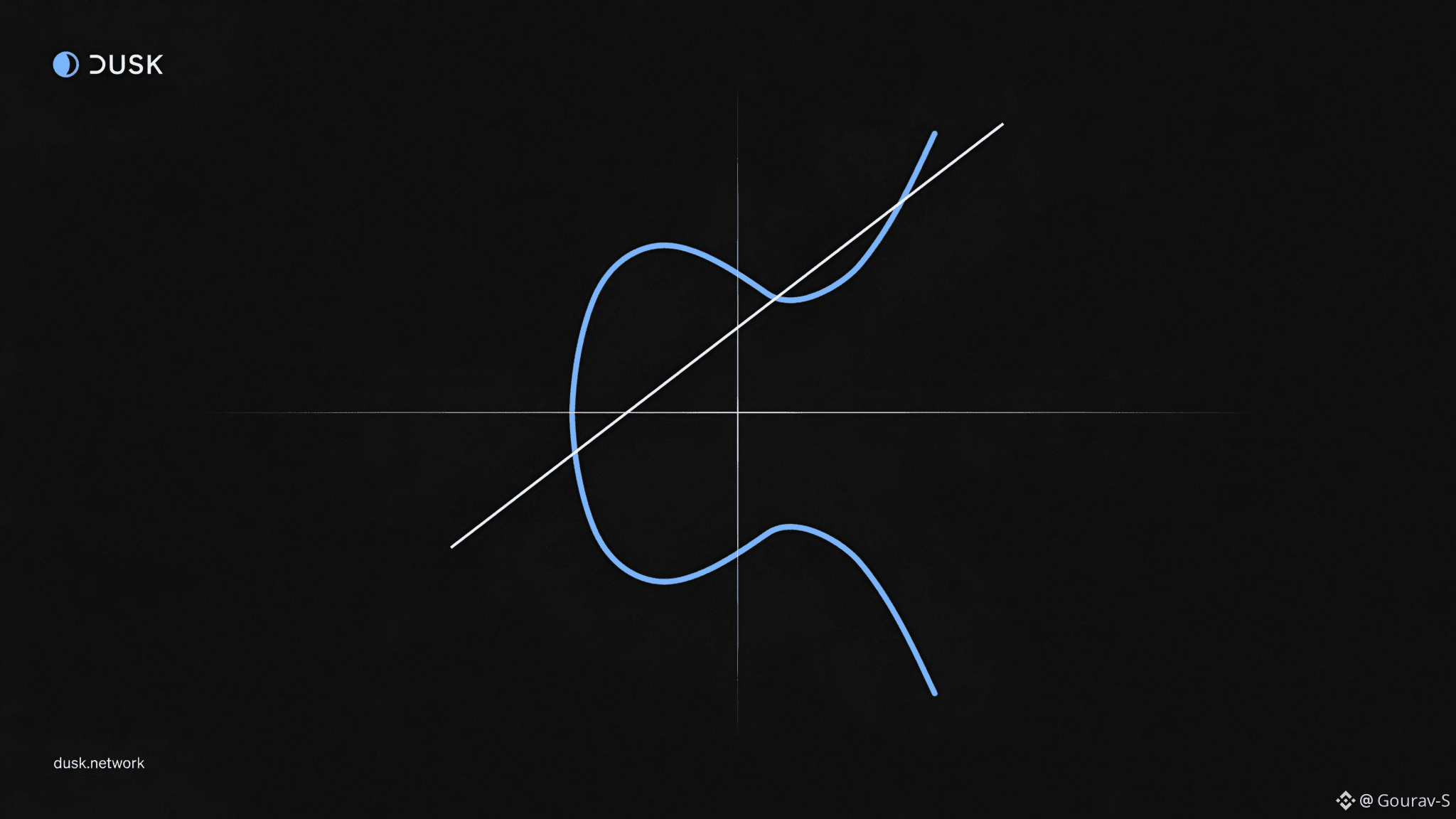
Dusk’s security model leverages a combination of elliptic curves, hash functions, signature schemes, and zero-knowledge proof systems. These tools work together to provide confidentiality, integrity, and performance on a blockchain designed for real-world financial markets.
BLS12-381 — Signature Aggregation & Efficient Proofs
One of the core primitives used by Dusk is BLS12-381, a pairing-friendly elliptic curve. It enables signature aggregation, which reduces data overhead — critical for efficient storage and transmission in decentralized networks. It also plays a central role in zero-knowledge proof constructions, enabling secure and compact proofs that underpin many privacy features.
JubJub — Fast, Secure zk-SNARK Support
JubJub is another elliptic curve optimized specifically for zero-knowledge proof systems. Within Dusk, it is used to build efficient zk-SNARKs (Zero-Knowledge Succinct Non-Interactive Arguments of Knowledge), which allow users to prove the correctness of a transaction or computation without revealing underlying details.
Schnorr Signatures — Strong Transaction Security
To validate transactions and smart contract interactions, Dusk uses Schnorr signatures — a signature scheme known for simplicity, efficiency, and resistance to forgery. Schnorr signatures ensure that only valid, authorized instructions are added to the blockchain.
Poseidon Hash — Optimized for Zero-Knowledge Circuits
Hash functions are the glue that secure data in blockchain systems. Dusk uses Poseidon, a hash function designed specifically for compatibility with zero-knowledge proofs. It is both fast and secure when used inside zk circuits, making it ideal for hashing transaction data and ensuring the integrity of cryptographic operations.
Dusk-Merkle — Flexible Verification Structures
Merkle trees are fundamental to blockchain integrity, enabling efficient verification of large data sets. Dusk’s custom implementation, Dusk-Merkle, is hash-function agnostic and optimized for use across core components like staking and transfer contracts. Its flexibility and performance help make proofs compact and verifiable throughout the protocol.
PLONK — The Zero-Knowledge Proof Engine
Perhaps the most impactful cryptographic innovation in Dusk’s stack is PLONK, a general purpose zero-knowledge proof system. PLONK enables efficient, reusable proof circuits that developers can integrate into smart contracts.
Zero-knowledge proofs (ZKPs) are a powerful class of cryptographic tools that let one party prove to another that a statement is true — without revealing any additional information. In blockchain terms, ZKPs enable confidential transactions, private smart contract logic, and compliance without exposing sensitive data to the public ledger.
By using PLONK, Dusk allows developers to define custom proof circuits that validate complex logic off-chain (or inside specialized proof systems) and produce compact proofs that are verified on-chain. This makes confidential transactions and privacy-preserving smart contracts both efficient and secure at scale.
Zero-Knowledge Proofs — The Privacy Backbone
At the core of Dusk’s privacy and compliance promise is the use of zero-knowledge proofs (ZKPs). ZKPs allow one party to convince another that a computation or claim is correct without revealing any underlying data. For example, a user can prove they have sufficient balance for a transaction without exposing their balance to the world.
These proofs make it possible for Dusk to support:
Private transactions where amounts and sender/receiver details remain concealed
Confidential smart contracts that enforce logic without exposing inputs
Selective disclosure for regulatory audits, combining privacy with compliance
In essence, ZKPs give Dusk the ability to balance two traditionally opposing needs: privacy and transparency — enabling confidential interactions while still permitting authorized parties to audit or verify when necessary.
Cryptography Serving Compliance and Finance
Unlike many general-purpose blockchains, Dusk’s cryptographic design is tightly aligned with compliance requirements for regulated financial markets. Its techniques aren’t just used for privacy; they underpin systems such as confidential security contracts (XSC) and private transaction models that enable issuance and transfer of regulated financial instruments on-chain.
Moreover, because these cryptographic primitives are integrated deeply into the protocol, authorized entities can selectively decrypt transaction data when legally required — preserving privacy for users while enabling compliance with KYC/AML and reporting frameworks. This dual capability is especially critical in regulated markets like EU MiFID II and MiCA environments.
The Outcome: A More Secure & Private Blockchain
Through its carefully engineered cryptographic stack — including elliptic curves, hash functions optimized for ZK, signature schemes, and PLONK proofs — Dusk delivers a blockchain that doesn’t force trade-offs between privacy, security, and compliance.
Every core component works in concert:
Transactions remain private and verifiable
Smart contracts can enforce complex logic without leaking sensitive data
Compliance can be achieved without exposing details on a public ledger
Cryptographic proofs remain compact and performance-efficient
In doing so, Dusk sets a new standard for blockchain cryptography in regulated finance — enabling both institutional participants and everyday users to interact with digital markets in a secure, private, and compliant manner.